

Kai Colbert, Staff Writer
What does it mean to be great? What does it mean to be perfect? What does it mean to be the best? These are the questions that the film Whiplash makes you think about.
Welcome to the first part of my ongoing series where I will do a deep-dive into all of Damien Chazelle’s films and reveal to you my perspectives on what the movie is all about. I admit that I am and have been a huge fan of Damien Chazelle’s work and I am so excited to have you along for the ride.
As you have probably guessed by now, we will start this series with Damien Chazelle’s directorial debut titled Whiplash. Whiplash was first conceived as a short film and was drawn from Chazelles’s own experiences in a highly competitive high school jazz band. After finishing the initial draft of the script, Right of Way and Blumhouse Studios became interested in the idea and helped it become an 18-minute short film. After the short film was complete, it was presented at the 2013 Sundance Film Festival catching the attention of numerous investors to help produce the completed version of the script. Shortly after this, it premiered as the opening film for the 2014 Sundance Film Festival where it won both the Audience Award and Grand Jury Prize for Drama and opened to theaters on October 10, 2014, until March 26, 2015.
Aside from the massive financial success earning $49 million on a $3.3 million budget, the film earned widespread acclaim for its unique screenplay, direction, style, cinematography, and film editing. This is the film that put Damien Chazelle as well as his lifelong friend and collaborator, Justin Hurwitz, who composed all of the music for all of his films on the map.
In case you’re bored by all of this necessary backstory to the film and eagerly waiting for me to talk about the actual story and themes, I feel you, but this was necessary for you to truly understand and appreciate the film. This is important information for many reasons. One, it explains how the main idea of the film came from Chazelle’s own experiences. Two, it tells you how the story and takeaways were meaningful enough to attract lots of famous investors and producers to transform it from a short film into a full-length feature film. Lastly, this tells you that the film struck a chord with everyone who saw it because of its incredible financial success and enduring legacy even 9 years after its initial release, with people still ranting and raving about it just like I’m doing right now.
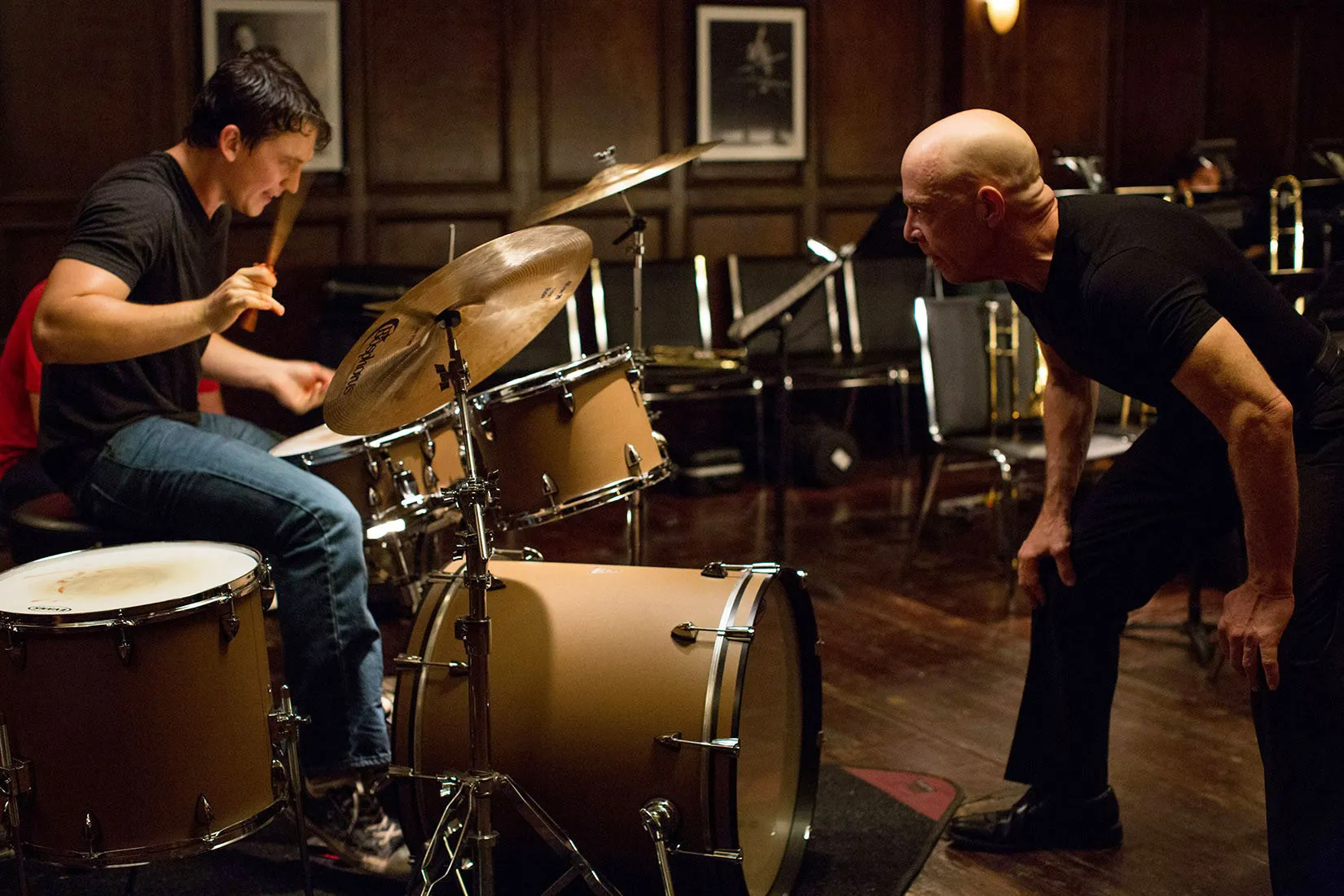
With all that out of the way, let’s now talk about the story. Whiplash centers on our main character, Andrew Neiman (Miles Teller), a naive first-year college student at the highly prestigious New York City Shaffer Conservatory. He has always aspired to become a great Jazz drummer and leave a lasting legacy behind just like his idol, Buddy Rich, did. The conductor of the school’s conservatory band invites Andrew to join the band as an alternate for the core drummer. The conductor’s name is Terrence Fletcher (J.K. Simmons), and as the audience and Andrew soon find out, there is much more to him than meets the eye.
This is perhaps best shown when he throws a chair at Andrew and then slaps and insults his failure to keep tempo in front of the whole band. Fletcher is manipulative in the fact that he will give you chances but only fleeting ones and will always go out of his way to make it clear that you failed.
What is amazing about this film is how Andrew as a character is shown leading up to this fateful moment. We are shown that Andrew is a hard worker by his constant practice of the drums and is someone who doesn’t crumble under pressure. He also has a crush on a girl named Nicole and is too nervous to ask her out–which is all too relatable.
These small but important scenes make us want to root for Andrew to succeed, to prevail, and to be the best. That is why, as the film goes on and Andrew’s life becomes consumed by trying to earn Fletcher’s approval, we still are hoping that there will be a happy ending.
Whiplash is a Thriller, but at its core, it is a cautionary tale. It is a story about how the pursuit of greatness can consume your entire life, relationships, joys, dreams, and identity.
My favorite scene in the whole movie is one that wasn’t even in the movie, funnily enough. There is a deleted scene where we spend some time with Fletcher alone in his apartment. J.K. Simmons, in an interview with That Shelf, describes the scene. He says, “We shot a half a day of scenes in Fletcher’s apartment – again, most of which aren’t in the movie – where we see just how Spartan his existence is. It’s a nice apartment, but the one time we see him, he’s drinking a glass of red wine with a frozen microwave dinner and eating by himself. He’s a sad guy, and the ONLY thing he has in his life is the music. At the end of that sequence, we showed me exercising and being obsessive about things around the house. The last thing is me putting on an old jazz record from 1938 and letting that wash over me.” I love this scene because it is a perfect visual vignette of what can happen if you close your whole life off to everything and everyone except your passion.
Fletcher seems to be doing well in all of the requirements that people deem important. He is financially well-off, he has a stable career as a composer, he is popular enough to land gigs at local bars playing the piano, and he is “helping” teach the new generation. But take a look back at all of those points and notice how there’s one similarity between all of them. Everything that he is known for and everything that he lives for is all about music. This means that when he’s not conducting or playing an instrument, he is utterly alone with nothing and no one else in his life to connect with which this scene shows perfectly. This scene shows one possible future that Andrew could experience if he continues to go down the toxic path of perfection which at the start of the film, seems to be completely different from the Andrew we have come to know and love but the end flips the coin on its head.
The climax of the film appears at the very end of the film when Fletcher deceives Andrew by switching the song the band is going to play without informing him. He tries his best to improvise and catch up with the band but it is pointless and he storms out embarrassed and angry. His father is there to comfort him and it is this moment where Andrew is at a crossroads. One outcome is that he can leave the concert with his father and cut himself off from Fletcher’s toxic teaching methods, giving him the chance to start his life anew and reconnect with others–which is why he played drums in the first place. The other outcome is to step back onto the stage and get Fletcher’s approval by any means necessary even if it means abandoning his family. Andrew chooses the latter much to his father’s dismay. He stands up for himself by cutting off Fletcher and cueing the band himself for the next song, “Caravan”, which is one that he excels at playing. Andrew goes one step further by playing an extended drum solo. This, at first, catches Fletcher by surprise, but slowly, he sees potential in Andrew to be the next great drummer, the next Charlie Parker.
Finally, in a moment of triumph, Andrew gets the approval he has been sacrificing blood and sweat over throughout the whole course of this movie. Fletcher cues Andrew to end the solo and the film cuts to black. This is a good ending, right? This is what Andrew has been seeking the entire movie and we were rooting for Andrew to succeed, to be the best, right? No, this is not a triumphant ending, the director himself even said so. In an interview with RogerEbert.com, Damien reveals, “I had always thought, when writing the film that the ending had always veered a little more on tragic than triumphant,” he goes on to say, “It’s that “Red Shoes” idea of dancing until you die, playing drums until you die and literally giving your entire life to your art, resulting in your death. In this case, I don’t think Andrew physically dies, but I think a big part of his soul has definitely died.” I couldn’t have said it better myself.
In conclusion, this film is about showing the purposeful and sometimes unintended negative consequences of one’s pursuit of greatness and stardom. It chooses to show how addicting and all-consuming the effort of self-improvement can get if left unchecked and/or forcefully pushed upon you by someone else. It is for these reasons that I feel that this movie became such an instant success and timeless film to look back upon.
Andrew’s journey could be applied to literally any person trying to succeed in virtually any creative endeavor which makes this film a cautionary tale for all who watch it. I love this film and deeply appreciate all who are still reading this. I hope this helped give you new insights into this film or hopefully intrigued you to see it for the first time if you haven’t already. I glossed over much of the story beats and individual character moments but I highly recommend all to watch this film. Thank you again and look forward to part 2 of this series where I will be looking at La La Land!
Featured Image Source: Whiplash

Leave a Reply