By JACKSON KOMPKOFF
Last week, Ohio State University implemented a wide-ranging ban on land acknowledgements. Ohio State has determined they are diversity, equity, and inclusion (DEI) statements, inconsistent with Ohio’s anti-DEI bill, SB 1, which went into effect on June 27th of this year. With the current federal administration being similarly anti-DEI and quite willing to pressure private colleges and universities to comply with their views, it is possible that there may be a national effort to remove land acknowledgements at institutions of higher learning in the near future. Beloit College would be unlikely to emerge unaffected.
As an indigenous student of Beloit, I felt that it would be useful to provide the perspective of the people meant to benefit from these statements, before such a movement to eliminate them starts in earnest. The most important part of land acknowledgements is the recognition of the specific groups of that land. I am obliged to acknowledge I am not a member of any of the groups listed in Beloit’s land acknowledgements, I am an Alaska Native of the Chugach Sugpiaq people.
I have no ancestral connection to this land. My people have an entirely different history of colonization. For one, we were not forcibly removed from our land. That means our land acknowledgments are not usually a settler institution writing out a statement of recognition for past wrongs, they are a Native to Native spoken act of gratitude for their current host during a specific event. Alaskan settler institutions have only adopted land acknowledgements in the past decade, with the recognition of the growing power of Alaska Native organizations.
I spoke with Professor Tacey Atsitty de Gonzalez for another indigenous perspective on land acknowledgements. She is Diné, of the Navajo Nation, with a very different history of colonization than both Alaska and Wisconsin. The Navajo have the largest contiguous reservation in the United States that is a product of fierce resistance to settlers and tactical acquisitions after a peace treaty with the U.S. was signed, though it is significantly smaller than their pre-removal territory.
The borders of the reservation have always been contentious. If one lives even just a few miles outside the reservation, regardless of blood quantum, then one is seen as less associated with the Nation. This detail of identity is especially relevant as the Hopi Reservation is completely encircled by the Navajo. This took place over multiple generations and disputes between the two nations over land continue until today. If the standard academic land acknowledgement where all groups are recognized and named that had lived on the land was spoken at a Diné gathering, the audience would take offense if the Hopi were included.
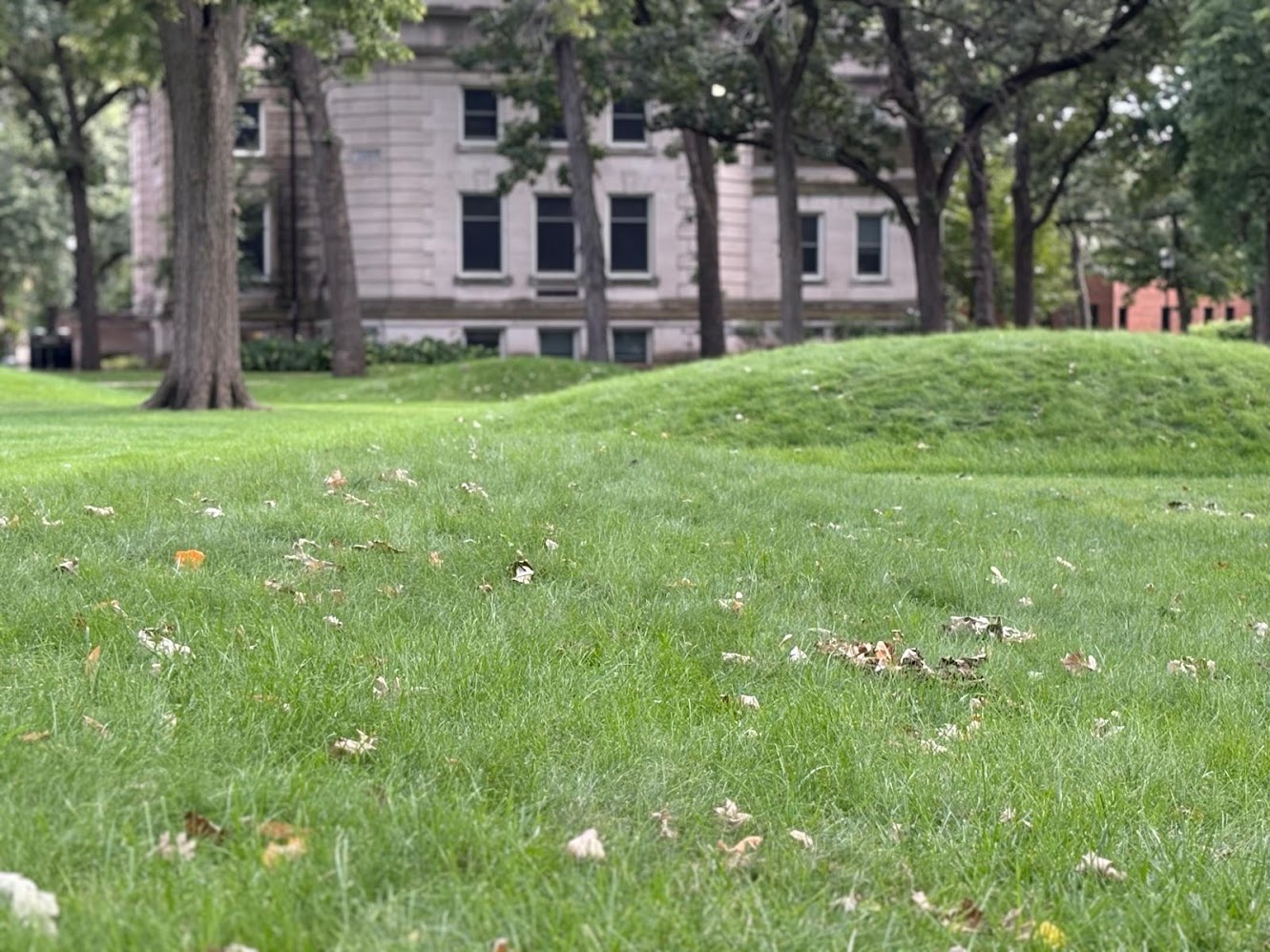
So that raises the question, why does Beloit do land acknowledgements? It is neither an indigenous gathering space nor is it occupying a space which indigenous people currently own. Beloit, and the rest of the Midwest, has a very different colonial history than both Alaska and the Southwest. The Ho-Chunk were removed from Beloit during the Blackhawk War of 1832. Some eventually returned to Wisconsin, but Beloit was already a settler town by then. And Beloit College was digging into their sacred mounds to establish itself as an anthropological institution of some renown.
It might be compelling to some then to buckle under the anti-DEI push. It’s just a statement of guilt, it’s all in the past, aren’t there more important things to fight for? This is right in a certain sense; most academic land acknowledgements have little relevance for the indigenous communities for which they are said in the name of, which is the same for Beloit.
Beloit’s land acknowledgement was created in the same year that most other college land acknowledgements were made, in the school year of 2017-2018. The administration that is in power today had just been elected for the first time in the previous year. It was Drew Agnew’18 and AmySue Greiff’18 who drew the acknowledgement up in Professor Shannon Fie’s Principals of Anthropology Fall 2017 course. I spoke with Professor Fie and she confirmed it was a primarily student led initiative. They requested the President that it be printed in the 2018 Commencement pamphlets and it was.
Another land acknowledgment was developed by the theatre department in collaboration with Bill Quackenbush, the Tribal Historic Preservation Officer of the Ho-Chunk, to be read before performances. As time went on the land acknowledgement was shared between departments and professors, tailored to each class and subject, usually put on syllabi. Though Quackenbush was occasionally consulted, it was not a first priority item for the Ho-Chunk.
We should acknowledge land acknowledgements for what they are at Beloit, an organic grassroots reaction amongst the student population to the policies of the federal administration. In that sense, Ohio State is right, land acknowledgments are political. But that means their removal is also political.
In the coming years, every college will face a choice: either admit their land acknowledgement is a hollow gesture or let it guide them to genuine accountability. Words alone will not reverse the reality that this institution was born on genocide, but refusing even these small acts of recognition would show that it is indeed shame and fear which guide academic policy.
The thing is, even if the acknowledgement is eventually taken down, the land will always be there. Every step of those who walked previous to us still reverberates through the land. We can always listen to its rhythms if we choose to. As Professor Atsitty de Gonzalez explained to me, the land is not ours to own, it is we who belong to it. We may not own this land, but every day it still sustains us because of those who came before us. The least we owe them is an acknowledgement.
Featured Image: Jackson Kompkoff’27

Leave a Reply