

By JACKSON KOMPKOFF
It is an odd experience to be Indigenous at Beloit College. It is not really an experience at all. How can one be Indigenous at a place built atop the destruction of Indigeneity itself? I am not Indigenous to Beloit because I am from Alaska. There are people who were Indigenous to this land, but nearly 200 years ago they were removed during a war with another Indigenous tribe and taken to Oklahoma. Here, Indigeneity is absence.
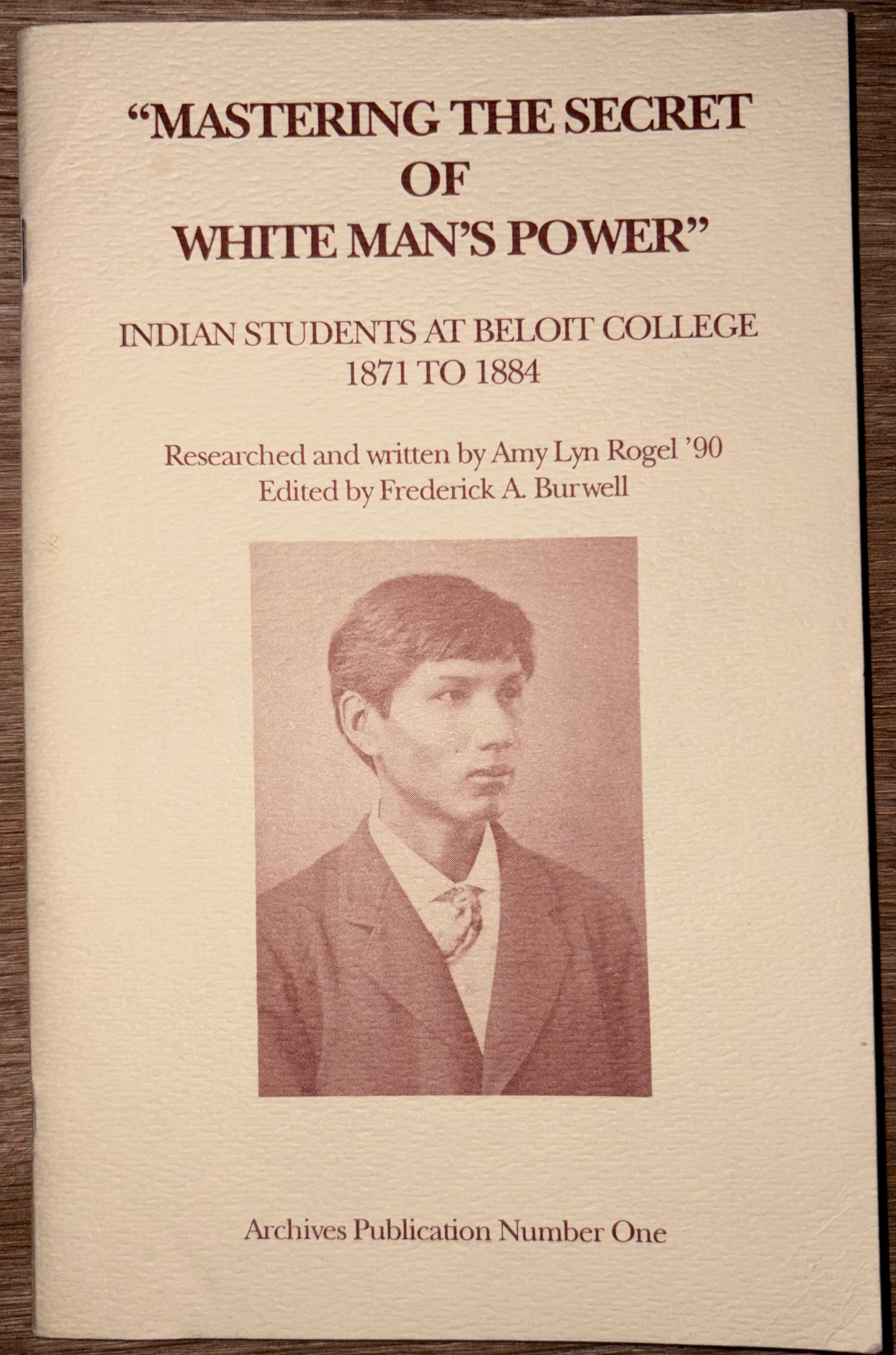
I was given a book from the Beloit archives when I interviewed Professor Tacey Atsitty de Gonzalez for my last article on land acknowledgments. It details the lives and events surrounding several Dakota students at Beloit from the period of 1871 to 1884. It is titled “Mastering the Secret of White Man’s Power,” a quote by Charles Alexander Eastman, the most famous of Beloit’s Indigenous students during that period. He went on to graduate from Dartmouth and get a medical doctorate from Boston University, becoming one of the first Native Americans to receive such a degree.
The short book is very informative and helped me understand Beloit’s place in American history, but as it relies on written documentation it cannot hope to capture the experience of the Indigenous at Beloit. I was honored when I was placed in contact with another Indigenous person at Beloit, descended from the same culture as Eastman. I interviewed Naomi Floren’28 about her experiences as a Dakota student at Beloit today, helping affirm my own experiences.
She emphasized her mixed experience as Puerto Rican and white, making sure I knew that she was not government certified as Indigenous to America. I too am mixed, Filipino and white, and though I am a recognized Descendent, I am too mixed to qualify for cultural hunts. This recognition of degrees of Indigeneity is essential to modern Native American politics. It did not always used to be this way.
Charles Alexander Eastman was named Ohiyesa, “the winner,” at the age of four when he won a game of lacrosse in what would shortly become Minnesota. His mother, a mixed woman of white and Dakota descent, died giving birth to him. His father, being full blooded, was arrested and sentenced to death at the end of the Sioux Uprising of 1862. Ohiyesa fled with his grandma, who gave him the name Ohiyesa, to Manitoba assuming his father had been executed.
His father’s sentence had been commuted by President Lincoln and he subsequently converted to Christianity taking the name Jacob Eastman. He had been captured with his eldest son, a half-white boy from a previous relationship, and he took on the name John Eastman. John went to the Santee Normal Training School where he was sponsored to attend Beloit by a Reverend whose brother went to college there. He was the first Native American student at Beloit in 1871.
Jacob Eastman found his other son at the age of 15 in Canada and brought him back to America to follow the same path as his brother. John Eastman only attended Beloit for a year, but the newly named Charles Alexander Eastman was intent on seeing his education through. As a three quarters Indigenous student that was dedicated to studying in the Western fashion, he was called by his educators, “white enough to be a half-breed.”
In 1879 the Carlisle Indian Industrial School was founded with the expressed intent to “kill the Indian in him, and save the man.” This boarding school in Pennsylvania was the start of a momentous shift in Indigenous education, from religious proselytizing for the salvation of souls, to the complete elimination of Indigenous culture for an emerging labor intensive industrial economy. In 1883, Beloit College would receive federal funding for a program to educate Dakota children in an official capacity, after over a decade of doing so already. To Beloit’s credit, they failed to live up to the government’s standards, as the college focused too much on scholastic pursuits and not enough on manual industrial labor that Carlisle excelled at.
The program was cancelled by the government in 1884. I have seen no evidence that Beloit College ever mistreated their Indigenous students. In fact, in Charles Alexander Eastman’s own words, he faced “gangs of little white savages giving imitation war whoops,” because Custer had just been slain in the Battle of Little Bighorn, but “at the school they received me kindly.”
In 1846 when the college was founded, the Ho-Chunk community had been removed just 14 years previously. Our most lauded institution, the Logan Museum, and our anthropology program, were built atop the mounds we now ask others to respect. Indigeneity at Beloit is the past, it cannot exist here in the present. Yet, we have been here for centuries, from John and Charles Eastman to Naomi and I today.
We are Indigenous, whether or not we want to be, even if we are not officially recognized as such. We are told to retreat from it, to embrace civilization. We hide it, we don’t want to be seen as just the “indigenous kid,” we want to contribute our whole selves, and Indigeneity feels like just a part of our identity. We want to be more than that. We want to finally master the secret of white man’s power. Beloit College offered and continues to offer that.
The thing is, almost all the Indigenous students who came to Beloit returned to their communities, including Charles Alexander Eastman, who became a doctor at the Lakota Pine Ridge Reservation in October, three months before the December Wounded Knee Massacre. He saved some lives, but could not stop the killing. He would go on to become a critical player in the written preservation of his people’s culture, along with being active in advocating for government reform.
We are the past, present and future of Beloit. Even after the last brick of the college crumbles to dust, the mounds will remain. Here, Indigeneity can never be absent. We will always be here.
Featured image: Jackson Kompkoff’27

Leave a Reply