

By CIAN MCKEOWN
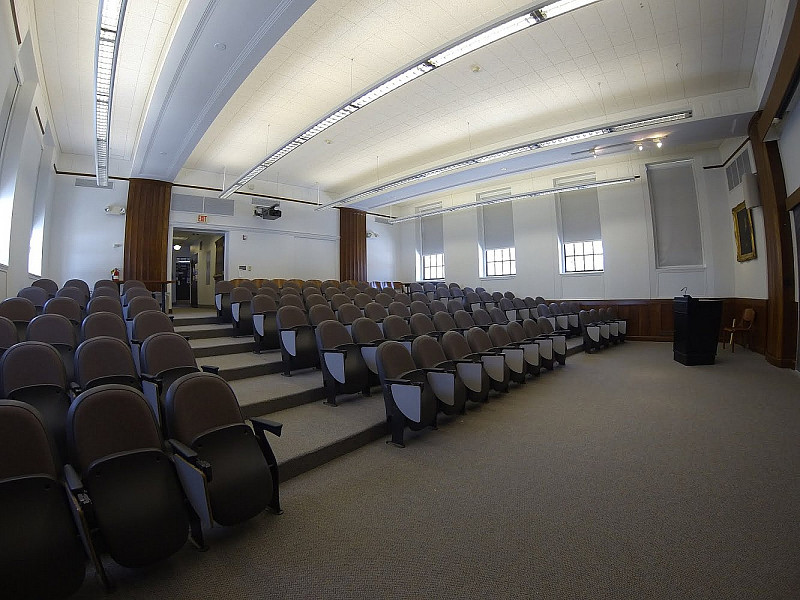
Beloit College’s Academic Senate convened for its first meeting of the 2025-26 Academic year on Wednesday, filling up the Richardson Auditorium in Morse Ingersoll Hall. It is a time of monumental change for the college as it faces a significantly enlarged student body, curriculum changes, and major policy revisions related to social media and Title IX.
Attendees consisted of Beloit professors, staff, and faculty, as well as administrative representatives like Beloit College President Eric Boynton, Dean of Students Rongal Watson, and Provost Donna Oliver, who presided over the meeting. Every faculty member is required to attend, although not all do. Student attendees included the eight academic senators, two from each graduating class, BSG President Frank Sharp-Hooten’26, and one Round Table reporter cowering in the middle rows.
While the all-staff faculty meeting that also occurs in Richardson Auditorium is closed to students, Academic Senate is open to campus, a chance for students and faculty to collaborate on the academic direction of Beloit. As attendee and philosophy Professor Matthew Tedesco says, “Beloit is a somewhat unique place because students are a part of all major decision-making at the College. Most colleges just have a faculty senate; we have an academic senate that students are voting members of.”
The proceedings began with Provost Donna Oliver moving to approve the minutes for the last meeting, and student senators introducing themselves. Most senators were new to the job, with the only exception being Madeline Wilhelm’27, a returner from last year and LITS Advisory Board member.
When new senators were asked what their responsibilities might be, they answered with optimism despite being in such an unfamiliar space. Says Veronica Kaluta’26, “Just being here the very first day I can see that [faculty and staff] would be open to hearing student voices. So I can definitely see myself going up there and giving a student perspective on whatever issue that they’re deciding on.”
Lily Bennett’28, a senator for the sophomore class, added that “I’m very excited to lead my class as a representative, but I’m also excited to have student perspectives represented here. Especially students who experience things around this campus and want to take action.”
After introductions, Oliver handed things over to the different faculty committees to give their progress reports. Associate Professor of Japanese Susan Furukawa presented on behalf of the Academic Strategic Planning Committee, or ASP.
Furukawa introduced the committee’s three-year plan for increasing enrollments, as well as announcing that they have begun reviewing the faculty candidates for tenure-track positions. Furukawa also addressed the growth the student body has undergone this year and the growing problem of students missing class for athletics participation.
Amy Tibbitts, Associate Professor of Modern Languages and Literatues and Curriculum Oversight and Administration Committee (COA) chair, then stepped up to the podium, flanked by ornate portraits for her COA presentation. The formal atmosphere of the meeting was broken by Tibbitts when she uttered a few sardonic lines that elicited belly laughs from the crowd. *
*Paragraph corrected from print edition
The final committee presentation was given by Professor and Cognitive Science Chair Robin Zebrowski, representing the Professional and Program Development Committee. Zebrowski explained their duties thusly: “We give you money, but you have to ask us in advance.” This means that PPD is responsible for allocating money for events and programs that the college holds. Zebrowkski said of the committee’s budget, “We’re all just really poor right now, so I don’t think it’s going to grow soon.”
It was now time for the main event, as Eric Boynton got up from his front row seat next to Dean of Students Rongal Watson to deliver his remarks. “This is a wonderful place,” said Boynton, opening with an anecdote about an interaction on campus he had with a Senior Northland College transfer student.
According to Boynton, the student gave the president a firm handshake and thanked him for the great experience he’s had at Beloit in his final year of college. Boynton maintained that while the student body has changed, the core qualities that make the college special remain the same.
In commemorating the new era Beloit has entered, Boynton implored the faculty and students present to “Find a way to tell the story of this place” and that “We have to sell this place to students and families.” He then lauded Beloit’s new mission statement, saying that “This is how Northland students talk about the college.” Boynton also highlighted the college’s new nursing program, remarking, “Nurses trained at Beloit College will be the best nurses out there.”
After his remarks and a presentation on behalf of the Strategic Vision Committee, where he cheekily remarked that he is “not a slides guy,” Boynton handed things back to Provost Donna Oliver.
Oliver cautioned the faculty, saying, “We need to be careful about how we use and interact with social media.” Oliver further emphasized that the social media policy currently in use is nearly a decade old and needs to be updated. Oliver added that anything a faculty member posts on social media could be misconstrued as representing the college’s views.
The social media issue was brought up due to the recent doxxing of a Beloit Professor on an alt-right webpage after the professor reposted a piece of content regarding the recent killing of conservative activist Charlie Kirk. Social media policies are being reviewed by the same committee that reviewed the diversity, equity, and inclusion policies when the college was mandated to do so last year.
Dean of Students Rongal Watson also spoke of changes during his presentation on Title IX, announcing that faculty are no longer mandatory Title IX reporters. Instead, faculty are instructed to refer students to Title IX Coordinator Gloria Bradley. Watson acknowledged the difficulties the college has had in the past with Title IX cases, but assured the attendees that “We have been working to implement restorative justice practices.” Watson did not specify in his remarks what these policies may look like.
Joy de Leon of LEADs also delivered an update on the policy regarding the recording of classes for students with accommodations. She specified that students now must ask professors for direct permission (although this is largely a formality) and professors must inform all students that the class is being recorded or place it prominently on the course syllabus.
Before Provost Donna Oliver moved to adjourn the meeting, history Professor Rob LaFleur gave a brief presentation outlining the touch-and-go relationship between athletics and faculty. LaFleur serves as the Midwest Conference Faculty Athletic Representative for the college.
The lack of communication between faculty and coaches at Beloit particularly concerned Lafleur, and he indicated that a faculty member calling a coach should be as easy as them calling a colleague, and the lines of communication need to be open. Said LaFleur succinctly, “We’re all in this together.”
Wednesday’s meeting represented the first time the college as a whole convened to address its newest changes, as well as the academic direction Beloit will go in as it enters its next chapter. As Academic Senator Marguerite Richardson’27 says, “I think there’s a big disconnect sometimes between students and faculty, and this is the only way that you can make it better.”
Featured image: Beloit College

Leave a Reply