

By JOSEPH DELPHEY
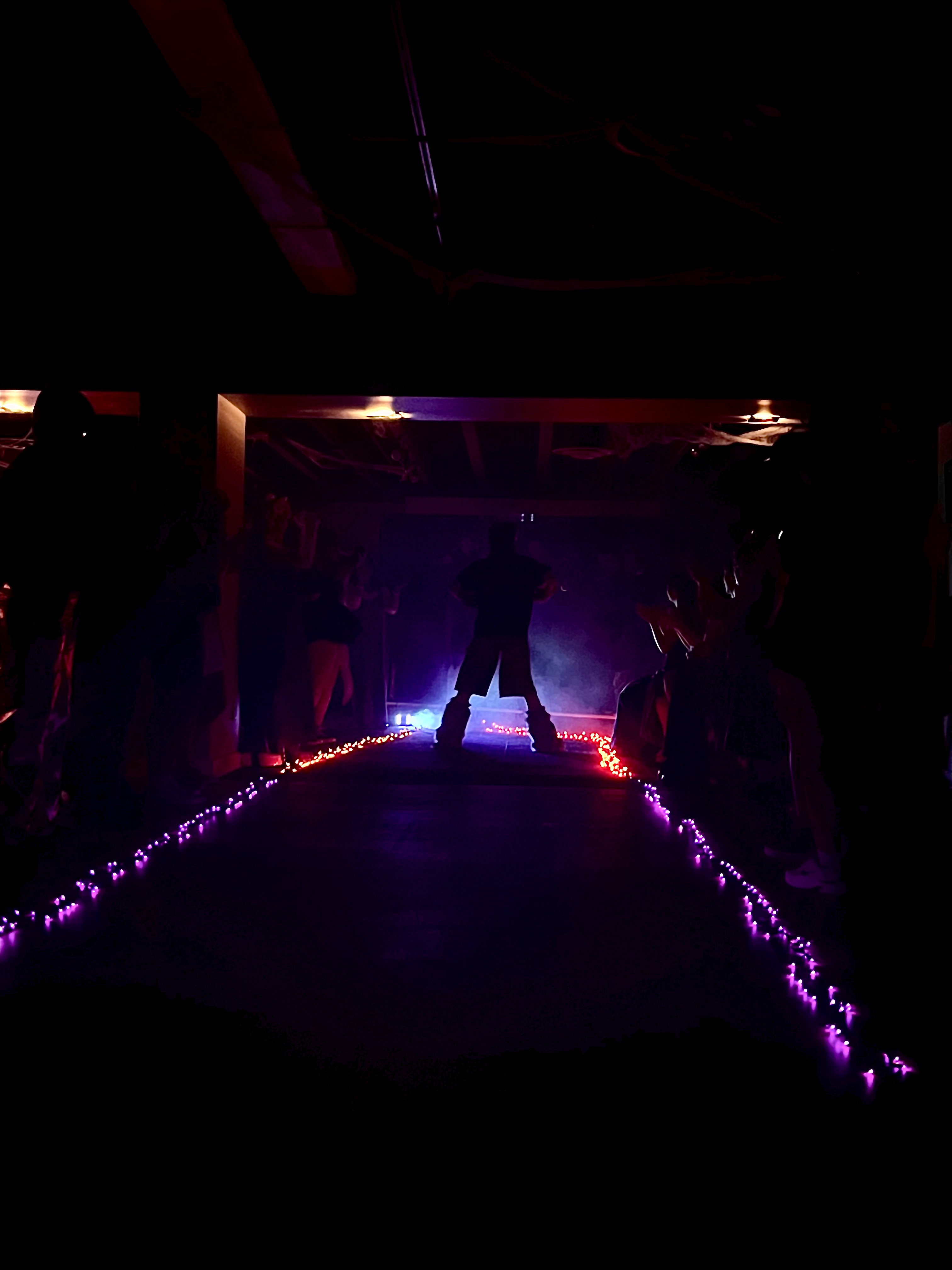
On the night of Saturday, Oct. 25, Grace’s Place held the Spooky Ball, an annual event hosted by Black Students United (BSU), Latinx Voices (LV), and the Sexuality and Gay Alliance (SAGA). With the music bumping, people chatting, and the room dominated by a runway defined by orange and purple string lights that ran the length of the room, the purpose of the event was clear.
As the event began, the runway was lined with costumed attendees, while the voices of the emcees, Ben O’Connor of SAGA and Lyndall Breaux of BSU, set the stage for the event and introduced the first walkers. These first “ballers” were the presidents of the three host clubs, Efrem Lilly’27 of BSU, April Armenta’26 of LV, and Corinna Pope’26 of SAGA, who also judged the event as a panel. As eager performers waited in the wings, the categories were introduced: Spookiest Squad, Gore Galore, Fussiest Fright, Too Hot to Handle, Vogue, and the Finals, from which the winners of the other competitions would compete for gift cards. After the categories, but before the finals, Breaux and O’Connor introduced the category of Most Fashionably Late, to ensure the slightly less punctual could walk as well.
The event functions more or less as one would expect, the categories introduced one by one, gathering walkers at the back of the runway while a DJ, Gabbi Willis’27, maintained energy to which walkers could move. Most of the categories follow a sense of “get to the stage by any means necessary,” as walkers dazzle the clapping and cheering crowd for thirty seconds to a minute, dancing, posing, and working to enchant the judges with their costumes and vivacity. The Vogue category, on the other hand, is focused on a specific style of dance, vogue, that arose within ballroom culture, and includes spins, dips and floorwork to show off the dancer’s abilities, the category being introduced via a demonstration from Breaux, who also provided a brief history of ball culture at the opening of the event.
The significance of the vogue category highlights the history the Spooky Ball is a part of, that of a ballroom culture that arose during drag balls in the mid-19th century, developing into the more competitive house ballroom upon which the Spooky Ball is based in the early to mid-20th century. The second evolution was in large part due to racism and white exclusivity in drag and queer spaces, and the Spooky Ball’s reflects this system of competition and walking brought about by queer Black and Latin spaces built to form families after voids of rejection. This house ballroom, as well as the drag balls that preceded them are centered upon expression and acceptance, something the Spooky Ball emphasizes as well. The Spooky Ball has no sign up sheet; decisions to walk are often made on the spot, and it is clear not all are fully comfortable doing so. Despite this, Breaux, O’Connor, and Willis, along with the crowd counted walkers in and supported them with noise and appreciation as they made their way to the stage.
The identities taken up are those of costumes, tailoring the drag and house ballroom fashion to a Halloween event, in which Garfield, Miss Piggy, Miso from Katamari, the Vague Idea of Disco, the Beloit Buccaneer Post Twink Death, the Ice King, Lorelei Gilmore and Luke Danes, along with most of the Teen Titans and Monster High were present. These identities being taken up reveals how the Spooky Ball is just as much about competition as creating a space in which you are raucously yet lovingly encouraged to push yourself and be someone you are implicitly or explicitly told not to be elsewhere, where all act in appreciation and awe for all others as they dance, step, and crawl down the runway.
Featured image: Vivian Kopka’27

Leave a Reply