

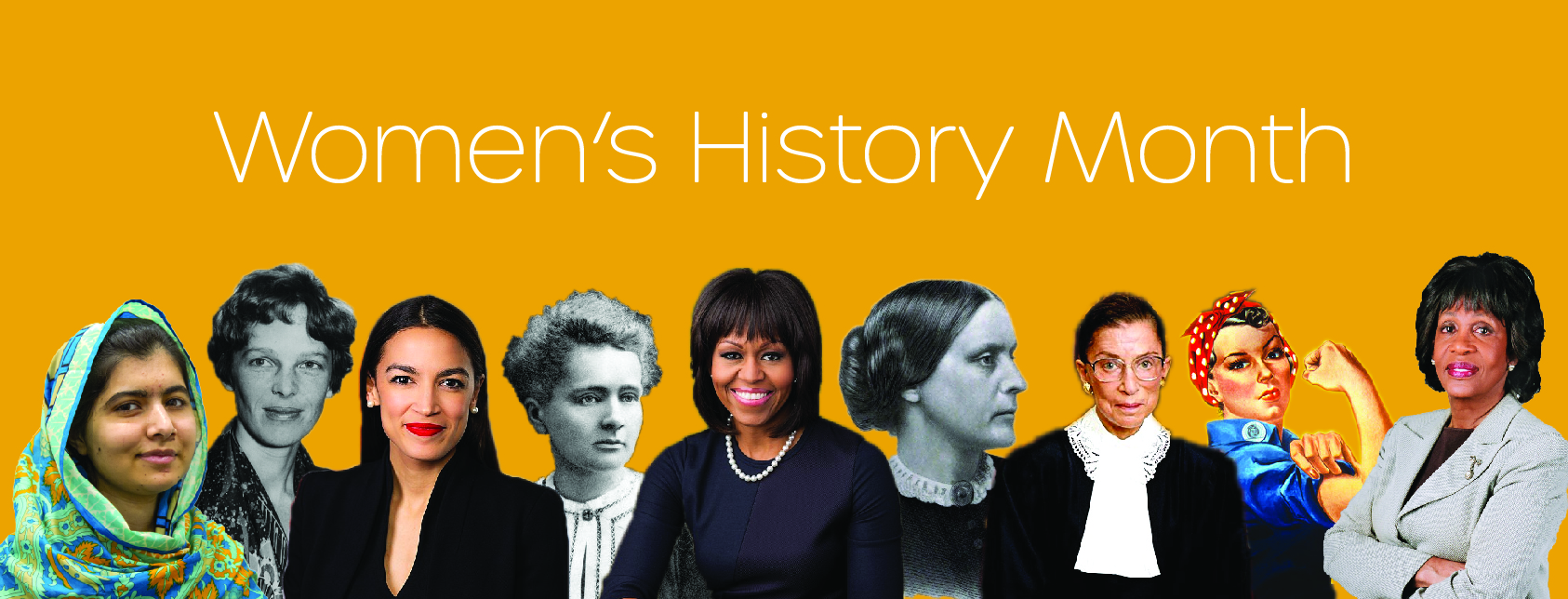
Women’s History Month originated in California as just a week put on by the Education Task Force of the Sonoma County Commission on the Status of Women. It was aligned with International Women’s Day on March 8 and continued to grow across the nation.
In 1980, women began lobbying for national recognition, and in February, Jimmy Carter declared the week of March 8 to be National Women’s Week. The tradition continued until 1987, when legislation started forming to designate March as Women’s History Month. Every president since 1995 has issued the annual proclamation.
From Mary Dixon Kies, the first woman in the U.S. to apply for and receive a patent, to Jane Goodall, American women continue to contribute to sports, science, culture, and every aspect of our world.
In 2025, Mary E. Brunkow won the Nobel Prize for Physiology or Medicine and Maria Corina Machado won the Nobel Peace Prize. Women broke records across the globe in running, swimming, as well as in other events. Beatrice Chebet (KEN) set the 5000 meter world record, becoming the first woman under 14 minutes. Faith Kipyegon (KEN) set the 1500 meter record, and ran the fastest-ever mile, at 4:06.42. Summer McIntosh (CAN) set long-course world records in the 400 meter freestyle, as well as the 200 meter and 400 meter individual medley. Katie Ledecky (USA) broke her own 800 meter freestyle world record, and Gretchen Walsh (USA) set a 100 meter butterfly record. Sarah Perry set a new record in the ultramarathon by running almost 400 miles in 95 hours. Femke Kok (NED) broke the 500 meter world record in speed skating.
Jessie Buckley won Best Actress at the 2026 Academy Awards, and Autumn Durald Arkapaw was the first female cinematographer to win an Oscar. Sara Blakely was the Inventor/Entrepreneur honored in the 2025 Women Making History Awards. Shirely Welsh Ryan was also awarded Advocate for Transformative Research and Education. Billie Elish was the first three-time Song of the Year recipient in Grammy history.
Women continue to change the world and impact everyone around them. According to UN Women, girls are surpassing boys in school completion, and in the past five years almost 100 countries scrapped discriminatory laws that have protected girls from child marriage.
However, equity has not been achieved yet, and although we’ve done a lot, more needs to be done. Ten percent of women live in extreme poverty, and women are more likely to go hungry than men by almost two percent. Even though girls surpass boys in school, they are less likely to end up in leadership positions. One in five women are still married before they turn 18, and after their marriage, their education ends. Violence and domestic abuse continues to follow women, with one in eight aged 15-49 experiencing abuse from a partner. Four million girls a year undergo female genital mutilation. Women hold around thirty percent of parliament seats and management roles.
Women around the world are still suffering, and there is more work to be done to bring equality into corporate offices and other management positions. Celebrate women in their leadership roles and the success they have achieved, but continue to support and assist other women across the globe as they continue to fight for their rights.
Featured image: The University of Akron

Leave a Reply