

By KAI COLBERT
Wes Anderson is a man of many unique accomplishments and talents. As of the writing of this article, he has written, produced, and directed 11 feature films that have received critical acclaim from audiences worldwide.
His movies, while different in story, setting, pacing, and genre, all contribute to Wes Anderson’s fantastical vision. He loves experimenting with new concepts and adapting pre-existing stories into something new, fresh, and unique in a way that only Wes Anderson can. It is for this reason that when it was revealed that Wes would adapt four obscure short stories from Roald Dahl into short films and that it would be presented by Netflix, those who didn’t know of Wes Anderson were surprised and the few that did were not.
I was one of those few. This collection would consist of a 37-minute film titled “The Wonderful Story of Henry Sugar”, and three 17-minute films titled “Poison”, “The Rat Catcher”, and “The Swan” respectively. Some but not all of these films would include the same actors with some even playing multiple roles at the same time.
This star-studded cast included Benedict Cumberbatch, Ralph Fiennes, Dev Patel, Ben Kingsley, Richard Aoyade, and Rupert Friend. Now that you know the history, we can dive into the actual films themselves.
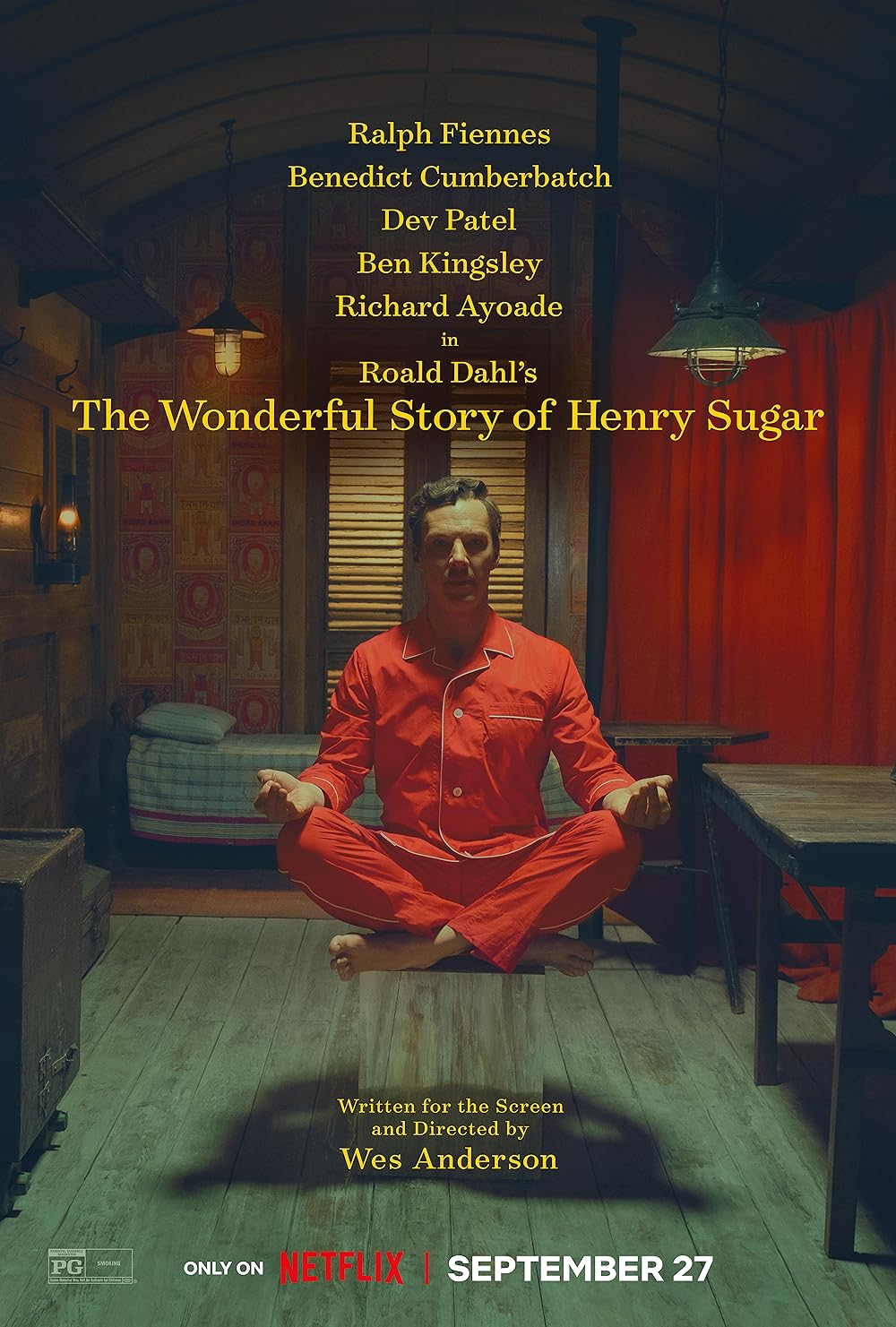
The Wonderful Story of Henry Sugar is the flagship of the collection if you will because as Wes states in an interview with Deadline, “It’s a sort of standalone, short film, but it’s also the reason why we’ve made a whole group of them”.
This film as well as The Swan were taken from a 1977 short story collection titled “The Wonderful Story of Henry Sugar and Six More” written by Roald Dahl at various points in his life. The story talks about a wealthy gambler by the name of Henry Sugar (Benedict Cumberbatch) and his journey on how he learns the unbelievable skill of seeing with eyes closed.
We watch as Dr. Chatterjee (Dev Patel) and his colleague Dr. Marshall meet a man by the name of Imdad Khan who claims to be able to see even with his face completely covered which is what the two doctors do. When he can tell how many fingers Dr. Marshall is holding up, they are dumbfounded and Dr. Chatterjee makes it his mission to learn as much as he can about this man.
I do not want to spoil the plot any further so if you want to know what happens next, watch it for yourself, I promise you won’t regret it. You will notice while watching this collection that there are no match cuts to a different location, no fast-forwarding, and no Spongebob transition that says 3 hours later. The scene transitions occur in real-time through the use of raised backdrops, stagehands, pantomimed props, quick changes, hidden doors, etc. Nothing is left to the imagination. It is more reminiscent of what you would see in a theater production than a film and this was done purposefully.
In the same Deadline interview, when asked about the making of this film, Wes responded, “I like stories that are stories within stories and plays within stories and movies within plays within stories”. In other words, Wes loves reinventing the film medium and adding unique storytelling tools from other mediums such as theater into them which was stage transitions in this case.
Another thing you might notice that is similar to all films is how they open with Roald Dahl (Ralph Fiennes) himself in his office as he narrates the story word by word exactly as the novel does. It is this dedication to the source material which had never been done before that as a review of the collection by The New Yorker magazine notes, “The four stories are, essentially, dramatized audiobooks”.
With this in mind, let us now talk about the 3 shorter short films in this collection starting with Poison. This story was written and originally published by Collier’s in June 1950. It was also included in the short story collection titled “Someone Like You” which was first published in 1953. The story is set in India when Britain occupied it.
Our main character is Harry Pope (Benedict Cumberbatch) a British soldier who due to unfortunate circumstances believes that a deadly venomous snake called a Krait has slithered onto his stomach while he had been lying down reading a book. His fellow British soldier and friend Timber Woods (Dev Patel) is informed of this perilous situation and Harry in a whispered tone tells him to fetch a doctor. Timber calls a local Indian doctor by the name of Dr. Ganderbai (Ben Kingsley) who is nearby. F
rom this point onwards, hijinks ensue and the ending will surprise you. If you don’t care about spoilers and want a sneaky hint about how it ends, my hint to you will be it’s familiar to the Schrodinger’s Cat paradox which if you know, you know.
Moving on, the next short film is The Rat Catcher. This story was taken from the same short story collection that Poison was taken from. The story’s setting and time are not directly mentioned but it implies that it takes place somewhere in Europe in the late 19th century due to the stone streets, seemingly endless valleys, and costumes. Our narrator is a reporter for the local newspaper (Richard Aoyade) and a car mechanic (Rupert Friend) for C. Cubbage & Co. Garage who calls up an infamously known Ratcatcher (Ralph Fiennes) to trap rats that have camped up on a nearby hill. The Ratcatcher is very mysterious in his methods and based on his mannerisms and physical appearance, he is more rat than human.
The film will be about the Ratcatcher teaching the reporter and mechanic the very complex steps that go into exterminating rats, even going so far as to do a cruel display on a vulnerable rat. As the story progresses and the Ratcatcher reveals more and more secrets about what it is he actually does, you as well as the mechanic will wish you never even asked.
Finally, we have reached the final short film in this collection! If you are still reading this, know that I appreciate you and I’m honored you have devoted time out of your day to read my ramblings. The final short film, The Swan was included in the same collection of short stories as The Wonderful Story of Henry Sugar.
Interestingly enough, this story was based on a true story that Roald Dahl saw in the local newspaper. He found this story so fascinating that he kept the news clipping in his “Idea’s Book” until finally making it a story in October of 1976. The story’s setting this time is even more vague although events happen at a lake and since this story was written in 1976, it can be inferred that this story takes place at around the same time it was written.
This story follows 3 young boys. There is Ernie who recently was gifted a rifle for his birthday, his close friend Raymond, and young Peter Watson (Asa Jennings) who spends his time looking at birds through binoculars. Ernie comes across Peter and points his rifle at him as he is just itching to try it out. They threaten Peter and tie his arms and legs onto the train track. Peter is smart and versatile however and he can survive the oncoming train. Still unsatisfied with his attempted murder, Ernie then ties Peter’s hands with a rope and takes him to a nearby swamp where there is a majestic swan in the distance. Ernie aims at the swan and Peter begs him to stop but he doesn’t listen and murders the swan.
What happens next is something that you have to see for yourself. It is the fantastical fantasy story that Roald Dahl excels in and which was amplified by Wes’s creative vision. To conclude, this collection is the culmination of Wes’s skills, ambitions, style, and outside-the-box thinking that he has been developing and improving upon film after film after film. The complex cinematography, intricate backdrops, sets, one-of-a-kind actors, and imaginative props all wonderfully complement Roald Dahl’s work and make this collection pleasing to all who watch it.
I hope this extensive look into this new collection of short films has been an enjoyable read and I hope my brief descriptions of each film have sparked your curiosity so much that you might think of watching them. Wes Anderson has inspired me to do many things in my life and reignited my love of cinema and I hope that by revealing my personal opinions on his works, it has the potential to do the same for you.

Leave a Reply