By CAMILLE BOYER and ELISA TURNER
“Project 2025 Mandate for Leadership: The Conservative Promise” is a 900-page document detailing policies that would be implemented by a conservative president, should one be elected in 2025 (and, lo and behold, one was). Cited sources range from the Federalist Papers to Twitter, and many claims lack sources entirely. This was copyrighted in 2023, but according to the document itself, “The idea of Mandate for Leadership was first conceived in the fall of 1979,” dating back nearly 45 years (883). Donald Trump denied association with Project 2025 during his debate with Kamala Harris; nonetheless, the document references him over 300 times. The document has 35 named authors and two named editors, 18 of whom claim affiliation with Trump and/or his administration. This article will break down the points of Project 2025 most relevant to Beloit College students who have a massive stake in the future of this country, and analyze what this means going forward.
From nuclear waste and weaponry to unclean air alongside unsustainable fuels, Project 2025 needs no preamble to how many steps it takes in the wrong direction. Starting off strong with its nuclear policies, the mandate suggests “…developing new nuclear weapons and naval nuclear reactors” (366). Hang on, it gets worse— the project also wants to “Fund the design, development, and deployment of new nuclear warheads, including the production of plutonium pits in quantity” (372). Now, I don’t know if you folks have seen “Oppenheimer,” but funding the development of nuclear weaponry paves a slippery-with-radioactive-waste slope that might be all too easy to slide down.
Speaking of radioactive waste, many of us know that nuclear power plants are currently storing nuclear waste on-site. This is because nuclear waste is not only hazardous, but extremely volatile; transporting it through cars, air, space, or by foot poses a lethal threat to anyone commandeering the device of transport, as well as anyone in its surroundings. Nuclear waste cannot be disposed of on Earth— the matter cannot be combusted, storing it underground will leech into soils and groundwater, dumping into the sea will contaminate ocean waters and kill sea life, and it cannot be launched into space due to aircraft dangers. Storing nuclear waste anywhere other than on-site has great potential to kill us all. Project 2025 has proposed “Develop[ing] a new approach that increases the level of private-sector responsibility for the disposal of nuclear waste,” and in order to do this, commencing the “licensing process for Yucca Mountain as a permanent repository for spent nuclear fuel…” (371-372). Now, I don’t know if I really need to explain how stupid this is, but for those of you who skipped fourth-grade science class (as I suspect the 35 writers of this project likely did), mountains are formed from tectonic plate convergence. And tectonic plates are constantly moving— this is why fault lines, mountains, and other features of tectonic activity are prone to earthquakes. So when we take volatile hazardous nuclear waste and store it in an area that is not only prone to earthquakes, but will be the first thing to go haywire during periods of extreme tectonic activity, what do we get? Evidence suggests we get dead people in Nevada. This is an unintelligent move in the environmental sphere.
But it seems like the writers and administrators of Project 2025 don’t care about the environmental sphere. The document explicitly states it intends to “Support repeal of… spending bills [towards] renewable energy developers, their investors… and support the rescinding of all funds not already spent by these programs,” effectively defunding the development of renewable energy and starving science of progress (365). The project also intends to “go beyond merely defending America’s energy interests but go on offense, asserting them around the world,” and states that “America’s vast reserves of oil and natural gas are not an environmental problem; they are the lifeblood of economic growth” (13). But it doesn’t end there— the project goes on with ignorance towards the unsustainability of these fuels and states that “the Department of Energy should end the Biden Administration’s unprovoked war on fossil fuels, restore America’s energy independence [and] oppose eyesore windmills built…” (286). Project 2025 radically demonstrates ignorance towards the numerous environmental problems with nonrenewable fuel sources, intends to further the usage of unsustainable fuels worldwide for the sake of economic growth, and nix the development/usage of renewable energy entirely.
But wait, there’s more. Project 2025 acknowledges that “EPA adopted… a goal of restoring natural visibility by 2064,” but responds by suggesting that “EPA should consider whether a longer timeline is less disruptive or more realistic. Regional haze rules should be revised to prevent subsequent “planning periods” from being abused to compel the shutdown of disfavored facilities” (424). This means that the Mandate for Leadership intends to extend the duration of allowing smog in the sky; this would undo previously initiated anti-pollution efforts and set us back in terms of environmental restoration. Did they forget to list Aloysius O’Hare and the Onceler as authors? Because I feel like I’m watching “The Lorax”, and there are simply not enough musical numbers in this 900-page document to support that.
It’s also worth mentioning that Project 2025 states “The next conservative Administration should withdraw the U.S. from the U.N. Framework Convention on Climate Change and the Paris Agreement” (709). Not only are they actively trying to counter environmental protection efforts, but they are withdrawing from the contracts that would deliver ramifications for the pollution that they actively want in the US.
Pertaining to environmental concerns, Project 2025 has some unique ideas on food production. Namely, the mandate wants to “Remove the U.S. from any association with… efforts to push sustainable-development schemes connected to food production” (293). Aside from more anti-sustainability efforts, the project suggests that the next US President should “Repeal the federal labeling mandate” and states “The USDA should work with Congress to repeal the federal labeling law” (307). It also acknowledges that “[Presently] Only meat and poultry from federally inspected facilities can be sold in interstate commerce…” but counters that “These barriers… should be removed” (305). And to top it all off, Project 2025 believes that “The USDA should… adopt policies to remove unnecessary barriers to approvals and the adoption of biotechnology [GMOs]” (307). This means removing food safety and transparency regulations, and allowing more GMOs into foods. This means food will be less inspected for safety, and you won’t know what’s in your food due to the lack of labeling and encouragement of GMO usage.
Since most of us have gone through the American Education system, we’re some of the most qualified to speak on the quality of our learning. The writers of Project 2025 beg to differ (despite the fact they couldn’t be bothered to find editors that did their jobs well). Their new proposed policies range anywhere from the content taught in schools to educational requirements for jobs. Even the Department of Education isn’t safe. The document states “…the Secretary of Education should insist that the department serve parents and American ideals,” and continues “Federal education policy should be limited and, ultimately, the federal Department of Education should be eliminated” (286, 319). Now, it doesn’t come as a shock to say that this policy is beyond radical. The Department of Education sets the standard for what content children learn in school and helps all students receive a well-rounded education. Ending a forty-four year old federal agency leaves the power of children’s entire education up to the subjective values of what Project 2025 considers “American ideals.”
As for the educational content Project 2025 wants to see, the document states “Parents’ rights as their children’s primary educators should be non-negotiable in American schools. States, cities and counties, school boards, union bosses, principals, and teachers who disagree should be immediately cut off from federal funds” (5). Not only are most parents unqualified to be teachers, the people we pay to do the actual teaching (aka: the people who have devoted years to train to be educators) are going to be heavily restricted in the content that they are allowed to teach, a blatant elimination of free speech, ironically something that Project 2025 loves to preach about. The authors also write “Pornography should be outlawed. The people who produce and distribute it should be imprisoned. Educators and public librarians who purvey it should be classed as registered sex offenders. And telecommunications and technology firms that facilitate its spread should be shuttered” (5). To put it succinctly, this policy is incredibly dangerous. In context, “pornography” is used to describe any media depicting sexual content. This means an end to sexual health books, wellness books, and your favorite romance novel. Despite any “defensive logic” the writers of Project 2025 may have, this is explicitly book banning.
It’s not only books that the project is focused on banning either! Within the government itself Project 2025 aims to “Minimize bachelor’s degree requirements. The President should issue an executive order stating that a college degree shall not be required for any federal job…” and even goes further to state “Congress should prohibit the inclusion of a BA requirement in job descriptions for all private sector employers, or the use of a BA requirement to screen applicants using algorithms, except where a BA… is a bona fide requirement of the position” (357, 596). Creating a job system that lets anyone become a federal employee or work in a position that they are under-qualified for is how we get documents like this one in the first place.
Finally, Project 2025 goes in-depth on every college student’s favorite phrase: paying for college. They write “The Secretary should make it clear that FERPA allows parents full access to their children’s educational records, so any practice of paperwork obfuscation on this front violates federal law” (334). This is a policy that gives parents access to both their child’s college funds as well as their grades, despite most college-aged students being legal adults by this time. The writer’s aren’t done however, they also write “The Public Service Loan Forgiveness program… should be terminated” (354). This is a terrible policy because it eliminates loan forgiveness and keeps people in debt.
Everything about Project 2025 shows a very clear and obvious bias towards “traditional” nuclear families. And no part of the document denies this— in fact, they effectively lean into it, stating “[Equity] policies… subsidizing single-motherhood… and… disincentivizing work… should be repealed and replaced by policies that support the formation of stable, married, nuclear families” (451). This would effectively make single-motherhood more difficult than it already is, for no reason other than promoting nuclear families— an undercut that will do more harm than good.
Other biases, however, rear their ugly head specifically within the context of employment. Abortion is a hot-button issue at the moment, and for good reason. The mandate explicitly celebrates the overturning of Roe v. Wade, and openly makes suggestions to coerce women into birthing by intentionally making abortion more difficult, if legal at all (6). In the context of employment, Project 2025 suggests “Pass[ing] a law requiring equal (or greater) benefits for pro-life support for mothers and clarifying abortion exclusions… That law should also clarify that no employer is required to provide any accommodations or benefits for abortion” (585). While employment benefits for pregnant women are great, placing them in tandem with a pro-life agenda that allows employers to deny women accommodations for abortion (such as time off during/post procedure, or lenience with bathroom breaks to deal with mediation side effects) taints the beneficial impact with sinister intentions.
Biases in government jobs would also be implemented into law under Project 2025, stating “Congress should mandate that all new federal [employment] contracts require at least 70 percent of the contractor’s employees to be U.S. citizens, with the percentage increasing to at least 95 percent over a 10-year period” (612). This quote reveals two important things about Project 2025: first, they want a government that is majority US citizens, effectively quieting noncitizen perspectives on pertinent issues. Second, that they expect their policies to be in effect for over ten years. Also, within the US Treasury department, Project 2025 expresses intention to “Treat the participation in any critical race theory or DEI initiative… as per se grounds for termination of employment” (708). Terminating employment within the US government exclusively on the basis of previous antiracism training is absolutely radical, and calls into question exactly what type of people that the authors of Project 2025 want running this country.
Also, we’re making discrimination legal again. This isn’t an exaggeration— the mandate states ”Congress should clarify Title VII’s religious organization exemptions to make it more explicit that those employers may make employment decisions based on religion regardless of nondiscrimination laws” (586). Under this, employers would be able to discriminate “regardless of nondiscrimination laws” provided that they play the religion card. This is the queer-couple-walks-into-Christian-bakery thing all over again, except now it’s for hiring processes.
Project 2025 also wants to “Re-implement work requirements [for food stamps]… to work-capable individuals—that is, adult beneficiaries between the ages 18 and 50 who are not disabled and do not have any children or other dependents in the home” (299). This makes food stamps unavailable for unemployed people. Not only would this mandate not account for undiagnosed disabilities, but many adults between 18-50 who do not have jobs, disabilities, or other dependents, are homeless. Intentionally making food stamps unavailable for the homeless and/or those with undiagnosed disabilities is ethically horrendous; employed or not, people deserve sustenance to survive, and holding their survival hostage to the almighty dollar is immoral.
Project 2025 also reads as very anti-union, stating “The next Administration should make new options available to workers and push Congress to… create non-union ‘employee involvement organizations’” (599). The reason that this quote reads as anti-union is because we don’t need “employee involvement organizations” with unions already in place. Why would we create alternatives to an existing infrastructure unless we were trying to change its purpose entirely? Why would we herd people towards corporate-sounding “employee involvement organizations” when we already know what unions do, and have recognized exactly how they’ve resulted in more fair labor practices time and time again? Why would we fix something that isn’t broken, unless we were trying to prevent workers from demanding fair labor practices?
Let’s put a cherry on top of this employment sundae: the children yearn for the mines, and according to Project 2025, we should support them. “Current rules forbid many young people, even if their family is running the business, from working in [hazardous] jobs. This results in worker shortages in dangerous fields and often discourages otherwise interested young workers from trying the more dangerous job… certain young adults should be allowed to learn and work in more dangerous occupations” (595). While the trades and other manual labor jobs are the backbone of the economy, there are reasons why laws prevent young people from doing them. Sixteen-year-olds can work at Chili’s but not construction sites because the latter involves a lot more heavy machinery, and the average teenager doesn’t have a prefrontal cortex that is developed enough to accurately assess the risk versus reward of such a job.
Project 2024 intends to roll out policies requiring less education for government officials and other jobs, less loan forgiveness making post-secondary education more difficult to obtain, encouraging young people to take on manual labor jobs before they can weigh the long-term consequences, and create new variants of employee programs to herd people away from unions that were not broken in the first place. These items in tandem with one another could leave one to speculate that the intended result of Project 2025 is a less educated nation full of workers who cannot demand fairer labor practices.
It’s old news that conservatives are very concerned about border security, but there is a line between rational and radical— a line that Project 2025’s proposals use like a jump rope. The document states “Prioritizing border security and immigration enforcement, including detention and deportation, is critical if we are to regain control of the border” (135). If detaining and deporting immigrants to separate them from their lives and families doesn’t sound like enough to justify our usage of the word “radical,” the mandate also proposes that “In addition to finalizing the southwestern land border wall, the next Administration should take a creative and aggressive approach to tackling these dangerous criminal organizations at the border. This could include use of active-duty military personnel and National Guardsmen to assist in arrest operations along the border…” (555). This is militarization of the border, and these defensive measures incite unnecessary violence. Immigration, legal or illegal, is a tumultuous trail— what good can possibly come of increasing its death toll?
These proposed policies will also affect low-income immigrant families. Project 2025 states “The Office of the Secretary should recommence proposed regulation… that would prohibit noncitizens, including all mixed-status families, from living in all federally assisted housing” (509). This would effectively remove all federal housing assistance from noncitizen and mixed status families. To worsen a family’s quality of life, putting them at risk of living on the streets simply because of immigration status, is cruel and unusual punishment.
Discriminatory policies are worked in all throughout Project 2025, which shouldn’t come as a shock; we saw more and more anti-trans bills being proposed and more fear-mongering messages around the concept of DEI in the buildup of this year’s election. Project 2025 claims to be entirely for protecting “the children” as they write “For the sake of child well-being, [adoption] programs should affirm that children require and deserve both the love and nurturing of a mother and the play and protection of a father. Despite recent congressional bills like the Respect for Marriage Act that redefine marriage to be the union between any two individuals, HMRE [Healthy Marriage and Relationship Education] program grants should be available to faith-based recipients who affirm that marriage is between not just any two adults, but one man and one unrelated woman” (481). Under this proposal, any queer couples looking to adopt or foster children wouldn’t have the rights to do so. The foster care system in the United States has been heavily criticized in the past for its lack of care for their children. By minimizing the choices of qualified parents based on a heterocentric idea of marriage, it leaves more children in the foster system. Considering that the legalization of gay marriage in the United States hasn’t even been around for a decade yet, this kind of extremist policy sets back queer people by several years.
Yet, that’s not all. The rise of anti-trans rhetoric in the past year has been extremely noticeable. Project 2025 continues this attack on transgender people, writing “No public education employee or contractor shall use a name to address a student other than the name listed on a student’s birth certificate, without the written permission of a student’s parents or guardians… [nor] use a pronoun in addressing a student that is different from that student’s biological sex… Federal lawmakers should not allow public school employees to keep secrets about a child from that child’s parents.” (346). You heard that right, the authors of Project 2025 want to ban the use of nicknames just in case the child is transgender. This policy is all based on a hypothetical scenario the authors made up. Furthermore, this policy puts students in far more danger considering the authors also want all public school employees to report secrets, once again, in the off chance they “catch” a transgender student. How many times have you told a teacher something in passing? How would you feel if that information went directly back to your parents? The authors continue “[National Institutes of Health] NIH… should fund studies into the short-term and long-term negative effects of crosssex interventions, including “affirmation,” puberty blockers, cross-sex hormones and surgeries, and the likelihood of [desistance] if young people are given counseling that does not include medical or social interventions.” (462). This would fund studies not only in favor of anti-transitioning but also look into research supporting conversion therapy. This is incredibly extremist.
In addition there are also motions that describe “The President should direct agencies to rescind regulations…prohibiting discrimination on the basis of sexual orientation, gender identity, transgender status, and sex characteristics” and “…under the Obama Administration schools were at risk of losing federal funding if they treated black and white students equally but had aggregate differences in the rates of school discipline by race (disparate impact)… The Trump Administration rescinded the Obama Administration’s guidance on school discipline… The next Administration should continue the policy of the Trump Administration in this area…” (584, 334-335). Putting this into simpler terms, if this were to pass, schools would not be punished if the results of their policies yielded racism. I cannot stress the amount of harm these proposals cause. This policy being put into effect means that both people of color and LGBTQ+ people can experience the effects of discrimination without punishment for the facilitating institution.
As if there weren’t enough dystopian policies proposed already, Project 2025 is looking to have full conservative control in the government. Currently, there is a Republican trifecta in Congress and the White House, however, Project 2025 aims to replace the heads of departments with people who also align with their ideals. Starting with the FBI they write “… the next conservative Administration should… terminate any [FBI investigations] that are… contrary to the national interest… submit a legislative proposal to Congress to eliminate the 10-year term for the Director…” and additionally states “…the next conservative Administration should seek a legislative change to align the FBI Director’s position with those of the heads of all other major departments and agencies.” (549, 551-552). This statement is concerning for a couple of reasons. For one, the concept of “the national interest” is very subjective and ever-changing. Ending investigations that may be of importance to some populations in the U.S. is dangerous and unethical. It also shouldn’t come as a shock to say that immediately changing the director of the FBI to better align with one party’s goals and ending the limit of a ten year term is concerning.
On the subject of ending programs and activities in the government, Project 2025 states “… prepare a plan to end immediately any policies, investigations, or cases that run contrary to law or Administration policies” for the Department of Justice (557). Similarly, for the EPA they state “Notify Congress that EPA will not conduct any ongoing or planned science activity for which there is not clear and current congressional authorization” (436). Both of these aim to restrict the freedoms that each department has to make decisions as an independent organization. If scientists can’t choose what they want to study, where is all this funding and research going?
Abortion has been one of the most divisive topics in healthcare and politics, but even more so after the overturning of Roe v. Wade in 2022. Project 2025 devotes several sections to abortion and pushes a very strong pro-life view. Their extremist policies start with “The [Health and Human Services & Centers for Medicare and Medicaid Services] guidance also declared that EMTALA [Emergency Medical Treat and Active Labor Act] would protect physicians and hospitals that perform abortions in violation of state law if they deem those abortions necessary to stabilize the women’s health. This novel interpretation of EMTALA is baseless. EMTALA requires no abortions… and explicitly requires stabilization of the unborn child” (473). Originally, the EMTALA served as a law that prioritized the health of a woman giving birth, but now has been flipped to prioritize the fetus at all costs. As radical as this is, it’s also extremely dangerous. Willingly risking the lives of women (including minors in some cases) is extremely telling to what Project 2025 is trying to accomplish in the long run. Project 2025 also says “[EMTALA] prohibits hospitals that receive Medicare funds from “dumping” emergency patients who cannot pay by sending them to other hospitals… Hospitals or physicians found to be in violation of the statute could lose all of their federal health funding… and face civil penalties of up to nearly $120,000” (473). This new policy makes it illegal to send people in critical condition to hospitals that they could afford for treatment.
It doesn’t stop with killing women, Project 2025 is also trying to discard abortions as a medical procedure entirely. They state “The CDC should eliminate programs and projects that do not respect human life… It should ensure that it is not promoting abortion as health care. It should fund studies into the risks and complications of abortion and ensure that it corrects and does not promote misinformation regarding the comparative health and psychological benefits of childbirth versus the health and psychological risks of intentionally taking a human life through abortion” and “Aggressively implement a plan to pursue and fund ethical alternative methods of research in order to ensure that abortion and embryo-destructive related research, cell lines, and other testing methods become both fully obsolete and ethically unthinkable” (454-455, 461). This policy would get rid of a life saving medical procedure, and research pertaining to it, in its entirety.
Finally, Project 2025 proposes a plan to track every abortion that happens in the U.S. in a direct violation of patient privacy laws. They say “… HHS should use every available tool, including the cutting of funds, to ensure that every state reports exactly how many abortions take place within its borders, at what gestational age of the child, for what reason, the mother’s state of residence, and by what method” (455). Cutting funds in a department dedicated towards a country’s health in favor of closely watching what medical procedures women are getting on their own bodies is a surveillance measure that’s incredibly dystopian. The writers state their overall goal for abortion in the United States to be “Conservatives in the states and in Washington, including in the next conservative Administration, should push as hard as possible to protect the unborn in every jurisdiction in America” (6). Unsurprisingly, the authors behind Project 2025 continue to take a strong pro-life stance and preach about “saving the children” (except when it comes to children of color, LGBTQ+ children, disabled children, etc.) It seems they have other priorities.
Project 2025 is the document that Margaret Atwood, George Orwell, and Ray Bradbury warned us about. This so-called “conservative promise” claims to advocate for the restoration of small government to states, but entirely disregards the smallest government of all— the government of oneself. The mandate intends to rip the rug out from underneath numerous groups, including but not limited to women, immigrants, queer people, and homeless people. And the kicker here is that Project 2025 is just the beginning— it is the first of four “pillars” to “assemble an army of aligned, vetted, trained, and prepared conservatives to go to work on Day One to deconstruct the Administrative State” (xiv). The second pillar is a “personnel database” to allow “coalition members to review and voice their recommendations” which would then be “collated and shared with the President-elect’s team” (xiv). The third pillar, the “Presidential Administration Academy,” is apparently “an online educational system” whose content ranges from “explain[ing] how the government functions” to “in-person seminars with advanced training” (xiv). Finally, the fourth pillar ominously involves something called “the Playbook” and “forming agency teams and drafting transition plans to move out upon the President’s utterance of ‘so help me God’” (xiv). Personally, that last pillar sounds grimly reminiscent of sleeper agents, but maybe that’s just me. This mandate being divided into phases reads like the parable of the boiled frog, and we have barely dipped our amphibian toes into lukewarm water. Project 2025 is extremist and rooted entirely in fear-mongering, and it is only the beginning— we can only speculate what the end might look like.
Works Cited – https://static.project2025.org/2025_MandateForLeadership_FULL.pdf
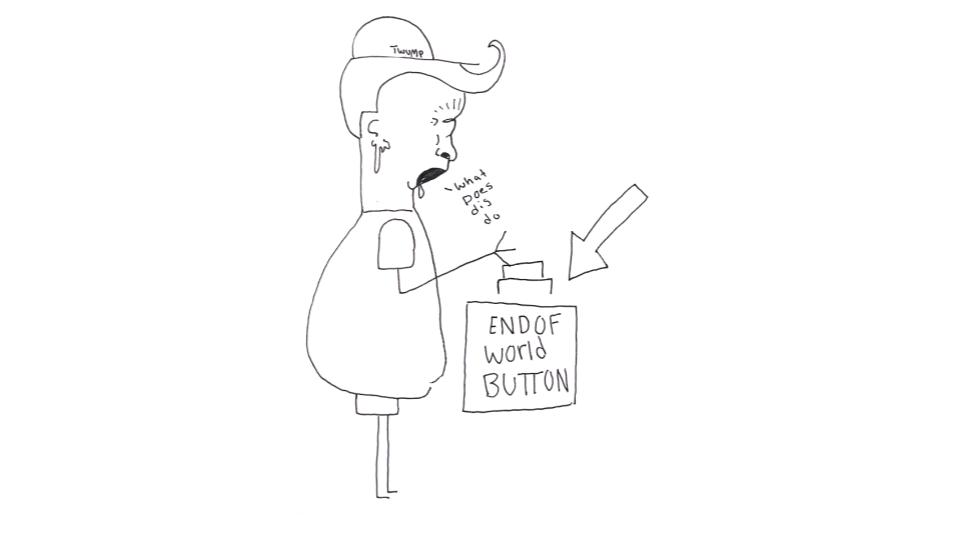
Graphic by Sophia Nitsche


Leave a Reply to cloveCancel reply