

By ELLA WALTERS
This past Friday, I, Ella Walters‘27, (accompanied by my lovely friend Jasmine Kingsbury‘28) sat down with Fred Burwell, the iconic archivist who has begun setting up shop on the first floor of our Morse Library with the final boxes coming in just the last couple of days. This was not my first time hearing about Fred, just this past year he was awarded the Joe Kobylka Alumni Award to celebrate his contributions and in 2020 PBS’ Wisconsin Life even did a segment on him. But I mainly knew him from his Fridays with Fred article series (I love the one on the Eaton Chapel Fire) and his help with my Speculative Fiction class with Tamara Ketabgian for the Ursula K Le Guin exhibit on the second floor. It is no exaggeration to say that he is a cornerstone of the Beloit College and city community.
As many may know, Beloit’s archive has been semi-operational and not on campus for the past year and a half. Sophomores like me and freshmen like Jasmine may not even know how to use the archive and what it’s like, so that’s what I found out.
At first, I was a bit intimidated, by his impressive beard and potentially limitless Beloit knowledge accumulated since he was a student in the 80s. I was not sure where to go, but more than anything Fred’s philosophy is to “Make the archives a friendly, interesting place – I don’t turn people away” and I truly felt that. You can use the archives for pretty much anything you are interested in. On one hand, there are a lot of academic uses for the archive, many professors use it in their classes, and history professor Ellen Joyce even teaches a class down there. You can even use the archives as a resource for special projects ranging from sports to photography, internships, and developing research skills for future career ventures like libraries, museums, and beyond.
On another note, there are also greater communal resources for Beloit as a city, a part of the wider American history, and also as a place that has been the home of many brothers, sisters, grandmothers, and great-grandfathers, throughout its time. Genealogy, the study of family history and lineages, is part of one of the numerous hats Fred wears; many families of Beloit alumni can find “relics that bring that person to life” within the archive. And even if you don’t have any family that went to Beloit, you can learn the skills and resources that you can use to help cultivate your own genealogy. This is something that really hit home for me and something Fred and I connected on, both disconnected from some of our family histories.
This is just one example of how learning about history and how archives hold and house them can deepen your world understanding and can be applied to each part of your life. Fred talked about how students can apply this to their own hometowns and cities, and learn more about the places they are from. The archives are also a place you can help create, they grow and evolve with the interest of the community. Back when Fred first started there was only one thick folder on black students and now there are boxes. Back in 1986, there was also nothing specifically for the LGBTQ presence but students made efforts to find the Saga of Saga comb through Round Table articles, and make a “finding guide” for the places they are referenced. Even around campu,s you can see places to donate posters to the poster archive (which he showed me and it was so cool!). Fred emphasized that the archive was not just a closet sitting there but a laboratory for history.
This is why archives like these are so important. In the article “‘To Be Able to Imagine Otherwise’: Community Archives and the Importance of Representation” M Caswell et al. talk about the impact of community archives in response to symbolic annihilation, what they call the negative consequences of a lack of or misrepresentation both archives and mainstream media. Within it they talk about the three parts of representational belonging, the positive effect of representation; the social “we belong here”, the ontological “I am here” and the epistemological “we were here.” And within the archives, I think that it is a way for you to find yourself in history and make your place there. Although many may think that history is of no interest, Fred even describes how some students may come in just for a class and not think there’s anything for them, but they can find a connection to their life that helps spark that interest. “A lightbulb, a story they can pursue through a Beloit angle.”
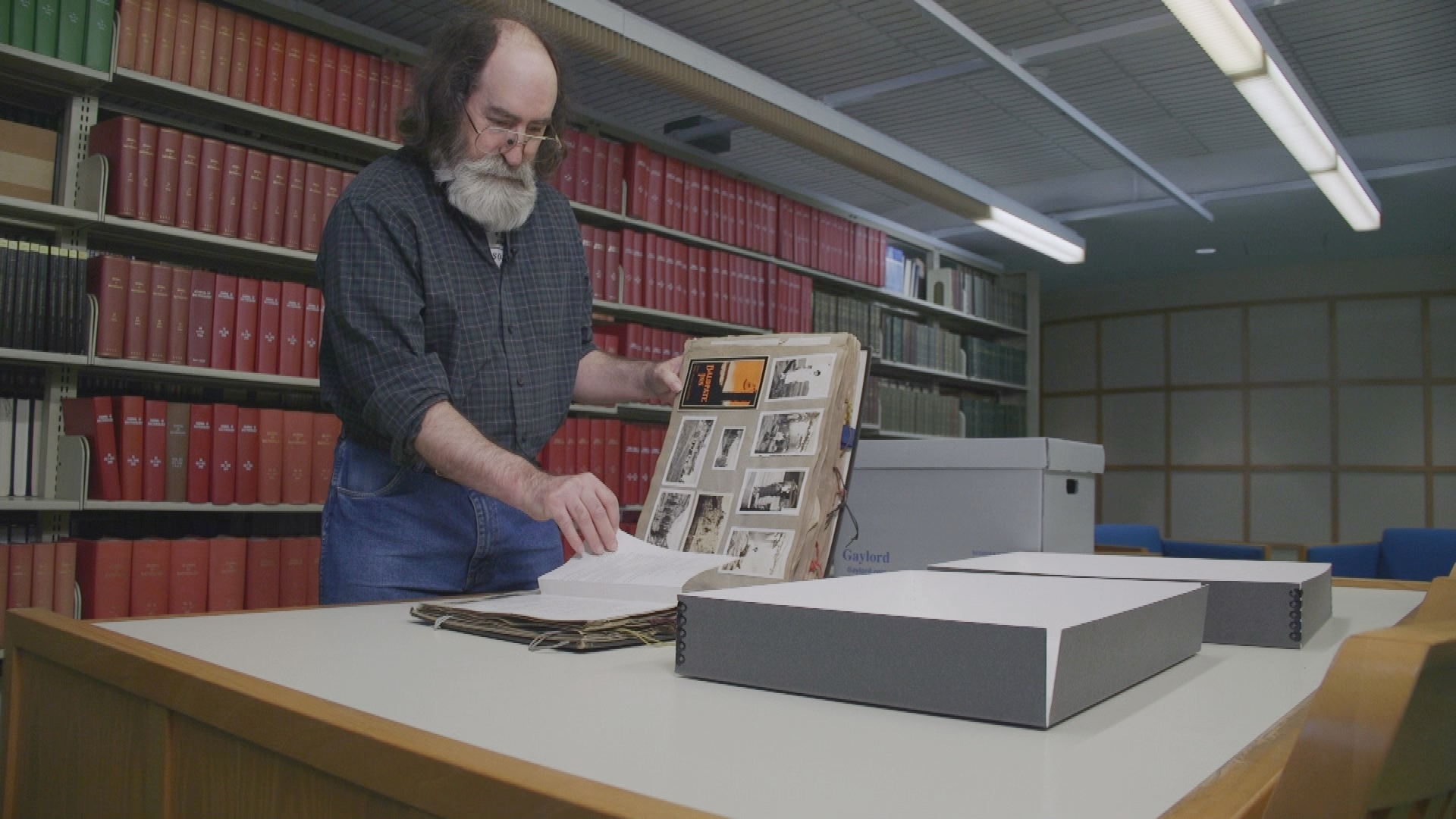
In the archives, Fred showed us so many things, aerial maps of the old campus, old merchandise, love letters between students, scrapbooks, books from alumni, CDs, it was truly a treasure trove. Although right now, the archives are in a point of transition like many things in this college at the moment. It’s still not fully open and organized and next semester we should be onboarding a new archivist, one who will hopefully stay for a while. Fred will still be with the college although eventually, he will step down from doing the day-to-day activities.
Jasmine and I have already been talking about making our own Beloit scrapbook. I may want to learn some genealogy, perhaps intern there next semester, and hopefully one day have a whole file down there for future students or family to find.
So definitely visit the archive on the first floor, be curious, be inspired, and be welcome! If it’s a class venture, personal interest, or just to chat a bit with Fred, the archive is waiting for you.
Featured Image: Fred Burwell

Leave a Reply