

By ELLIOT AVE-LALLEMANT and ALEX MAULE
This past February 25, Beloit’s School of Environmental Sustainability and Cognitive Science Club held a panel discussion on the environmental impacts of Artificial Intelligence (AI). The panelists were cognitive science Professor Robin Zebrowski, political science Professor Gregory Koutnik, and geology Professor Jay Zambito, who is also the director of the School of Environmental Sustainability.
The discussion started with a few preset questions from CogSci club president Ayane Kono’25. The first question was about how we define AI, with Professor Zebrowski (who has been working and studying AI since the 90s) differentiating between the different types of AI. She mainly talked about strong and weak AI, with strong AI being the more “scifi” type, and weak AI being something like ChatGPT or DeepSeek. Professor Zebrowski also mentioned that the large language models most people use haven’t changed since the 80s, and that the main way these models operate is through prediction.
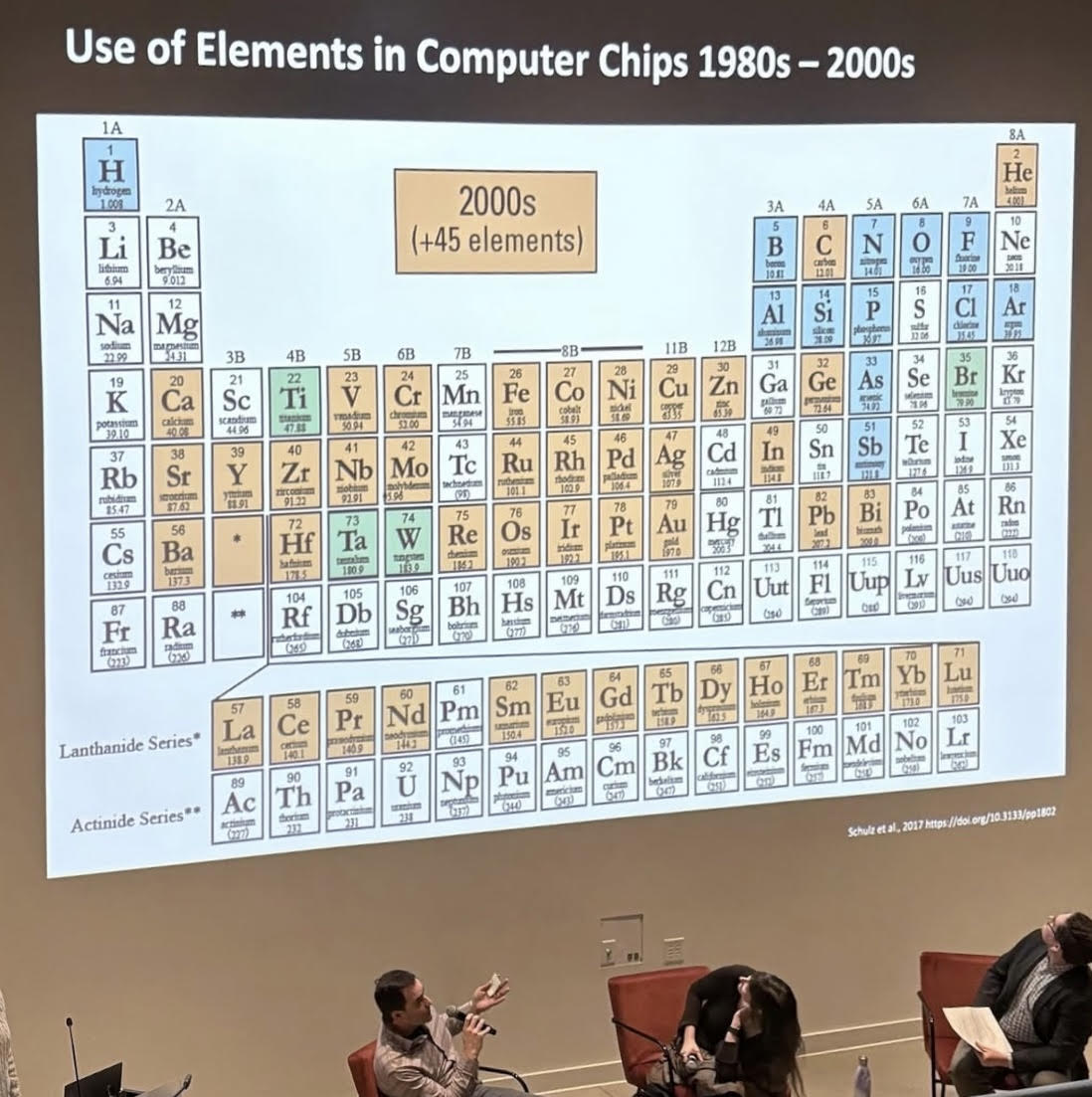
The next question started to talk more about the main topic of the discussion, which was the kind of environmental impact the use of AI has. Professor Zambito mentioned that AI requires large amounts of electricity to run, in addition to using large amounts of water to keep AI servers cool. This led to the point that many large tech companies are now starting to buy energy and upscale already existing operations. Professor Koutnik also mentioned that many legislative actions have impacted the trade of minerals necessary for building AI servers, such as the United States and China.
The positive environmental impacts of AI were also discussed very briefly, because there didn’t seem to be any. The only thing that Professor Zambito concluded was that the upscaling of AI could potentially speed up the process of using cleaner energy (like nuclear energy).
The question then became if it was possible to create and use AI in a sustainable way, and the answer to that was people need to upscale the amount of E-waste and technological recycling that is being done. Professor Zebrowski also expressed her distaste for the idea of using AI in every aspect of life, saying that “keeping people in the loop” was just as important.
Then it was time for open questions. A student in marketing asked how one could avoid the use of AI in a field that seems to endorse the use of AI to give a person a competitive advantage. Professor Zebrowski’s response was to ask “encouraged by who?” She went on to say that there are many creatives who dislike the use of AI, and that people still have the agency and power to say no to the use of AI.
When asked why these types of conversations were so important, CogSci Club treasurer Hanna Fassilis’27 said that “personally, I know a lot of people who have been flagged for the use of AI. Having these talks is important to help them see why using AI may not be the best thing for them.” Ayane also agreed, saying that “AI is a huge part of Cognitive Science. I know that some of my peers use AI for essays or get prompts from it. Not many people know a lot about the impact [AI] has.”
This panel discussion was another important step towards keeping the conversations surrounding AI active within the Beloit community, and students seemed to find it very valuable.
Featured image: @ses.beloit on Instagram


Leave a Reply