

By ELLA WALTERS
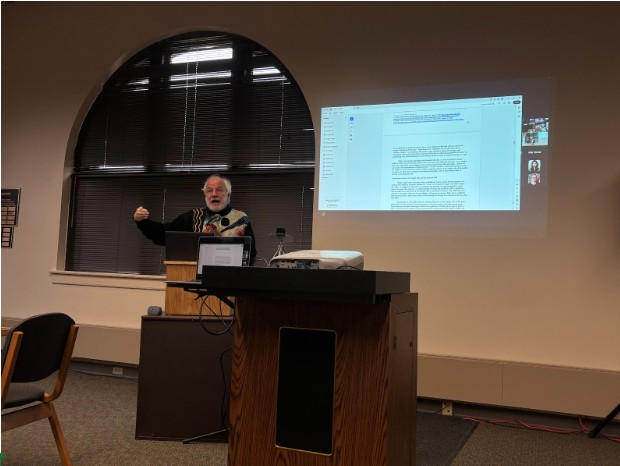
On March 19, 2025, I attended Dr. Robert “Bob” Elder’s, a well loved professor and department chair of Economics and Business, Faculty Forum entitled “Toward a New Textbook for Sports Economics.” Here, I sat in Weeks Longue, from around half past noon to 2 P.M., chatting amongst professors and faculty and learning about what Professor Elder is teaching in his Sports Economics and Sports Analytics classes.
Faculty forums are a community buffet meal followed by a presentation often by a professor or visiting resident, usually happening twice a month, Wednesdays from 12:30-1:20.
With a warm introduction from Dr. Diep Phan, professor of Economics and Business and director of the School of Business, I learned a bit about Dr. Elder and his 36 years spent as the longest current member of the econ department with our Beloit College (some of which included: his collection of famous sweaters (one of which he was wearing), his iconic classroom, and his turtle collection!).
Dr. Elder began his forum presentation by introducing us to the book he began writing on his sabbatical – which looks to explore the versatility and applications of economic theory through the vehicle of sports. In this lecture, Bob guided us through mathematical models, numerical examples, diagrams, and hypotheticals. He described how he likes when authors show every step – from their initial assumption to the final result – having maximum clarity to the audience.
But even though some of these steps went into aspects of calculus and introduced a new language of economic terminology, Bob kept to his intention of having his teachings be accessible and likable for everyone. Which is why the model of sports can be so attractive – as it is something familiar to many. To the amusement of many of the 20 plus professors and faculty members there, Bob also used the example of the May Faculty Senate Meeting to illustrate his points. Throughout the book there are skippable “Brief Forays” and “Brief Digressions” that go further in explaining mathematical concepts or other – so if a reader is interested in the math they can but if not they can jump over.
I myself have found math intimidating and unenjoyable at times – and I am also not huge into sports – but I found the presentation and the teachings to be really engaging and interesting!
To summarize some of the ideas discussed in the lecture: Dr. Elder goes into “Prospect Theory” a behavioral economics theory developed by Nobel laureate Daniel Kahneman and Amos Tversky. This theory aims to explain how people make decisions (like going to buy tickets to a sports game or not) under uncertainty by how they value gains/wins or losses differently.
So depending on if you expect your team to win or lose, the actual outcome of the game, and how upset you are if they win or lose (if you are a loss-averse person or more loss-enduring) – we looked at all the different scenarios and see how that affects people happiness/utility and their likelihood of buying a ticket a game.
After the presentation, it opened up for professors to chime in and ask questions, which was interesting to see how different professors, from different disciplines and knowledge pools explored and interacted with the topic.
Professor Gregory Koutnik, a professor of Political Science, who spoke about his own love baseball asked about how and aesthetics and kinds of wins may affect the attractiveness of a game.
Environmental Studies and International Relations professor, Pablo Toralwho, spoke about the lucrative market in sports from the demographic of men who had an “aversion to the bedroom” and wanted to use sports as an escape from their relationships.
To Religious Studies and Critical Identity Studies professor, Dr. Sonya Maria Johnson who thanked Dr. Elder for the concept of loss-aversion and planned on bringing that and applying the concept up to her “Doing Community” Capstone later that night.
Afterwards I got to chat with Dr. Johnson, who said that she loved the faculty forums and found them a place where faculty could “commune together in fellowship” and learn things that you wouldn’t otherwise.
In my interview with Dr. Elder, in his new School of Business office located in Pearsons (I saw the turtle collection!), we got to talk more about sports economics and the department as a whole. A big theme was about accessibility and welcoming. The Department of Economics and Business has a wide range of classes and aims to be open to any student from any walk of life and kind find interest. Bob talked about how liberal arts education really offers a lot of breadth where you can discover what you like and “maximize the chance you run across something you like” where then you can explore the depth of your major or minor.
Although I was the only student there, and Faculty forums are more geared towards being opportunities for faculty and staff to connect with one another, students are able to attend. More geared to students are the Faculty Spotlights hosted by res life that happen every month, as well as department discussion panels and different forums throughout the year.
Despite never taking anything with the department, I really enjoyed connecting with Dr. Elder, and as an undeclared sophomore may check out what upcoming classes may suit my interests. Learning about different corners of Beloit, can really open you up to people you would have never met and things you would have never learned or known you like.
Featured image: Ella Walters’27

Leave a Reply