

By ELISA TURNER
We’ve all seen it. Don’t act like you haven’t. You’re taking a stroll through Commoltons, trying to find what to eat, when you see it—
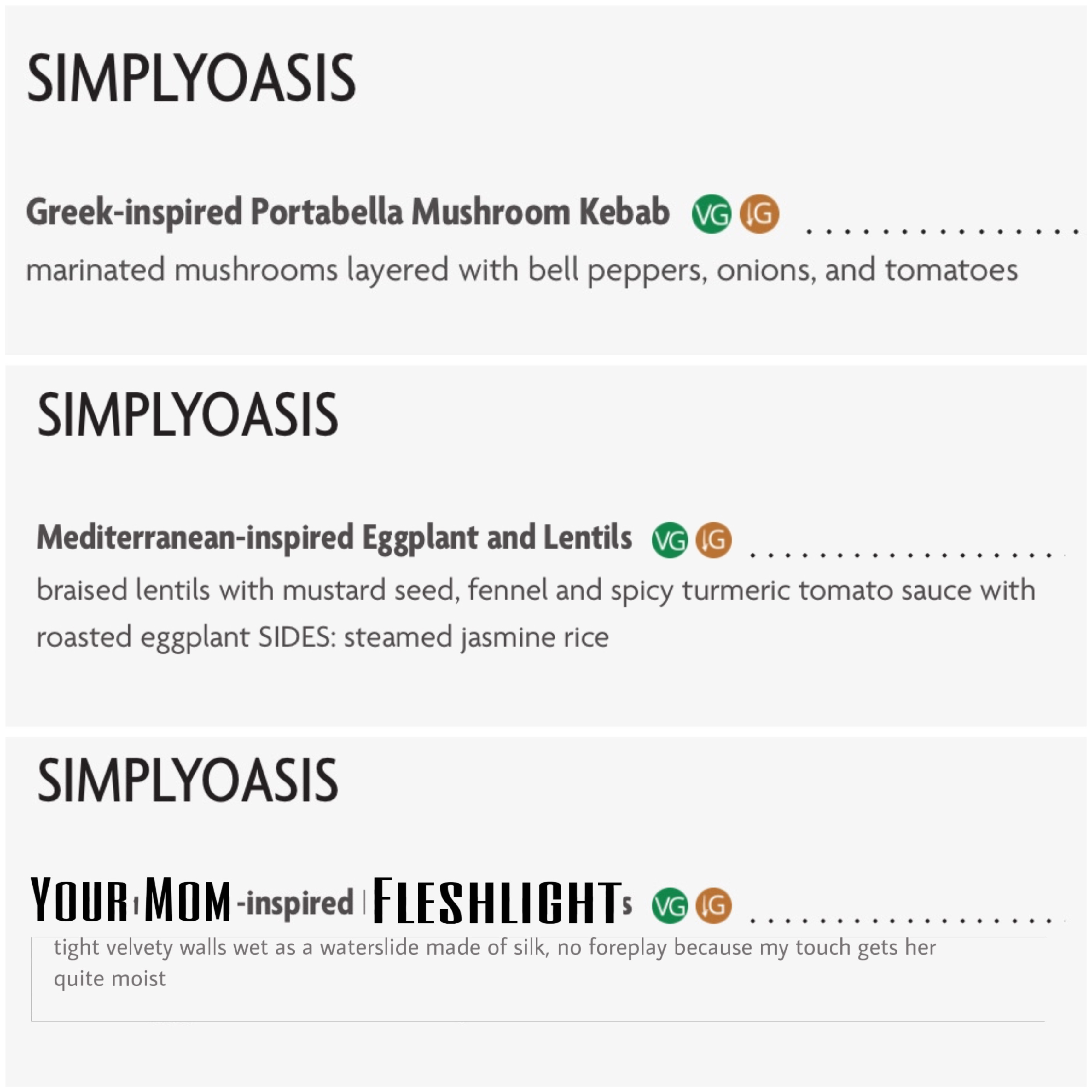
Spanish-inspired Rice. Mediterranean-inspired Eggplant and Lentils. Greek-inspired Portabella Mushroom Kebab.
Inspired. Fucking inspired.
Sure, it looks like another fuckass adjective they throw in to make the food sound better when you read it online before being sorely disappointed upon arrival. But I do find myself asking— why, other than to piss people off, does Bon Appetit insist on using this particular word? It’s not like they’re trying to meet the word minimum on an essay they forgot was due. What does Bon Appetit have to gain by throwing the word “inspired” as a suffix to an existing nation, in order to describe their food? Why not just Spanish Rice, or Mediterranean Eggplant and Lentils, or Greek Portabella Mushroom Kebab? There are two possibilities that I’ve speculated, and I’m gonna shit on both of them.
First, there might legitimately be a word minimum on food descriptions. You ever read the unnecessary amount of bullshit in item descriptions? It’s like when you give a fifth-grader thesuarus.com and tell them “go crazy.” This is stupid for obvious reasons. Abraham Lincoln didn’t even need 300 words to address Gettysburg or whatever; your ass does NOT need a novel to address Beloit.
Second, and the more likely explanation— labeling something as “inspired” by a culture’s cuisine gives one more leeway to make sucky food while simultaneously tacking on the name of somebody’s home country for the reminiscence factor.
Now, I don’t have the credentials to go swinging my cultured dick around and say that this all-but-bastardization is morally wrong in any capacity. It’s not racist, not cultural appropriation, not anything despicable I’m able to claim with any confidence. But it does bother the hell out of me. It is intentionally phrased in a way that mitigates all obligation to retain any semblance of a dish’s cultural origin. Bon Appetit is aware of how their notorious mediocre quality can estrange a dish so far from its roots it becomes unrecognizable; they throw in the country’s dish and downplay it to a derivative in an attempt to cover their own ass. It’s a blanket statement of guaranteed inauthenticity, and it should never be held as an equivalent to “inspiration.” There comes a point where a dish stops being “Filipino-inspired” and starts being “Filipino? Maybe! We’re not sure!”, the latter of which would be better for the aforementioned word minimum that may or may not actually exist.
Is this a harmful thing for Bon Appetit to do? Honestly, probably not all that much. It’s contained within colleges whose student populations already don’t take the dining menu seriously— I know I’m convinced their asses are lying about half the ingredients listed on the too-many-word item descriptions. That doesn’t mean it won’t irritate me every time I see it. I am tempted towards vandalism every time my eyes lie upon the word “inspired” in Commoltons— one of these days I’m gonna have a bad day and a sharpie in my pocket, and on that day no man nor menu will be safe from my wrath.
Featured Image: Elisa Turner ’27

Leave a Reply