

By DEMIR KASAPOĞLU
London became the center of the Grand Sumo Tournament last week, with 40 wrestlers, known as “rikishi,” in attendance. This was only the second time an official sumo tournament was held outside of Japan in two thousand years of the sport’s history.
Royal Albert Hall, a concert venue, took on the responsibility of hosting the event. Upgrades to facilities were made in the hall to accommodate the wrestlers, who had an average weight of 330 pounds. When speaking to the Guardian about the accommodations made, Matthew Todd, the Royal Albert Hall’s director of programming, said “we’ve actually had to source and buy new chairs which can take up to 200kg in weight.”
To be suitable for the calorie necessities of the rikishi, who needed 10,000 calories everyday per person, including almost 5 pounds of rice, a lot of food was bought by the hall. Todd also told the Guardian that the rice supplier had literally run out of rice as they had ordered the entire stock they had on hand.
Workers flew in and material was imported from Japan to honor the spiritual and historical traditions of the sport. To create the wrestling ring, or “dohyō,” 11 tons of clay were needed. Ring attendants, who are called “yobidashi” and are employees of the Japanese Sumo Association, were brought in the dohyō.
After the assembly of the dohyō and other parts of the stage, a blessing ceremony was held. It is done every morning before any matches take place. The ritual, called the “dohyō matsuri,” is done with one head referee, “tategyōji,” and two referees, “gyōji.” The gyōji take the place of a Shinto priest. A hole is cut into the middle of the dohyō to purify it with ingredients like salt, kelp, dried cuttlefish, chestnuts, washed rice, and torreya nuts. The tatgyōji leads a prayer for a bountiful harvest and a blessed tournament, a prayer that has been tradition since the 1790s. A part of the ceremony also invites “kami,” Shinto deities, to watch the sumo.
The Shinto religious roots of sumo are very much present in the sport even in its modern form. The gyōji double as priests for ceremonies and the famous foot stomp by rikishi at the start of a fight is meant to cleanse the dohyō of any evil spirits.
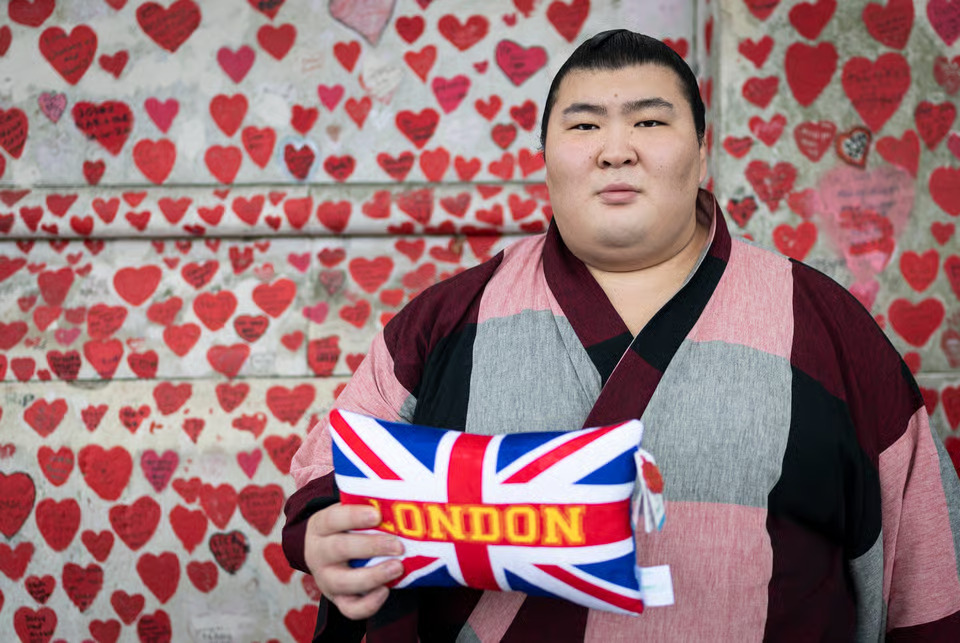
Before the tournament, the rikishi were seen exploring London and its many sites. Social media became flooded with images and videos of them going sightseeing. They were seen at Platform 9 ¾, Big Ben, Abbey Road, and more. They were excited to experience London, with photos of rikishi drinking pints of Guinness and eating fish and chips also found on social media. They became a sort of tourist attraction for tourists and locals alike. People were eager to take pictures with them to mark this once-in-a-lifetime opportunity.
While tournaments typically last 15 days, for this event a special five day tournament was held. The hall was packed with spectators, a standard ticket costing more than $350, the closer to the dohyō, the more expensive the ticket. Closer seats do give a better view of the action, however since there are no physical barriers between the dohyō and the audience, there are moments when rikishi go towards the audience.
Since there are no weight restrictions or categories in the sport there were exciting moments where a smaller rikishi went against a larger one. Smaller, of course, is relative, as they are still at least 280 pounds. This doesn’t mean that smaller rikishi are at a disadvantage.
On Thursday Tokihayate Hideki, weighing in at 291 pounds at 5 feet, 8 inches, went against Shonannoumi Momotaro, who weighed in at 403 pounds at 6 feet, 3 inches. In their fight, Tokihayate sent Shonannoumi into the audience as he had pushed him out of the dohyō, certainly making the cheaper ticket worth it for some.
One of the most viral clips from the tournament came from Ukrainian rikishi Aonishiki Arata. Aonishiki was facing Ura Kazuki. The two were locked head to head for approximately 12 seconds when Aonishiki twisted Ura up into the air and onto the ground with just one arm. The move left Ura and the audience in shock.
The tournament came to an end with Mongolian “yokozuna,” the highest rank in sumo, Hoshoryu Tomokatsu winning with an undefeated record going 5-0.
Featured image: British GQ

Leave a Reply