

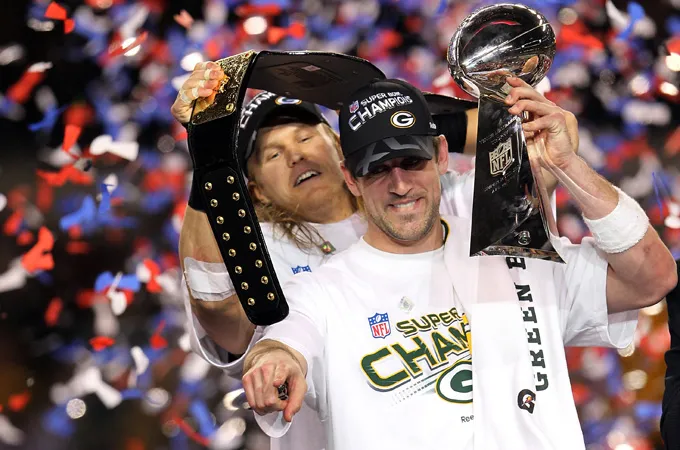
The history of the Green Bay Packers is a history of victory. From their entrance into the NFL in 1921, back when it was still called the APFA, to today, they have played over 1,450 games, a number only beaten by the Chicago Bears, the oldest still-operating franchise. Over the course of more than a century of football, they have maintained a franchise winning percentage of .571, beaten only slightly in that regard by only two historically incredible teams, the Baltimore Ravens and the Dallas Cowboys.
There’s just one problem with comparing them — and that’s time. To help illustrate this, I’d like you to join me for a moment, in another (very silly) reality where the Baltimore Ravens do not exist. In 1996, Art Modell, then-owner of the Cleveland Browns, decides not to move his team to Baltimore. Instead, he’s bitten by a man wearing a ten-gallon hat — and following Spider-Man logic — becomes the world’s biggest Dallas Cowboys fan. His love for them is so profound that he moves the Browns (who would normally become the Ravens) to Dallas, and specially petitions Paul Tagliabua, at-the-time NFL Commissioner, to let them also be the Dallas Cowboys. Paul thinks this is an excellent idea — and the Cleveland Browns are henceforth known as the Dallas Cowboys 2. We change absolutely nothing else. All of Baltimore’s players, their game history, and every franchise win also just so happen to also belong to an entirely separate team of Dallas Cowboys. The games where they play one another still occur, and are exactly as confusing as you’d imagine, with the “Dallas Cowboys” receiving both a win and a loss, regardless of the game’s outcome. Announcers resign en masse in protest after being told to call the game, citing the illegality of: “cruel and unusual punishment.” The games are presumably played in silence.
Back to reality. So, how does this hypothetical merged team — this super-franchise composed of the two winningest football teams of all time — stack up against the Packers? With napkin math, they’d have a winning percentage of around .5735, and have played only 14 more games. Their combined might only manages to eke out a mere 10-win lead over Green Bay. In order to find a team that’s been so consistently good for that long, we have to look at completely different sports altogether. In terms of time against winrate, only the New York Yankees out of the MLB and the Montreal Canadiens out of the NHL can attest to maintaining a winning percentage that high since their inception. And like these other teams, these towering, ancient giants, The Green Bay Packers are, with little room for debate, the greatest franchise in their sport’s professional history. How did they do it?
By doing absolutely nothing.
This isn’t to say that they haven’t played well — far from it. Exceptional football, and exceptional football players alike, seem to just follow them around. The team’s first head coach, Curly Lambeau, for which the Packers’ stadium is named, led the Packers to a win rate of .657, all the more impressive considering he maintained it for 29 entire seasons. From there, they lost consistently for about a decade or so under various head coaches, but it didn’t stay that way for long. A convention of genuine megastars quickly reversed the Packers’ slump. Under the leadership of Vince Lombardi, a head coach so dominant, so steeped in the mythos of football, and so prolific at the time of his death that the Super Bowl’s trophy was named for him, a decade of truly dynastic football, executed by players like legendary quarterback Bart Starr, hall-of-fame cornerback Herb Adderly, and a roster consisting of four other eventual hall-of-fame inductees, would shake the league to its core.
Following Lombardi’s death, they would continue to perform well, or at the very least serviceably for another decade, only truly falling from grace in the mid-eighties to early nineties. Then, when any other team would take a few years to rebuild and restructure, Mike Holmgren arrived, and taking advantage of burgeoning superstar QB Brett Favre, immediately put the team back in playoff contention again. When he departed, Aaron Rodgers took his place, and continued to lead the team to consistent success, and, like his predecessor, another superbowl title. And just when it seemed that with Rodgers’ slow decline and release from the team coupled with rookie QB Jordan Love’s lukewarm start the team would finally slow down for a minute, Head Coach Matt LaFleur immediately rallied the team for an 11-6 season in 2024. Following the surprise acquisition of star defensive lineman Micah Parsons, the team has gone on to produce a division-leading record of five wins, one loss, and one tie — at time of writing.
The Packers defy convention. It is not just that they are good — it’s that they are almost never bad. Some teams, like the Saints and the Cardinals, have had to wait their entire franchise histories for one season good enough to give them a shot at the Super Bowl. Some teams, like the Lions and the Browns, still haven’t even seen the inside of the arena. Even teams that have built dynasties, like the Patriots and the Chiefs, had long stretches of disappointing performance before their dominant stretches. What is it that makes the Packers an exception to this rule? What is their secret to commanding such a consistently unstoppable force?
They do absolutely nothing. Fate seems to favor them in truly unique ways. They are always just bad enough, for just the right amount of time, to pick up a new superstar. Sometimes, they don’t even have to be bad. Sometimes, players like Micah Parsons are simply given to the Packers for what seems to be no reason at all. They continuously collect and produce generational franchise quarterbacks, and consistently provide them a core composition that allows them to flourish. They continuously select head coaches that go on to lead the team to winning season after winning season. They continuously make good calls on when to cut unproductive players. This is not merely the result of a team of brilliant managers — even they can’t stay in the job forever. It borders on the supernatural.
If you’ve read this far and you’re looking for an answer, I’ll be honest with you and say that I don’t have one. I’ve been a Packers fan for just about all of my conscious life, and even across that many seasons, I still haven’t been able to figure out why they keep winning. Perhaps it’s a curse. Maybe, by naming the trophy after one of the greatest Packers to ever walk the earth, the NFL enshrined them into semi-permanent contention. Maybe they’ve employed a family of genuine psychics in the front office, who have given them foresight into every player’s future. Maybe they’ve just gotten lucky. I don’t know, and I don’t think I ever will, but I will continue to look forward to our appearance in this year’s playoffs, and the next, and (probably) the one after that, and throwing on my old Rodgers jersey each and every time.
Featured image: Al Jazeera

Leave a Reply