

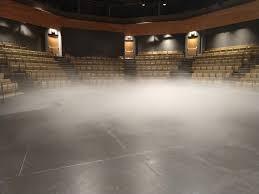
The Laura Aldrich Neese Theatre was previously utilized by the Performing and Applied Arts department for performances such as Chelonia, plays, and musicals. Beyond a unique, thrust stage experience for up to 300 people, the Neese featured classrooms, historical costume displays, a black box theater, a costume shop, and a scene shop. The last performance in the building was likely Chelonia 2024, according to Performing and Applied Arts’ Instagram postings. Due to neglect of the building, however, Neese is no longer suitable for performance. Students can now find performances held in the Hendricks Center within a dance studio, though the additional resources like a black box theater, scene shop, and legitimate stage are not featured within the Hendricks Center.
In an attempt to understand what student opinions were in the switch from the Neese to the Hendricks Center, I created two surveys last spring. The first one, titled “Beloit College Student Input on Performances/Performance Spaces,” had 63 respondents. This survey gathered an overall campus perspective on the matter. From this survey, the Hendricks Center was described as “less inviting” and “just clearly not a theater.” But just how much do other students agree with this take?
When asked about their perspective on the Hendricks Center performance venue, students reported being unsatisfied across multiple categories: 55% with seating availability, 64% with location in proximity to campus, 67% with the stage, and 52% with engagement of the space. The only category with high levels of satisfaction was the safety of the space, coming at a 73% satisfaction rate.
When asked about their perspective on the Neese performance venue, students reported being satisfied across multiple categories: 97% with seating availability, 88% with location in proximity to campus, 97% with the stage, and 94% with the engagement of the space.
In a separate question regarding how the Hendricks Center’s lack of a proper stage impacted Beloit College, 54% of students responded that it negatively impacts current and prospective students of the college.
Qualitative data further suggests the negative impacts of no longer utilizing the Neese: “It needs to be dealt with, and I think that the college needs to demonstrate its commitment to the arts because many arts students feel the college has left them behind,” said Rowan Wilson’27. “The lack of adequate performance space is a disservice to all current and prospective Beloit students, whether they be PART majors or not,” stated another student.
Alex Fondrk’28, who works for the Hendricks Center, finds that “it’s very obvious that it’s not really a space that can do performances. The number of people that can watch performances there is seriously diminished, and the tickets we have sold are significantly down from years past.”
My second survey, titled “PART Performance Space and Department Survey,” had 40 respondents and was used to survey anyone under the PART umbrella, which includes music, dance, theater, and media. The majority of respondents had a concentration in theater at 45%, then music at 40%, 37.5% in dance, and 20% in media (this section allowed multiple concentrations to be selected).
When asked, “Do you feel content with the Hendricks Center resources in regards to performance space, places for scene shop work, costume shop, and dance/theater practice spaces?” 2.5% of respondents stated that they were completely satisfied, with no room for improvement — a stark contrast from the 77.5% that fell in the somewhat to completely unsatisfied categories. When asked their level of happiness in regards to Studio 1 as the new performance space, again, only 2.5% felt completely happy. 47.5% were completely unhappy, and 30% were relatively unhappy. I then asked if they had performed in the Neese before. 42.5% said yes, and that they miss it. 37.5% stated no, but they wish they had. No respondents reported yes, and that they don’t miss it.
Perhaps the most integral question to get into the perspective of PART students was “What is your relationship with the performance space of Studio 1 and your satisfaction with the PART department?” 72.5% of respondents selected “I’m debating staying in the department- I am unhappy with the performance space, but like the department.” Meanwhile, 7.5% of respondents selected “I am leaving the department – I feel the change to the Hendricks Center is causing a decline in performances/the department.” This data alone provides significant correlation between student dissatisfaction and Studio 1 as a performance space. Furthermore, the data suggests the problem lies in performance space, not the department itself.
Lastly, in both surveys, I asked what students would like to see if the Neese was ever renovated. In the multiple choice question for PART students, they chose: performance venue for theater, dance, or music (90%), dedicated rehearsal and practice space (80%), to build PART related workshops for the Beloit community (72.5%), student performance space (ie: Karaoke spot, student band performances) (65%), and film screening space (40%).
In the multiple choice question for Non-PART students, they chose: general performance venue (84%), practice space for the performing arts (81%), workshop space for PART related subjects (acting, dance, music, etc) (76%), student-run event space (karaoke, guest speakers, open mic night, student band performances, etc) (61.9%), community performances (Beloit Civic Theater) (63.5%), and film screening venue (58.7%). Non-PART students, when asked about who should have priority access to the Neese, primarily felt that “some spaces should have PART student priority, but other spaces should be open to everyone,” at 58.7%.
Synthesising this data, it’s easy to understand just how important the Neese was and is to Beloit College students. Furthermore, it’s clear that PART and non-PART students alike feel the negative impacts of no longer having the Neese in operation. The biggest data to reinforce this go back to the impact on current and prospective students, the qualitative comments describing desperation for the Neese’s return, and how many students feel they might leave the department due to facilities, as much as the overall worse user experience in the Hendricks Center in comparison to the Neese.
Featured Image: PART Department Facebook


Leave a Reply to Richard AllenCancel reply