

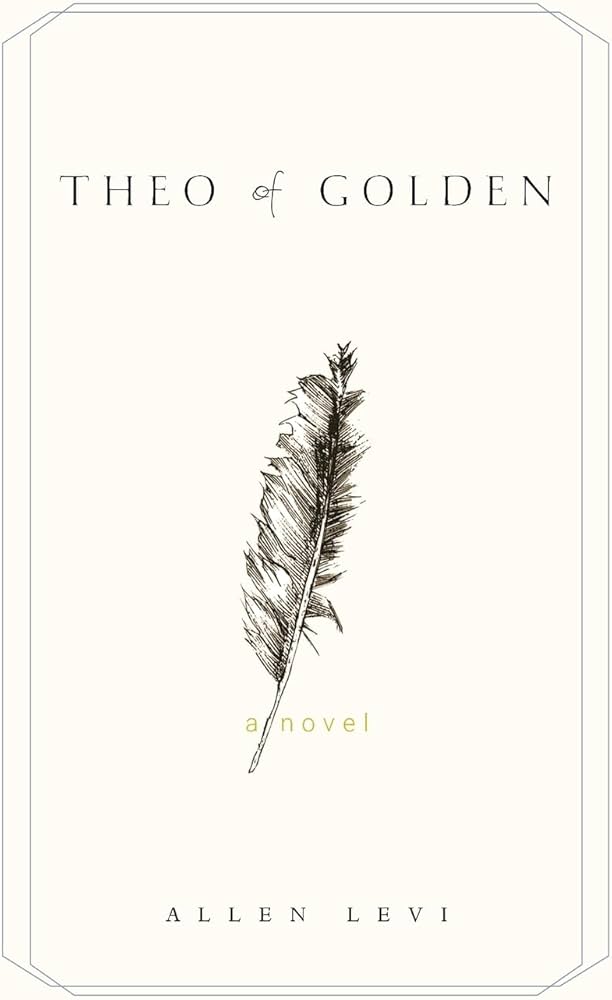
Simply put, when I picked up “Theo of Golden” by Allen Levi, I expected a light cozy mystery, a feel-good book, something to casually pick up and read a chapter here or there.
Instead, my heart shattered into thousands of pieces. By page 43, I had tears in my eyes. I met characters who will stay with me for a long time. Towards the end, I grew so mad I almost threw the book (don’t worry, it stayed in my hands).
The prologue states that Theo spent just one year in Golden:“Only a year. Not so long. But long enough to create a current of his own and to catch others in it. Without knowing it, a whole cadre — Asther, Tony, Ellen, Basil, dozens of others — was being carried along by the vortex that was Theo.” I, too, was swept up in the current and will never be the same.
The story follows Theo, an 86-year-old from Portugal who settles in the small town of Golden, Georgia. In Golden, he visits a coffee shop displaying 92 pencil portraits by a local artist. Inspired, Theo buys the portraits and begins to give them to their “rightful owners.”
He does so quietly, not wanting to draw attention to himself, and slowly but surely along with him, we are introduced to the citizens of Golden, and at the same time, Theo himself. He is quite a mystery to the town and to the reader alike, and throughout the pages, you are trying to guess what brought him to Golden and his intentions.
Normally, I only annotate books for academic purposes. I like to let myself get lost in the story without analyzing literary themes or subplots. That went straight out the window after I began reading. Levi’s elegant prose moved me seamlessly from one chapter to the next, all while my pencil moved of its own accord, underlining words and phrases, leaving theories, or even just reactions.
“Theo of Golden” falls under literary fiction, focusing on characters, themes, and stylistic writing rather than fast-paced plots. The characters in this book are what really sold me. They were expertly written, so that I felt like I intimately knew them even if they only appeared for a total of three pages. I cared about every single member of the main cast, which is rare for me (I tend to pick favorites).
The book has great one-liners that had me laughing, whether from Theo’s thoughts, actions, or Tony’s running jokes. Other lines made my eyes water, or caused me to pause and think.
Books like this make me hesitant: I worry they’ll get too preachy about positivity. “Theo of Golden” walks the line where Theo just says what he sees and thinks, like how your best friend would talk to you. Very straightforward, and very, VERY little sugarcoating.
My biggest, and only, caveat with the book is how the plot is explained with letters at the end. I usually find that authors use this device as a scapegoat to cover up their work when they haven’t properly threaded plot lines throughout and need to magically tie them into a quick, pretty little bow at the end.
Somehow, someway, I didn’t really mind the way Allen included the use of letters. He introduces the idea of letters earlier in the book, and he also weaves so many threads together to form an entire tapestry, where the letter at the end is almost like his final signature of the piece, rather than the thing that holds the entire story together.
I liked “Theo of Golden” as soon as I started reading, but it was the elegant prose, the character interactions, and the ending that left me a sobbing mess, which solidified its place as one of my favorite books I have ever read.
Image Credit: Amazon

Leave a Reply