

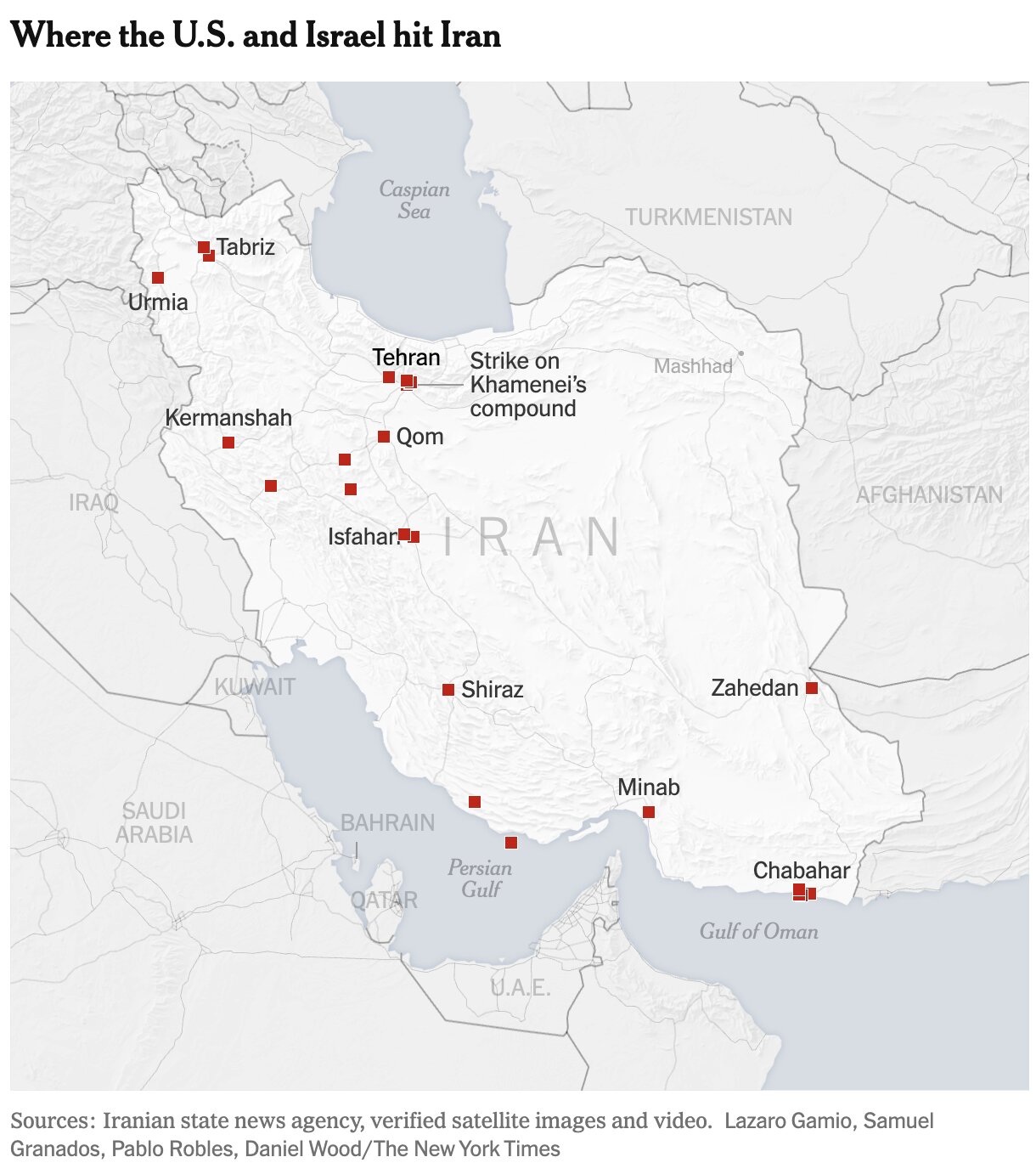
In the early hours of Feb. 28, the United States and Israel launched “Operation Epic Fury,” joint coordinated strikes on Iran, with the aim of dismantling the alleged nuclear infrastructure and to topple the Islamic Regime. At 12:15 a.m., Tehran was struck by the first waves of missiles, particularly targeting senior leaders and the Ministry of Intelligence. At around 9:40 a.m local time in Tehran, US ballistic missiles struck a compound where top Iranian Defense leaders were gathered including Supreme Leader Ayatollah Ali Khamenei. Reports suggest that the US-Israel joint operation has fired close to 3000 missiles into Iran.

Major Israeli and US news agencies confirmed the elimination of the Supreme Leader, the commander in chief of the IRGC, the minister of defense, the head of the Military Council, the commander of the IRGC Aerospace Force, the deputy intelligence minister, and others. On the morning of March 1, at around 2:00 a.m. EST, Iranian state media confirmed the death of Ayatollah.
Mizan news agency, the official news outlet of Iran’s judiciary reported that a girl’s elementary school in south Iran was part of a fatal strike that killed around 150 people and injured around 100 more. The school building appears to be adjacent to an Islamic Revolutionary Guard Corps barracks. Here’s a list of all the cities that were confirmed targets in Iran by the Jewish Institute for National Security of America (JISNA): Tehran, Isfahan, Qom, Karaj, Kermanshah, Tabriz, Bandar Abbas, Bushehr, Chabahar, Ilam, Kharg, Parchin, Shiraz, Mashhad, Khorramabad. Additional provinces like Shahroud , Hamadan , and Minab also saw strikes.
Reports confirm that the U.S. severely damaged Iran’s Kharg Island oil terminal which handles 90%+ of crude oil exports and has a 1.8-2 million BPD capacity. Satellite images show 80% of the 28 storage tanks have collapsed or burning. The Bandar Abbas naval fuel bunkers were also hit, with 60% reserves destroyed. Bloomberg reports that oil prices globally have jumped up by 13% and are now $80 per barrel of oil.
In retaliation to these strikes, Iran launched multiple attacks on Israel and US military and naval bases and allied US countries in the Gulf region. So far, the IRGC says it has launched attacks on 27 bases in the Middle East where US troops are deployed as well as Israeli military facilities in Tel Aviv and other parts of Israel. Iran has launched strikes across eight main countries in the region: Bahrain, Iraq, Jordan, Kuwait, Oman, Qatar, Saudi Arabia and the United Arab Emirates.

In Israel, the primary confirmed impact was on cities like Tel Aviv, Jerusalem, and Beit Shemesh. According to the Middle East Eye, and several reports, around 200 buildings are destroyed in Tel Aviv, and the city is under critical damage, with around 500 wounded. The largest impact took place in Beit Shemesh, where a ballistic missile fired by Iran struck a nine story residential building and nearby areas, killing more than 10 people, and injuring several. Jerusalem and Haifa also had reports of minor explosions.
A second strike hit near Ashdod in southern Israel around midday, damaging a warehouse and injuring four workers. Further impacts included a missile fragment striking a school in Petah Tikva and explosions over the Golan Heights, where interceptors downed most projectiles but caused minor property damage.
In Bahrain, targets include the U.S. Fifth Fleet headquarters at Naval Support Activity Bahrain, Bahrain International Airport, the Crowne Plaza Hotel in Manama, and Era Views Towers residential complex. The UAE saw strikes on Dubai International Airport, Zayed International Airport in Abu Dhabi, the Port of Dubai, Fairmont Palm Hotel, and Burj Al Arab Hotel, with most of 165 missiles and 541 drones intercepted but three civilian deaths reported. Iran had also fired missiles at Cyprus, where around 300 British troops were stationed, although there are no reports of direct hits to the bases. British Prime Minister Sir Keir Starmer has authorised the United States to temporarily operate from its bases.
Qatar’s Al Udeid Air Base and nearby residential areas were targeted, while Kuwait International Airport faced attacks. In Iraq, Erbil International Airport and Baghdad International Airport were hit along with US Army bases. Saudi Arabia and Jordan also reported impacts on U.S. bases. In the Strait of Hormuz, Iran did not strike specific naval bases or named ships but targeted multiple commercial tankers, such as the U.S.-sanctioned Skylight (Palau-flagged), MKD Vyom (Marshall Islands-flagged), and an unidentified vessel, using unknown projectiles amid IRGC warnings barring passage.
Reports also claim that several Iranian proxy groups have joined in. Recent developments claim that Hezbollah has fired several rockets being launched towards Northern Israel. This the first time there has been military activity from Lebanon after the 2024 ceasefire. The Iranian Shaheds are also operating in the Persian Gulf as explosions are being constantly reported over Bahrain.
It is uncertain as to how long the cross-border exchanges will continue, but at the time of writing, (i.e, March 1, 5:22 pm) the strikes still continue with full force, with both sides refusing to stop, and countries like the United Kingdom and France joining the operation against Iran. As of today, both Tehran and Tel Aviv are in a state of destruction, with citizens claiming that “they are starting to look like Gaza”. The question still remains, will this chain of events lead to a much bigger global war? Or are we already in one? Are we entering a new phase of world order? How many civilian lives will be lost due to these brutal exchanges? Is this the starting point for World War 3?
Featured image: Iranian state news agency
Additional images: Iranian state news agency

Leave a Reply