

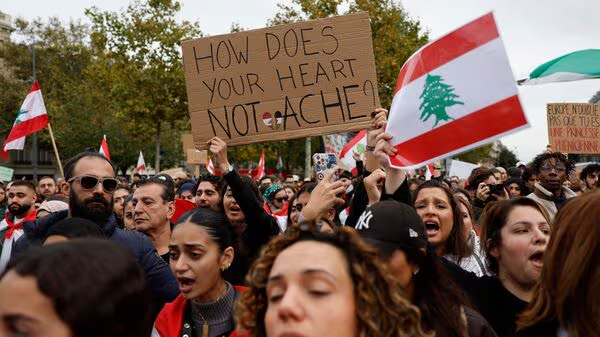
Israel and Hezbollah have opted once more to revive their old rivalry and serve up the latest act in the high-stakes drama they play for the world to see. This time, they’re given top billing in an over-the-top production that features explosive pagers, airstrikes, and enough rockets to make even the industry’s boldest fireworks experts blink.
For those who’ve been living under a rock (or perhaps wisely avoiding the news), here’s a quick recap of the long-standing enmity between Israel and Hezbollah: The Lebanese Shiite (Shia Muslim) militant group and political party was formed in the 1980s with support from Iran, with the primary goal of resisting what it views as Israeli occupation in the region. Major conflicts between Israel and Hezbollah occurred in 1993, 1996, and most notably in 2006, which resulted in significant casualties and destruction on both sides.
But these are the old chapters of this book.
The latest chapter in this long-running saga began on September 18, 2024, with a series of mysterious explosions targeting pagers and walkie-talkies used by Hezbollah operatives in Lebanon. These attacks, widely attributed to Israel although never officially claimed, resulted in at least 37 deaths, including two children, and injured around 3,000 people. The unprecedented nature of these strikes sent shockwaves through Lebanon and signaled a dramatic escalation in the conflict.
Hezbollah, not-so-surprisingly, retaliated pretty quickly. On September 22, they launched 150 rockets targeting the Haifa area and Jezreel Valley in Northern Israel, causing injuries and damage to buildings. This barrage marked a significant intensification of Hezbollah’s attacks, which had been ongoing since October 7, 2023, when the group first joined the conflict in solidarity with Hamas and the Palestinians in Gaza.
The situation reached a fever pitch on September 23, when Israel launched massive airstrikes on Lebanon, resulting in at least 558 deaths. This attack, which targeted residential areas in Southern Lebanon, has been marked as the deadliest day in Lebanon since its civil war. The Israeli military claimed to have hit around 800 Hezbollah targets, including weapons sites and rocket launchers.
In a further escalation, Israel conducted multiple airstrikes on Beirut on September 27, specifically targeting Hezbollah’s headquarters in the southern suburbs. This attack resulted in significant destruction, with entire blocks obliterated near Beirut’s international airport. Among the casualties were Hezbollah’s Secretary General and Mastermind: Hassan Nasrallah, and Ibrahim Akil, the commander of Hezbollah’s elite Radwan unit, along with other top unit leaders.
As the conflict intensifies, both sides continue to suffer losses. Israel has reported civilian casualties and damage to infrastructure from Hezbollah’s rocket attacks, while Lebanon’s Health Ministry announced over 720 deaths, including many women and children, from Israeli strikes. The total death toll since the conflict’s escalation in October 2023 has surpassed 1,000, with tens of thousands displaced on both sides of the border.
Hezbollah’s involvement in this conflict stems from its long-standing opposition to Israel and its alliance with Hamas.
Since October 7, 2023, when Hamas launched its attack on Israel, Hezbollah has been firing rockets, missiles, and drones into Northern Israel in support of the Palestinian cause. This support is not merely ideological but also strategic, as Hezbollah shares common backers with Hamas, most notably Iran.
Iran’s role in this conflict cannot be overstated. As the primary supporter of both Hezbollah and Hamas, Iran has been providing these groups with weapons, training, and financial support for decades. This backing has allowed Hezbollah to amass an arsenal estimated at around 150,000 rockets and missiles, some capable of reaching any part of Israel. Iran’s involvement has turned what might have been a localized conflict into a potential regional conflagration, with implications far beyond the borders of Lebanon and Israel.
The international community is urging for a pause in the fighting. The United States and its allies are advocating for a 21-day ceasefire along the Israel-Lebanon border. However, these calls for restraint seem to fall on deaf ears as both sides continue to escalate their attacks.
As this latest episode unfolds, both sides seem determined to outdo each other in a dangerous game of one-upmanship. Israel’s military has significantly ramped up its operations, conducting hundreds of airstrikes on Hezbollah targets across Lebanon. Meanwhile, Hezbollah continues to launch rockets deeper into Israeli territory, with some reaching as far as Haifa and even Tel Aviv.
The humanitarian cost of this conflict is staggering. Thousands of civilians have been forced to flee their homes in both Southern Lebanon and Northern Israel. Hospitals in Lebanon are struggling to cope with the influx of injured, with some medical facilities themselves becoming targets of airstrikes.
The destruction of infrastructure, including roads, bridges, and power plants, threatens to plunge large parts of Lebanon into a humanitarian crisis.

Leave a Reply