

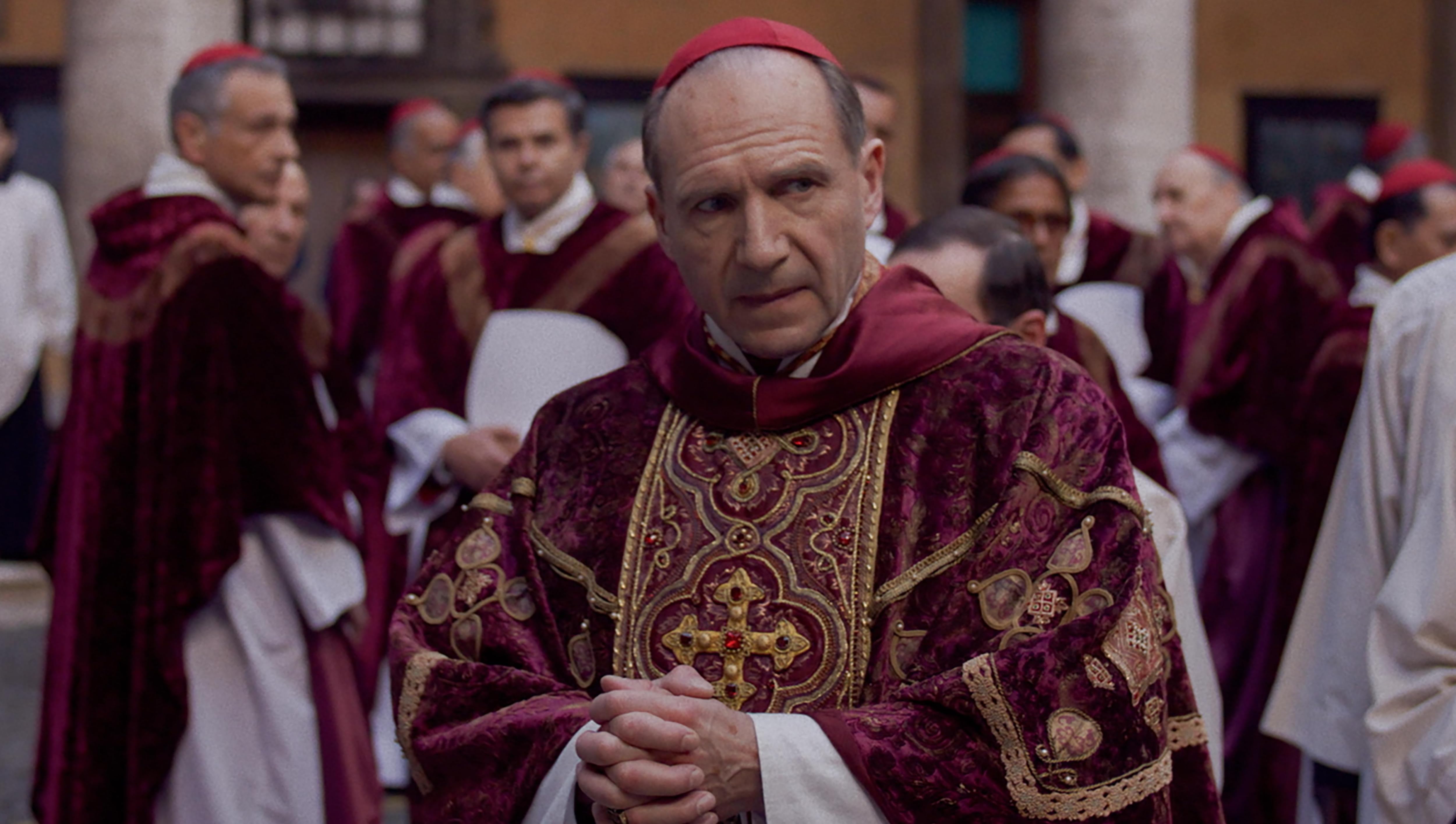
I’ll be honest, the last thing in the world I care about is the election of a pope. Truly, it does not interest me at all. Which is exactly why it’s a little surprising how much I love “Conclave.”
At face value, the film is substantially about the secretive process of selecting a new pope. In reality, however, it plays out more like a Catholic version of “Mean Girls.” Between sex scandals, blackmail, and the occasional vape hit, the cardinals in this movie do not know a single moment of peace.
The very first scene of “Conclave” sets the tone immediately, establishing a sense of tension that never really lets up. It begins in the immediate aftermath of the pope’s death, and the atmosphere is so heavy it’s almost suffocating. There is grief, but it feels controlled, and almost rehearsed. No one is unraveling, no one is even particularly expressive.
As the film fast forwards to the days leading up to the Conclave, it becomes clear why. The Curia is quickly depicted as more of a political one, than a spiritual one: an environment driven by reputation, rumors, and quiet competition, in which everyone is watching one another as if waiting for the other shoe to drop.
Visually, the film reinforces this sense of control. The establishing shots are precise and almost unsettling. They emphasize perfection in moments that are undeserving of them. As cardinals stand around, gossiping, scrolling on their phones, and smoking, there’s a distance to it all, as if these moments were performed rather than lived. If anything, the cinematography of this movie does what the institution itself tries to avoid. It makes the cardinals look ordinary, replaceable, and, at times, kind of small.
One of the things “Conclave” does is strip belief of its certainty. You would expect a film about the inner workings of the Catholic Church to center unwavering faith, but it does the opposite. Instead, belief is portrayed as unstable, something that is constantly negotiated, doubted, and, in the most extreme of cases, weaponized. This idea comes through most clearly in one of the film’s most memorable lines, “certainty is the greatest enemy of unity … the deathly enemy of tolerance.” It’s a line that lingers throughout the movie because it applies not only to the Church, but to everything else in the world.
The characters bring these tensions to life in ways that are often unintentionally hilarious. Cardinal Tedesco, for example, represents a rigid, traditional vision of the Church, constantly pushing against any form of progress. But honestly, between the hair, glasses, and the vape, he feels less like a conservative cardinal and more like someone who belongs in a completely different movie.
Cardinal Bellini, on the other hand, feels grounded in a way others don’t. He advocates for practical responses to issues such as divorce and LGBTQ+ matters, while also supporting a more open and progressive Church, particularly when it comes to the role of women. What makes him compelling is not just his perspective, but his reluctance to be pope. He does not want the papacy, but he clearly understands the stakes of allowing someone like Tedesco to take it. The tensions between personal hesitation and moral responsibility grounds his character in a way that feels human.
At the same time, the film fully leans into its own chaos. The scandals, the constant gossip, and the increasingly dramatic reveals, all chip away the illusion of order. The scene revealing Tremblay’s resignation is one of the best examples of this. Everything unravels at once, and the composure the film has been holding onto just collapses. At a certain point, the “Mean Girls” comparison rings true as Tedesco basically becomes a conservative Regina George, watching everything fall apart while insisting he’s the solution.
“Conclave” also bargains with the concept of religious wars, what it means to fight in the name of belief, and whether those conflicts are ever truly justified. The film does not offer easy answers, but it does make it clear that faith, when intertwined with power, becomes something far more complicated than doctrine alone. And then, just as the film seems fully grounded in its political and ideological tensions, it shifts. The revelation at the center of the final scenes of the movie, “I was who I had always been … I know what it is to exist between the world’s certainties,” reframes everything that came before it. The introduction of an intersex identity within a space as traditionally rigid as the Catholic Church is not treated as spectacle, but as something deeply human. In a story so concerned with certainty, this moment insists on ambiguity, on complexity, on the validity of existing outside of fixed categories.
The very last scene, centered on the presence of women, feels almost quiet in comparison, but is no less significant. It suggests, without overstating it, the possibility of change, of a Church that might begin to move in a different direction, however slowly.
“Conclave” is one of my favorite movies. It’s not just a film about selecting a new pope. It is about power, belief, and the fragile systems that hold both together. It is about the tension between certainty and doubt, tradition and change, performance and truth. And somehow, it manages to explore all that while also being genuinely entertaining, occasionally absurd, and at times, unexpectedly funny.
It’s a film I believe everyone should watch, if not for all of that, then at least for the two hours of cardinals being gossiping divas.
Featured image: IMDb

Leave a Reply