

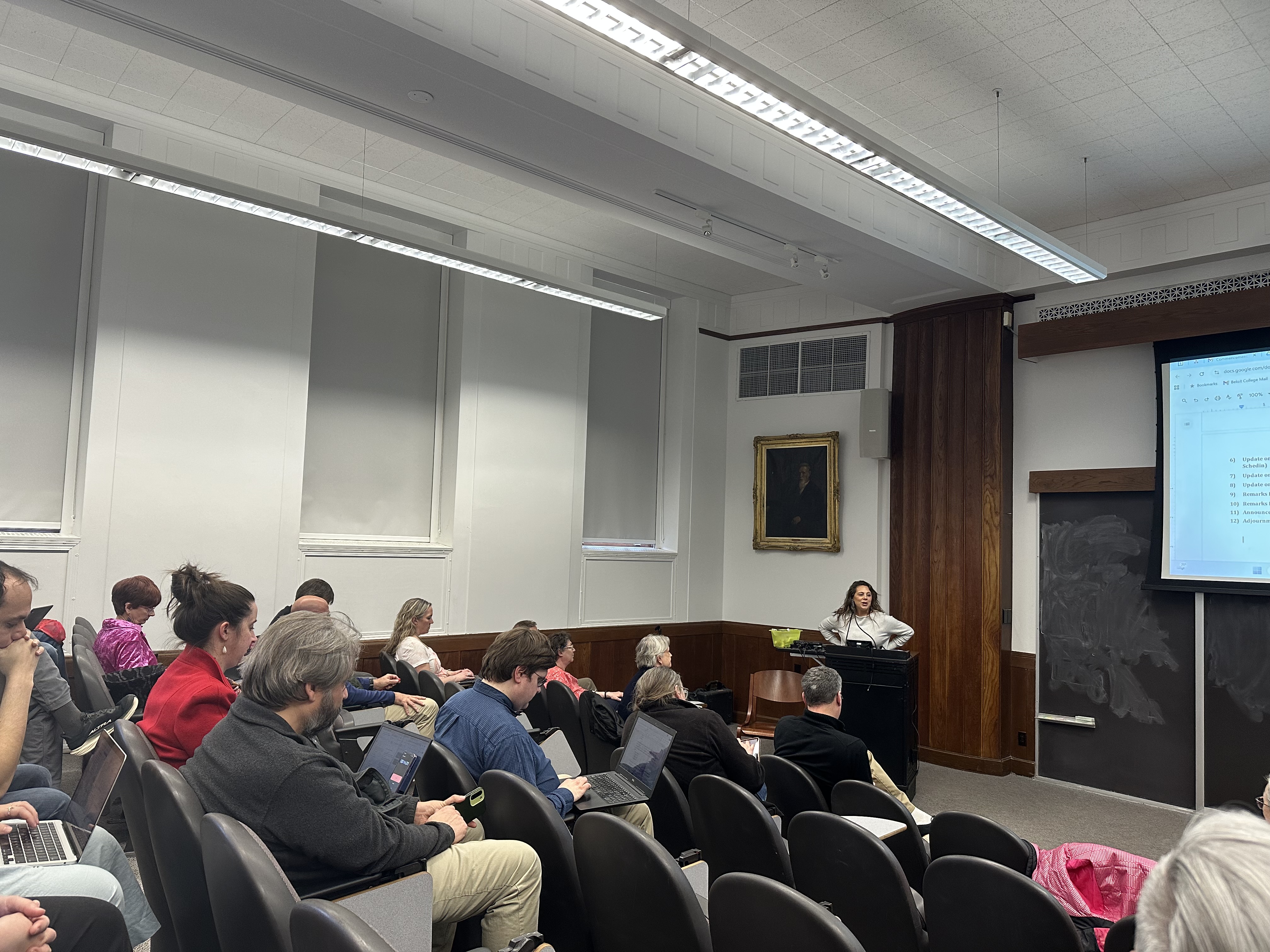
The April meeting of Beloit College’s Academic Senate filled Morse-Ingersoll Hall’s Richardson Auditorium with staff, faculty, and students on April 8 to dictate changes to the college’s academic program. In the meeting, administration stressed trust, admissions provided hope for the next academic year, President Eric Boynton was reverent toward the college’s accomplishments, and healthcare costs rose for faculty.
After Provost Donna Oliver called the meeting to order, ballots were handed out to faculty for the purposes of a tenure track faculty only vote to give an honorary degree to 2026 commencement speaker Silvija Martincevic‘02, a Beloit alumnus and tech CEO for the workforce management company Deputy. This motion was adopted, as was the customary motion to officially approve all the seniors eligible for this spring and next fall for graduation.
Faculty-led committee reports began with Professor of Sociology Charles Westerberg presenting on behalf of the Academic Strategic Planning committee. “Hi, I’m Charles,” he said, waiting for a collective chuckle to subside and explaining that he was standing in for the committee’s usual “fearless and inspirational leader,” Professor of Japanese Susan Furakawa, as she dealt with “personal matters.” Westerberg explained in his brief presentation that the committee’s main goals in the short term were to have further discussion about and revise chapters 6 (“Special Provisions Governing Faculty Employment”) and 8 (“Policies and Procedures Governing Academic Senate, Divisions, and Departments”) of the college’s Administrative Policy Manual. Both were last updated in December and April of 2025 respectively, according to the college’s website. It is unclear at this time what these proposed changes are.
An item up for action came courtesy of the Faculty Status and Performance committee, anchored on the podium by Associate Professor of Sociology Kate Linnenberg, who then handed the floor to Associate Professor of Geology Jay Zambito, who sprang up from the aisles mic in hand. Projecting a new policy on the screen for approval, Zambito explained that in order to qualify for the federal funds that many departments rely on, the college must institute an institutional base salary. Said Zambito, “We should have this in place already, and we don’t.” The motion to outline a plan to calculate what that salary would be was approved by the voting body.
Next up was a presentation from the Curriculum Oversight and Administration committee, which was spearheaded as always by Associate Professor of Spanish Amy Tibbitts. Tibbitts outlined a slew of new courses in the Sociology, Business, and Economics departments and changes to the Museum Studies minor. Tibbitts also gave a brief comment on the use of digital translators or apps intended for international students for whom English is not their first language. She indicated that there was no official policy regarding the usage of these tools in the classroom at Beloit and that they “will continue to not have a policy on this,” clarifying that it is at the discretion of faculty whether to allow it in their syllabi.
Tibbitts handed things off to Professor of Cognitive Science Robin Zebrowski, who spoke on behalf of the Professional and Program Development Committee (PPDC). Zebrowski said succinctly, “PPDC continues to give out money, please keep asking for money,” adding that funding requests for departmental programming must be submitted prior to the committee’s final meeting of the semester on April 27. Zebrowski also admitted that it has been perhaps more difficult to get guest speakers or scholars to come to campus this year because the United States is a “literal war zone right now.” Because there is more money in the budget, Zebrowski says, “We’ve been trying to award every allotment $500 over.”
Armed with her usual arsenal of numbers, Vice President for Enrollment, Marketing, and Athletics Karen Schedin transitioned the proceedings from committee reports to an update on admissions. “Good news from the admissions office,” she said cheerfully, announcing to a showering of applause that Beloit College has received 192 first-year deposits from new students for fall 2026. Schedin also emphasized that this was a 45% increase from this time last year, when the number was 134, and that there will also be 67 students on campus for Accepted Students Day on April 18. The numbers also reflect a good pace for accepted students, a 35% increase from last year, and Schedin estimated that Beloit will reach 4,000 accepted students in their current recruiting cycle.
As she often does, Schedin outlined the current recruiting angles admissions wants to be widespread, urging the audience to focus on “differentiating attributes” when they speak about the college. She compared Beloit’s strategy to that of regional rival Cornell College, which unleashed an inbox blitz of 16,000 offers in order to spike its applicant numbers, although this strategy might lack substance. “We’re still outperforming them,” Schedin proclaims. In fact, according to Schedin’s admissions office, Beloit College has the best admissions numbers among the fourteen Associated Colleges of the Midwest since March 31. All of these numbers acutely indicate an upward trend, Schedin says, as she predicts that Beloit will hit 275 first-year students in this year’s class, among them 140 athletes.
An update on benefits from Chief Human Resources Officer Hope Ballentine sent some in the room from applause to gasps as she announced that healthcare costs for faculty and staff would increase by 19% on January 1, 2027, explaining that the increase is “right where the market projected us.” She clarified later in her presentation that not all of this additional cost would be levied on faculty. Ballentine assured faculty that meetings between the college’s Board of Trustees and Human Resources department were being held, and the groups were looking to “find innovative ways to drive these costs down.”
Dean of Students Rongal Watson delivered an update on student affairs, discussing the Beloit Student Government’s updating of the student statement of culture, and the renewal of a “Last Call” celebration to bookend the semester and coincide with Residential Life’s Late Night Pancake Breakfast on April 29. Watson also previewed the upcoming April 17 Day of Unity from 4 to 6 p.m., featuring Oakton College’s Director of Institutional Equity and Inclusion, Dr. Rick Daniels. Watson also expressed regret about the “miscommunication” contained in the initial email sent to students campus-wide regarding the increase in housing costs, which confused students. “The single [room] is the one increasing,” Watson clarified, also confirming that a second email had been sent out to students by the college’s Chief Financial Officer Elizabeth Moore, and Vice President of Finance, Strategy, and Operations, Tim Leslie, to resolve any misunderstanding.
Watson also addressed a question posed earlier by Marguerite Richardson’27 regarding the effect of the costs on students with disability accommodations, saying that these students could occupy a single room for a lesser cost of a double if their specific accommodations deemed it appropriate. He concluded his remarks by admitting that he was taking the mistrust of administration among some students caused by miscommunication about housing costs “pretty hard,” and that he does not want students to feel as if they cannot trust the messages that administration disseminates.
Beloit College President Eric Boynton provided another edition of his neatly arranged oratory as the meeting drew to a close, speaking about navigating challenging times and saying, “We need to make sure we listen to one another.” He told the audience a story of a recent conference he had with the presidents of regional public universities, and that they were trepidatious about their model of education being subsumed by the convenience of artificial intelligence and large language models. His remarks revolved around the broader theme of the importance of people and connection across campus, which Boynton often frames in his Senate addresses as a knotted interdisciplinary web.
To Boynton, it is the style of education that becomes more important in this world. “What we do matters,” he remarked, “Probably more than ever at this point.” He posited that Beloit offers a personal connection, “something that gets through the noise and finds the signal.” Touting the recently announced donation goal of $85 million by 2030, Boynton finished off his speech with new numbers that were “hot off the press,” as he said. He boasted that the college had already raised “almost 50%” of that goal, having taken in a total of $42 million in gifts as of March 30.
Before adjourning the meeting, Senate presider and Provost Donna Oliver gave a brief reminder to faculty about alert slips (“they really, really, really are important”) and that remote learning arrangements for students are not permitted to be longer than a week and a half. Oliver also announced a new initiative to pair advanced transfer students who already know exactly what they are going to major in with advisors from that department immediately to solidify a connection with their academic purpose at the college earlier. Oliver encouraged faculty advisors to “please be responsive.” The Provost concluded her remarks with the juxtaposition of celebrating newly minted parents on the faculty through a baby photo slideshow after announcing that, “We need to cut some more expenses from the operating budget,” across departments.
Featured image: Cian McKeown’27


Leave a Reply