

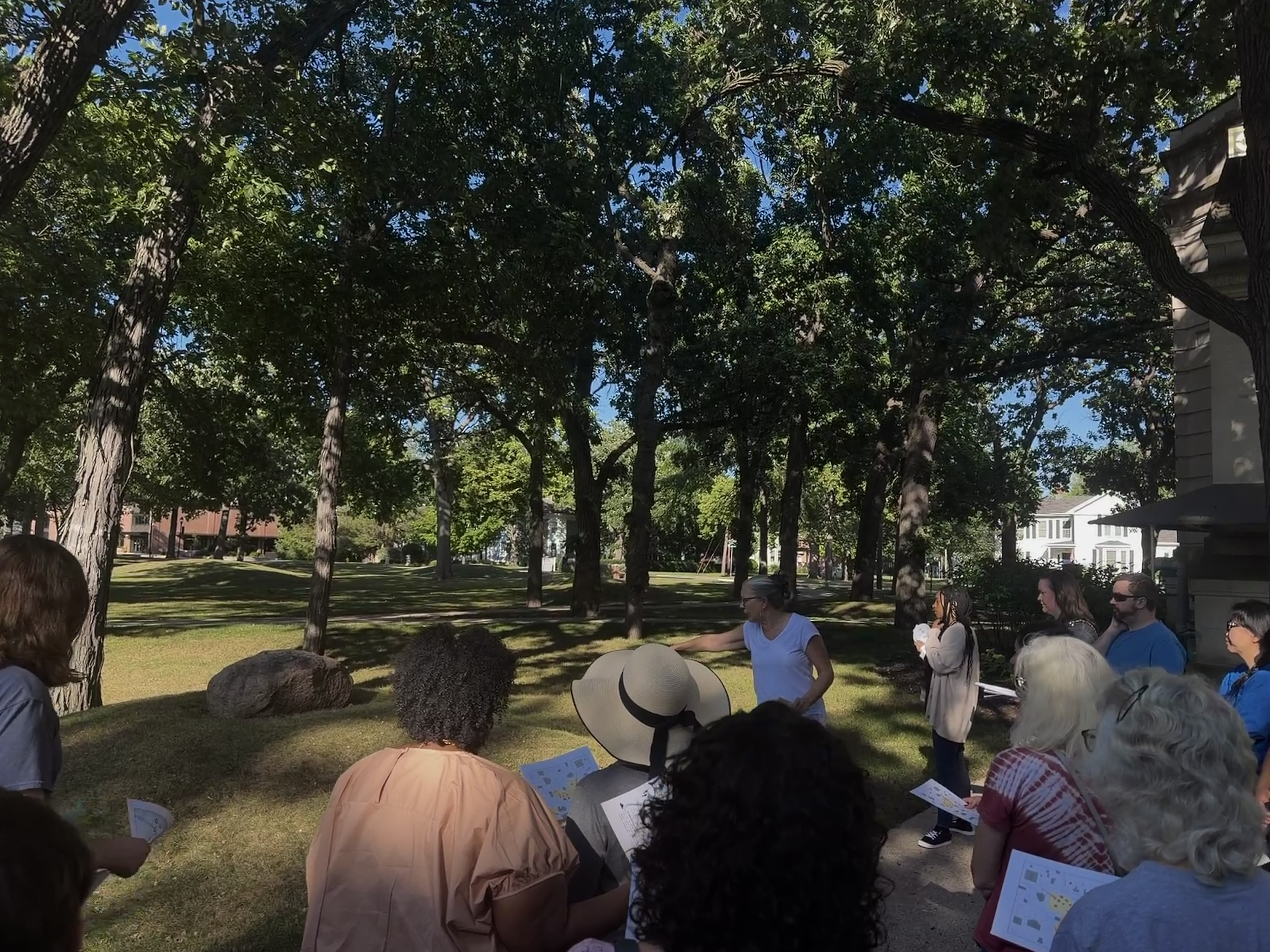
On Friday, Sept. 11, Professor Shannon Fie led a walking tour of the Beloit College Mounds in collaboration with Beloit Heritage Days.
The Beloit College mound group, which dates back to 400 CE, consists of 20 mounds across campus and is recognized as a formal cemetery protected by state and federal laws. Fie, who has been on campus since 2002, takes on the role of educating staff and students on the long and growing history of the mounds.
Over 40 people gathered for the walking tour, including students, professors, and Beloit locals and families. When asked why she chose to come to the tour, student Armita Aghamiri’28 said in her role as student ambassador for admissions, “The one part I always get questions about is the mounds.”
Teresa Oldenburg, a coordinator and volunteer for Beloit Heritage Days, said there was no mound tour last year for Beloit Heritage Days, “but they have [been offered] periodically, so it’s kind of nice to offer something new and different and bring it back.”
The group left from the Logan Museum of Anthropology at 4:30 p.m. under clear, sunny skies. Fie guided visitors through what is known about the builders of the mounds, the history of the college’s use of them, and its current effort to preserve and protect the mounds.
In the early 1800s, efforts to document monuments across the eastern U.S. led Wisconsin to build its own collection of data. The first map of the mounds was created in 1852, and included 19 mounds.
When settlers discovered them in the 1800s, many mounds were excavated as a training tool for researchers and students. Many of the protections surrounding the mounds did not go into effect until the early 2000s. Professor Fie states these protections have “caused a lot of challenge, given that the college grew up around these mounds.”
Fie continued, “The protected area of the cemetery has fiber optics, sewer, and sidewalks — all of it.” To do any maintenance or work within the protected region, contained mostly around Middle College, the college is required to put in a request with the state of Wisconsin. The request then goes to a list of interested parties, which include the Ho-Chunk. “We have a very good track record of working in the mounds since the protections have come into place,” said Fie.
As the tour approached mound 23, Fie shared that last June, a car entered the mound group in front of Middle College. The car drove straight down Chapin Street, blowing its tires on the curb. It then became airborne over the mound, flipping multiple times. It was later removed. Students were not on campus and were not notified of the event, although campus security contacted Professor Fie. A report of the damage was documented; Fie contacted the Ho-Chunk Tribal Historic Preservation Officer with a possible plan to put dirt back on the mound and reseed the damaged area, which was met with approval.
Students continue to play a role in research and education about the mounds. The Campus Mound Sustainability and Advocacy Initiative, or CMSAI, is a student organization focused on raising awareness and protecting the mound groups. “Our main job is to make sure that students are educated about the mounds [and to] make sure that there is proper awareness,” said Vice President Colby Bern‘27. Bern said that after a less active past year, the club is “trying to get much more back into the swing of things.”
CMSAI is developing a research project to learn more about the significance and possible removal of a rock placed on mound 15, located near the World Affairs Center. The club is also preparing for Beloiter Days and plans to put up signs, hand out pamphlets, and inform alumni about the significance of the mounds and the protections in place for them.
Many alumni have a different relationship with the mounds than current students, who have been taught to avoid walking and sitting on them. Fie explained this shift came around 2017 with investments in the Critical Identity Studies Program, growing sustainability practices on campus, and interest from anthropology students.
After the hour-long tour, many stayed and asked questions related to the mounds and other Heritage Day events. When asked her thoughts on the tour, Kate Mann’27 said, “This walking tour of our mounds is a great example of why I’ve started saying yes to new experiences, and as a result, I got to deepen my understanding of Beloit and our community.”
To find out more about the mounds, visit the Logan Museum of Anthropology, reach out to the Campus Mounds Sustainability and Advocacy Initiative, or talk to faculty in the anthropology department. Students can also access a wealth of information about the mounds including publications, investigations, and site stewardship through an open Moodle course called “Campus Archaeology.”
Featured image: Bethany Yu’27

Leave a Reply