

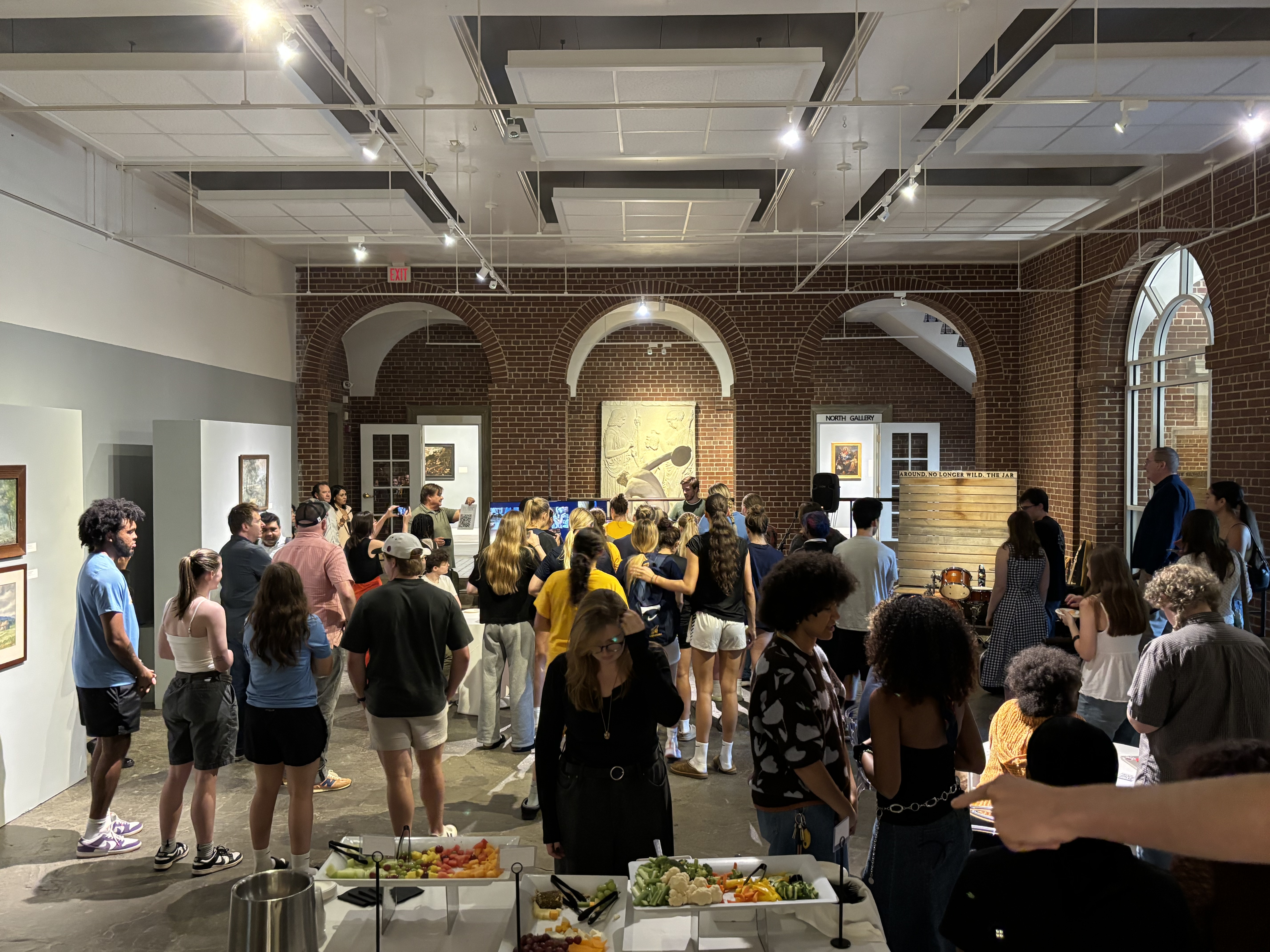
On Thursday, Sept. 10, the Wright Museum hosted a celebration of art and music to celebrate the opening of this fall semester’s art exhibits. The event included three musical acts starring media and arts professor and director Dr. Cullyn Murphy, acoustic guitar duo J. D. Shoniker‘29 and Sophia Corley‘29, and the rock ‘n roll band Gutter Trash.
Before the main event began, a short reception was held to allow attendees to explore the art galleries within the museum, as well as socialize with the other attendees. During this time, Dr. Murphy provided insight toward the ethos of this gathering. “We have three musical acts, performing 10-15 minute sets in a surprising and new location,” he said. For this semester, Murphy hoped to bring together visual and audible art in a shared space. “We include a wider variety of our music community, as well as faculty that you’d be surprised to know also do music.” Later on, during his set, Murphy brought in instructor and curator Christa Story to provide vocals. Their work together encapsulated the desire behind the event: to combine and uplift both art and music.
Dr. Murphy himself composed a unique, dreamy style of music. What he reductively called “sad boy computer music” was an intricate and variable pattern of sounds that provoked strong feelings of loneliness and loss. He played three songs: “Flash” by 2Hollis, “Archie, Marry Me” by Alvvays, and “One for Sorrow, Two for Joni Jones” by The Japanese House. Murphy created a special computer program that made it so each rendition of a melody would never be exactly like the previous one. It is a testament to his creative ingenuity, and a fine example of modern artists finding new ways to push boundaries and explore the depths of their medium.
Next up was an illustrious guitar duo. Two sophomores, both athletes, had refined their talents in the last year to perform together at the museum. Hockey player J. D. Shoniker‘29 played lead guitar and sang backup, while basketball player Sophia Corley‘29 led voice and strummed rhythm. They were the highlight of the night, as their chemistry boiled over in explosive harmony in songs like “Home” by Edward Sharp. Corley’s rich voice was heard clearly in the normally echoey halls of the museum, and Shoniker’s overdriven solos were as fun as they were emotionally resonant.
Wondrous things happen by chance, as they say — something the duo discovered themselves their freshman year. “A friend just introduced me to J. D., and I just happened to mention I was going to play guitar later that day,” said Corley. “He mentioned how played guitar too, and later that week I just happened to be playing in the Powerhouse and ran into him while he was playing grocery bingo. It was just fate, really. After that, we started to come together once or twice a week to play.” The duo had a shared interest in folk and country artists like Noah Kahan, and have since been able to uplift each other and their talents to new heights. “It’s been a lot of fun doing this with Sophia,” said Shoniker. “We’re going to be doing this a long time.” The pair currently have no future events planned, but they can often be found practicing at the gazebo.
The last set was a powerful and exciting act by Beloit’s rock ‘n roll group Gutter Trash. Described as “a ship of Theseus of a band” by Dr. Murphy, the group has seen the coming and going of several musicians, with rhythm guitarist Jasmine Kingsbury being the only founding member. You’d be forgiven to not have realized this on Thursday night, as the band came together with reverent integrity. The audience moved rhythmically with their rendition of “Suck My Kiss” by the Red Hot Chili Peppers, with lead singer Katelyn Shroeder bringing an ecstatic energy to the room. They also performed “Birds of a Feather” by Billie Eilish, and “Louie Louie” by Richard Betty. The power exhibited by the drums and bass guitar were only matched by the tantalizing melodies of the lead guitar. Gutter Trash performed an exceptional set last Thursday night, and will surely make their presence known on campus again in the near future.
The whole show, and the preceding reception, were broadcast live to a television screen in the museum. Attendees were encouraged to scan a QR code to use their phone as a video camera to join the broadcast. Visiting Instructor of Media Studies Mats Rudels patrolled the event, using his phone as the main camera. When asked about this peculiar set, Rudels said, “I’m looking for people to be involved. Especially today, everyone is filming everywhere, but is some really watching? I go to a concert and see 50 people filming it, looking at the screen instead of actually being there in reality. This is a reflection of that. We all have cameras here, but is anyone looking? Does anyone care anymore? Those are the questions I’m trying to raise.”
This concern ultimately led Rudels to keep the video as a live broadcast, not to be saved as a recording anywhere. “This live event is just existing here and now. After this, it’s gone, and it will never be seen again. The art, the live music, is about being there, and nowadays people are forgetting how to participate.” By designing the set this way, Rudels confronts students on how they engage with art, and offers insight as to how it can energize the mind in ways it couldn’t before. The set, along with the entire exhibition, is a thesis on new ways art is challenging thinking and pushing boundaries in the modern era. To this end, the Wright Museum is an exemplary home for such ideas that define the liberal arts project.
This exhibition was, of course, in ceremony to three new exhibits opening in the Wright Museum. “Looking Forward / Reaching Back: The European Painting Collection Revisited” is a series of paintings depicting historic and pastoral scenes from Europe’s past. Several works have not been on display for decades, lending intrigue to how the cultural perceptions of such work change over time. “Source Material: Tyanna J. Buie,” meanwhile, is a deep-dive into the intricacies of modern art design with an emphasis on the formation of identity through childhood and cultural experience. Lastly, “Woven & Embroidered Identities: Fashions from China’s Last Dynasty” is another fantastical exploration of culture and identity, this time focusing on the contextual narrative of high fashion in Imperial China. For the historically inclined, it is a wonderful set with great levels of detail and even greater mysteries. Each exhibit offers a great deal of profundity to those interested. As such, the Wright Museum encourages everyone to visit this fall semester. If you are so inclined, be sure to stop by!

Leave a Reply