

The September exhibits at the Beloit Art Center prompt questions surrounding human relationships with nature, environmental destruction, and the possibility of renewal.
Every month, The Beloit Art Center presents new exhibits with free admission, giving community members an accessible place to engage with art. This month, the Center features Midwest-based artist Jeanne Garrett’s “The Charcoal Forest” and Beloit-born, Milwaukee-based artist Em Johns’s “Surface Value”.
The full title of Garrett’s exhibit, in the Sveum Gallery, is: “The Charcoal Forest, Nature’s Narrative of Rebirth and Renewal.” Garrett’s work includes pigment prints, silk murals, and photographic imagery capturing the aftermath of controlled burns and natural wildfires. Some piece titles specifically name locations like Bryce Canyon, Bighorn, Mojave Desert, and the Grand Canyon while others remain more vague.
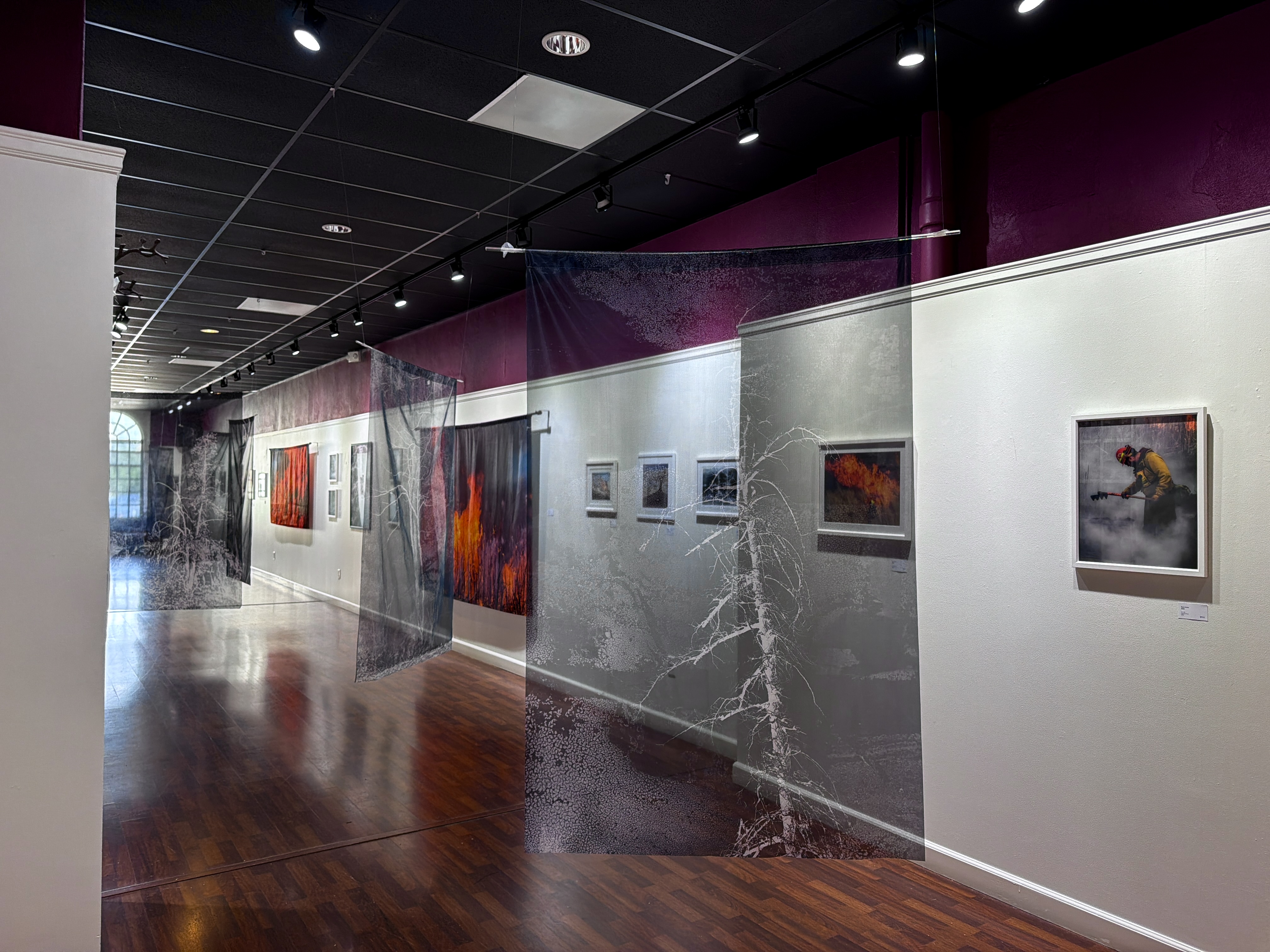
Directly under the title of the exhibit is a piece called “The Stillness After,” which depicts a fog-filled forest after a fire. Walking through the gallery there is a consuming feeling of stillness. Black and white silks hang throughout the center of the gallery, making it seem as though the room is suspended in time.
The exhibit’s biggest pops of color come from silk murals of bright orange flames that line the gallery walls. Walking between the semi-transparent silks, viewers are able to see multiple phases of a forest fire at the same time. The pieces create an environment where visitors are surrounded by the destruction caused by fire.
Some other titles of Garrett’s pieces include “Raging Flames,” “Gold Among the Ashes,” and “Light Overcoming.” In these pieces, Garrett presents fire as both destructive and as part of a larger cycle of change.
Em Johns’ exhibit “Surface Value” is in the Bell Gallery. Johns earned a BFA in Studio Art from UW-Milwaukee. Their work focuses on the role of human activity in the depletion and alteration of Earth’s resources.
Johns’ artwork uses acrylic on 10” x 10”, canvas-wrapped panels lined up in orderly rows. The open space and simplicity of the arrangement strongly contrasts the immersive experience of Garrett’s exhibit. In the Bell gallery, visitors can slow down, focus on details, and appreciate the differences and continuity between each section of the work.
Johns’ exhibit is divided into three parts: Roadways, Farmland, and Soil. Each section explores a different way humans interact with the earth. A binder accompanying the exhibit describes Johns’ series as “the epitome of our flawed and destructive capitalist system,” (Beloit Art Center).
The “Roadway” section focuses on how roads and highways dominate the American landscape “due to factors such as population growth, mass industrialization, and increased commerce,” (Beloit Art Center). The paintings make the familiar sight of a highway worth stopping to examine.
In the “Farmland” section, Johns draws inspiration from patterns found in the American agricultural landscape. According to the exhibit materials, the paintings also serve as “an ode to the barn quilts traditionally used to decorate family-owned farms.”
Finally, the “Soil” section uses plants native to Wisconsin on a faux-soil texture to draw attention to the ways humans shape the landscape and ecosystem. Johns lists the names of these plants in the exhibit material binder as well.
The two exhibits, “The Charcoal Forest…” and “Surface Value,” will be open through September 24. Next month, the center’s featured art will be from The Wisconsin Regional Art Program (WRAP). WRAP encourages non-professional artists to exhibit their work and is a regular part of the Beloit Art Center’s yearly calendar.
For more information on upcoming events and exhibits at the center, readers can visit beloitartcenter.com.

Leave a Reply