

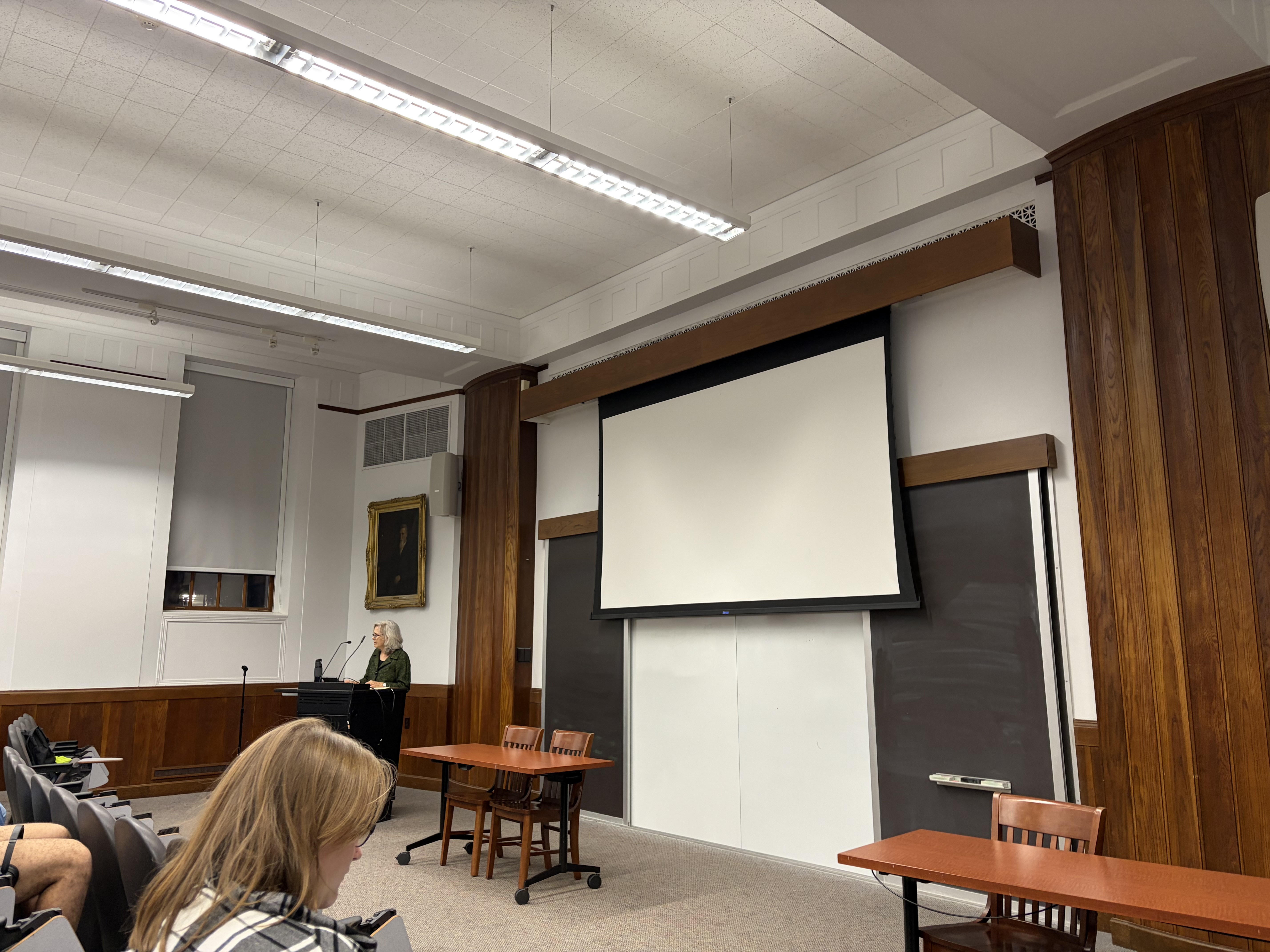
The annual Harry Davis lecture took place in Richardson Auditorium at 7:00 p.m. Friday, Sept. 18. This year’s guest, Sharon Krause, is the William R. Kenan, Jr. University Professor of Political Science at Brown University. Her research focuses on a broad range of topics under the umbrella of political theory, including classical and neo-liberalism, social inequality, and, more recently, climate change. The subject of the lecture was Krause’s 2023 Clay Morgan Prize-winning book, Eco-Emancipation: An Earthly Politics of Freedom, the goal of which being to reveal and hopefully exorcise “…the specter of a domination that shapes every aspect of our lives while being virtually invisible to us,” namely the exploitation of nature by human beings.
Before the event, five students had the opportunity to have dinner with Krause at Zen Sushi downtown. Accompanying the students were professors Pablo Toral and Gregory Koutnik from the Political Science department as well as two members of the Davis family.
Prof. Koutnik gave a warm introduction for Krause, noting how this event represents a proverbial “full circle moment”, whereby he had attended an event where she was lecturing several years ago. Koutnik also delivered a short elegy for Harry R. Davis, briefly outlining his storied tenure at Beloit College, spanning from 1948 until his retirement in 1990.
The event was well attended, drawing students, faculty, and alumni who are here for the weekend-long Beloiter Days festivities. Krause took the podium and commenced her nearly hour-long lecture by outlining the contours of her research. Eco-Domination, as Krause conceives it, derives its force from the myriad ways in which we as humans manipulate, destroy, exploit, ravage, and devastate our natural environment. Krause explains how this particular form of domination does not derive from an easily identified enemy, such as “…a political strongman or thug.” Eco-Domination enlists us all in its insidious machinations without an apparent or easy way to opt out. She begins, “If you warm your home in the winter and cool it in the summer, if your toilet is connected to a city water supply, if you wear clothes, you are a participant.” However, she notes that not all of us participate equally or in the same ways. She cites an interview with climate scholar and activist Naomi Klein, explaining, “You, me and Exxon (Mobile) are not all in it together,” referencing unequal contributions of fault across geographical and socio-economic strata.
Further, she critiques notions of personal sovereignty and human exceptionalism which serve to ideologically underpin the material practices of oppression which we doubly enact on nature and ourselves. Rejecting Lockean ideals of individualism and classical liberalism’s insistence on private sovereignty, Krause advocates a view of agency which is distributed, interpersonal, and intracorporeal. She stresses the necessity of community reliance, highlighting the “…material circuitry of agency” which serves to undermine outdated notions of sovereignty.
She also points out how domination need not mean unlimited control. Krause asks us to “Think of the despots depicted by Plato or Montesquieu, whose anxious efforts to master their subjects leave the despots themselves desperate and dispirited because perfect control perpetually eludes their grasp. Domination is about power that lacks effective institutional constraints, not about perfect control.” Utilizing this framework allowed Krause to diagnose what she believes to be causing contemporary malaise.
Despite the narratives of damage, oppression, and extinction, Krause makes sure to highlight the victories and success stories as well. She discusses the Kenyan Green Belt Movement, a grassroots organization that seeks to empower women, combat deforestation, and advocate for human rights. The GBM has gained international prestige for its groundbreaking work in the aforementioned fields, and represents a major force for global transformation, or, as Krause would have it, emancipation. Another example she utilizes is the green infrastructure of Soweto. Soweto is a township in Johannesburg, South Africa, and has garnered attention recently for implementing climate-resilient infrastructure in a way meant to meet economic goals whilst remaining sustainable. This means ecological restoration, urban agriculture, and targeted community investments. By underscoring positive developments against the overwhelming breadth of violence and horror, Krause seeks to show that the future we are heading towards need not be the future we live in.
She ends the lecture by reflecting on the current international climate regime. While some critique the mechanisms in place to protect the climate as not enough, needing a complete overhaul in order to work. Yet Krause is cautiously optimistic. She says, in response to such critics, “Even when rights seem to fail, animal and earth rights are often the catalyst for resistance and change… While it’s true that rights are imperfect mechanisms… they are also necessary.” She advocates for robust institutional mechanisms to uphold the ideal of what she terms a “political respect for nature,” a new paradigm that moves away from modern political philosophy and into an age where the rights of nature are just as important as the rights we apply to ourselves. Krause concludes with an uplifting sentiment: “The rules we make are always threatened, in danger of being overturned. Yet they persist, and we can too.”
Before departing, she took the time to field some audience questions, encompassing a diverse array of commentary, inquiries, and expressions of appreciation.
Featured image: Ethan Cooper’27

Leave a Reply