

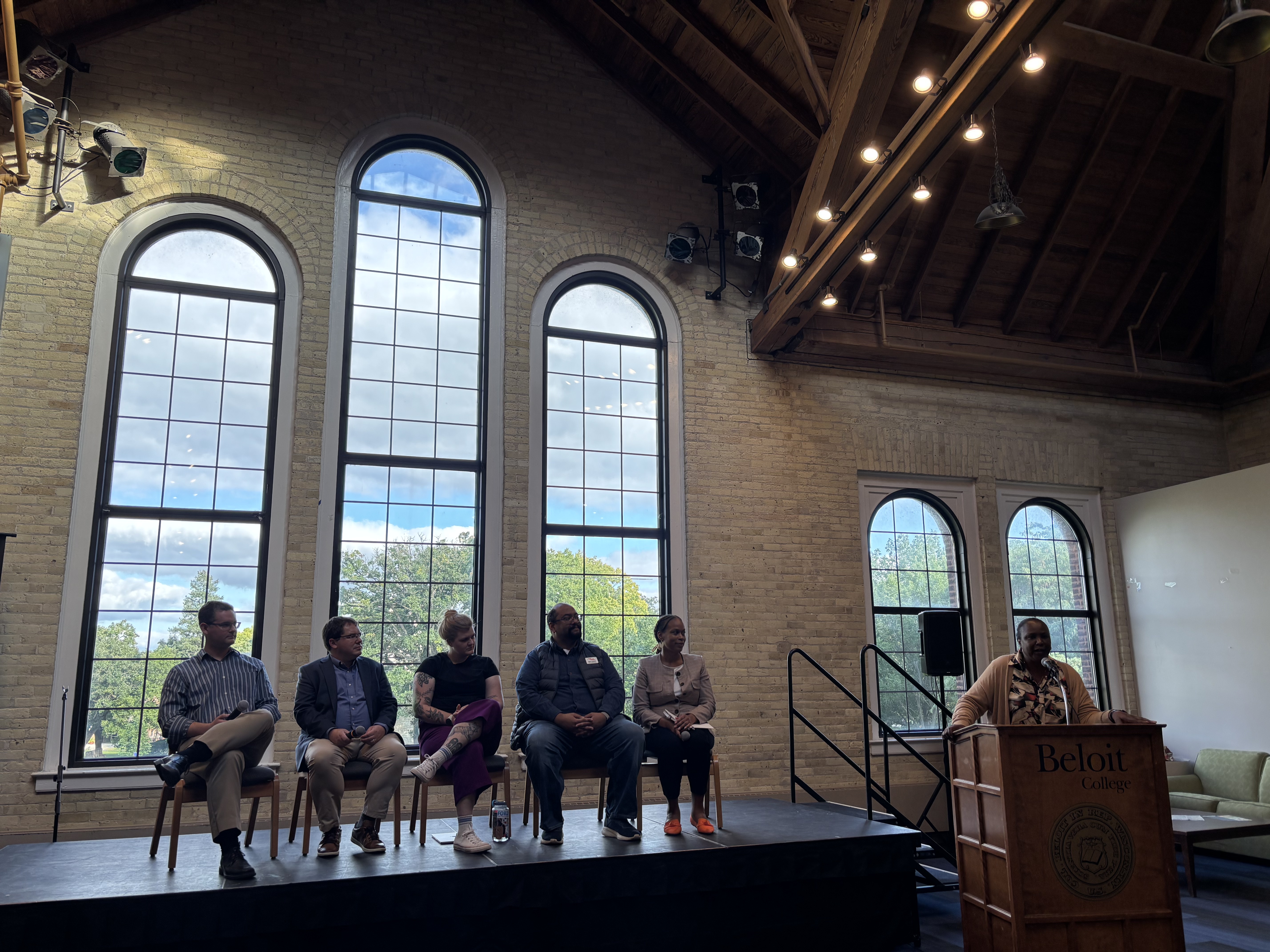
This year’s Ousley Scholar-in-Residence, Beloit Alum Jasmine Nears’09, led a panel discussion in Moore Lounge Wednesday, Sept. 23, followed the next day by a Keynote address at 7:00 p.m. in the Weissberg Theater. Nears is presently serving as Chief of Staff at America Votes, a national organization working with over 400 organizations across the U.S with the mandate to increase access to voting rights and civic engagement. She has been involved in some of the most important elections in recent history, coordinating strategies and building coalitions. At both events, she gathered students and staff together to discuss the state of our nation and the future of democracy. Nears believes that thoughtful engagement and fair deliberation are the keys to a healthy democracy. She stresses the importance that democracy is a team effort, and a task that can be exercised daily, using the proper methods. History is fluctuating, and Nears believes we must meet people’s needs, and grow our community in order to secure a more perfect future.
After Beloit, Nears got her Masters degree in Public Administration at NYU, and joined Everytown for Gun Safety, before eventually joining America Votes, where she has continued to work for eight years. She notes how important it was for everyone to understand each other’s needs, especially when surrounded by so many experienced and passionate people. This sentiment was echoed at the panel, where civic discussion took place with these thoughts in mind.
The panel, titled “Paths to Power: The Future of American Democracy”, was joined by Political science faculty Gregory Koutnik and Klara Fredriksson, as well as state senator Mark Spreitzer of Senate District 15, encompassing Beloit and Janesville, and Sam Liebert, the Wisconsin state director of voter advocacy organization All Voting is Local.
Nears moderated the panel, asking questions such as “How do you see yourself as candidates, but also practitioners in civil society, how organizations are really adapting to the changes that are already taking place to make sure that there’s an increase in civic participation?” The panelists each gave insightful answers, all lending toward their specific fields of expertise. Professor Koutnik, with his background in political theory, deliberated on the meaning of coalition building, and why people stand behind certain ideals. Mark Spreitzer discussed his experience as state senator, using it as a backdrop for his answers. Professor Fredriksson cited empirical data and historical lessons, and Liebert deliberated through his experience as a non-profit advocate. All agreed that we lived in a turning point in history, and that things can only get worse if we don’t ask the difficult questions and work with the right people. She and the panelists agreed that local governments can become “sleepy” as Spreitzer said, but there are certain issues that spur people into action. One example given at the panel was data centers, as we see more people than ever feel the need to speak out. In many ways, such issues bring people closer together.
The panel covered a wide range of topics, from money in politics to misinformation. Frederiksson discussed the reconstruction era, noting how …“it was a real period of huge expansion of enfranchisement rates for black men…suddenly, we see thousands [of black men] running for office in the South, which for the generation before would have been impossible…and we see a very quick reversal of this as soon as the north pulls out.” She notes this in reference to democratic backsliding in American history, drawing parallels between historical moments and the present. Students, faculty, and alumni also asked questions for the panelists. May Zaw‘27, asks “How do you, in your classrooms, your office, and your organizations, create safe environments, so communities who are most vulnerable feel empowered? How do you get them to open up and to have these sorts of safe conversations with you guys?” Sam Liebert and Jasmine Nears both voiced the importance of meeting people face to face, and how achieving daily functions like childcare and grocery access can encourage people to participate in their community.
This sentiment was echoed at Nears’ keynote as well. “I want to innovate. I want to prove things. I want to test assumptions, and make sure good policy actually has the impact that’s intended.” She eventually entered the field of lobbying, where she raised funds and advocated for her cause. She sought out “the right levels of influence” to make drastic changes to the legislature, but soon wished for more direct ways to make a change. “You can have all the great ideas in the world, but without the right champions in office, you can’t get too far,” Nears said. Thus, she started her journey into electoral politics.
Nears also notes how politics and cultural values can swing like a pendulum, and there are moments of rapid progress, as well as rapid fallbacks. “The fight for a more perfect union has never moved in a straight line. It’s always swinging back and forth.” Over half of the U. S. have different forms of voting restrictions and laws like the SAVE act add further restrictions. America Votes voices their chief concern: that the voter turnout is far too low, and only getting lower. Over 40% of eligible adults did not vote in 2024, a massive group that America Votes hopes to reach. Nears expresses concern about how unaware people are about the impact they can make, and wishes to show how proactive coalition building and advocacy can make a drastic difference.
If you are interested in further information on Jasmine Nears and her work, stay tuned next week for an exclusive interview.
Featured image: Alex Cambouris’27


Leave a Reply