

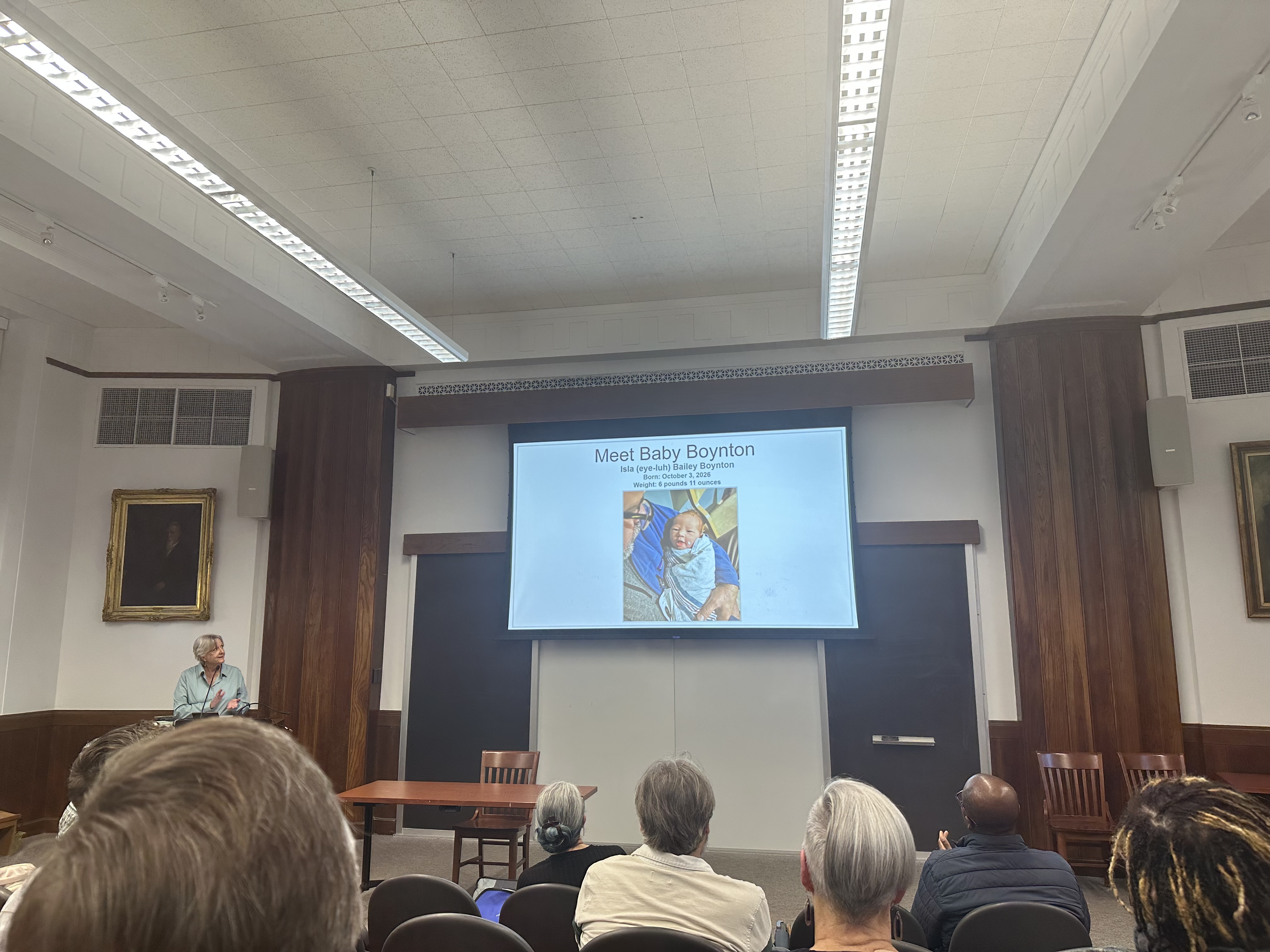
On Oct. 7, Beloit College’s faculty, staff, and student senators gathered in Richardson Auditorium for the second Academic Senate meeting of the fall semester. Provost Donna Oliver called the meeting to order. She began by asking each newly elected student senator to introduce themselves and state which senate committees they would serve on. The senate session brought with it the unveiling of the college’s new operating budget, changes to the administrative policy manual, and discussions concerning how internship and employment opportunities for international students might be affected by recent federal government initiatives.
Professor of International Relations Beth Dougherty started the committee reports phase of the meeting by presenting on behalf of the Academic Strategic Planning Committee. Dougherty said the committee “doesn’t have a whole lot to report,” but has been meeting with Beloit College President Eric Boynton again, briefly touching on the language changes to Chapter VIII of the administrative policy manual up for action later in the meeting. Associate Professor of Sociology Kate Linnenberg then delivered concise remarks when speaking on behalf of the Faculty Status and Performance Committee, stating that her committee is currently working on tenure review for eligible faculty members. Stepping up to the podium next for her Curriculum Oversight and Administration Committee presentation was Associate Professor of Spanish Amy Tibbitts, who moved to adopt eight new courses as permanent offerings and eliminate two upper-level philosophy courses, PHIL 260: Critical Philosophy of Race and PHIL 385: Colloquium in Philosophy. The changes were passed unanimously by the voting body. Tibbitts also announced that her committee approved a proposal to change the drop deadline for Advanced Mentoring Program — or AMP — courses for first-year students. Students are now prohibited from dropping an AMP class until week five of the semester.
Next was a report from the Professional and Program Development Committee delivered by Assistant Professor of Mathematics and Computer Science Katherine Harris, who highlighted projects and opportunities being pursued by faculty using funding allocated by the committee. Associate Professor of Performing and Applied Arts Gina T’ai gave an update on Academic-Athletic Initiatives in place of Professor of Anthropology and History Robert LaFleur.
After brief remarks by T’ai, Dean of Students Rongal Watson took the stage with items for action and discussion. Watson moved to approve changes to Chapter VIII of the Administrative Policy Manual regarding the function and membership of the Judicial Board. Watson expressed in his remarks that these changes were drafted to better align the language in the Administrative Policy Manual with that of the Student Handbook. The changes were approved by a unanimous vote.
Section G of Chapter VIII of the Administrative Policy Manual now states that the Judicial Board will serve as an “appeal board for eligible disciplinary decisions made by the dean of students,” excluding matters of academic dishonesty and Title IX violation appeals. The board will hear appeals questioning innocence or guilt, as well as the severity of disciplinary action taken in the case. Hearings will be staged for cases in which charges are brought by a party outside the Dean of Students office, such as a resident assistant, student, or member of the campus security force, as well as in “certain cases by the dean of students when the dean feels that they cannot provide a fair hearing for the defendant or that a community hearing is appropriate.” Members of the board are now required to be trained on the appeals process at the beginning of the fall term by a member of the Student Life team and may not hear cases until their training is complete. Regarding membership, subsection ii of section G says that the membership of the Judicial Board will consist of two student representatives, either student senators or members of Beloit Student Government, an Associate Dean of Academic Affairs, and three alternates to fill each position. The section describes the alternate process by stating that the dean of students “shall select from among these alternates when schedules preclude the permanent members from attending the hearing. The chair or dean of students may also substitute a board member if the dean determines there is a perceived conflict of interest.” It concludes with the provision that preference will be given to individuals already trained in the appeals process when selecting alternate board members.
After the item for action was passed, Watson highlighted the high energy on campus and participation from students over the first half of the fall semester. “The Powerhouse is busy, which is what we always wanted it to be,” he said.
Watson discussed how the recent, stringent federal interpretation of Curricular Practical Training, or CPT, and Optional Practical Training, or OPT, which govern internship and employment opportunities for international students with F-1 visas, might affect international students at Beloit. The interpretation now says that in order for students with F-1 visas to be able to participate in CPT, an internship must be required for all students in their major program. This could hinder international students who wish to pursue internships for credit in departments where they are not required. Additionally, the Department of Homeland Security’s new proposal for OPT would require institutions to pay $70,000 per person for the first session of OPT and $30,000 for each subsequent session. We are hopeful,” Watson said, expressing that the new policy is a proposed change and is being challenged in court. On Oct. 5, four higher education associations launched lawsuits against ICE, the Department of Homeland Security, and the Department of Justice to challenge the legality of the new CPT interpretations. Speaking about the possible outcome of the case, Watson said “We have our fingers, toes, and other body parts crossed,” in regard to the outcome of the future ruling.
Watson concluded his update by expressing that international students have “been dynamic and are dynamic” contributors to the Beloit College community, and by saying that “the notion that international students would not be a good thing for our college or our country is offensive to me.”
Following an update on faculty benefits by Director of Human Resources Michael Meteyard and Vice President for Operations and Chief Information Officer Ted Wilder, Chief Financial Officer Elizabeth Moore unveiled the college’s new operating budget for the 2026-27 fiscal year. Moore discussed how this year’s budget takes into account a decline in revenue generated by tuition this year compared to last year’s total, saying that although “we have to do more with less,” the college is still breaking even. Overall, the college is taking in $3,963,000 less in revenue compared to last year, an 8.7% decrease. Faculty salaries and benefits also decreased by 1.7% and 3.4% respectively, while the student employment budget saw a 5% increase. Through her slide presentation, Moore established priorities for budget development going forward, announcing the development of a “comprehensive strategic plan” and the enhancement of “reporting and other tools for transparency” related to the availability of budget information to those on campus.
Vice President for Enrollment Karen Schedin and President Eric Boynton were scheduled to give remarks at the meeting but could not attend. Provost Donna Oliver shared via slides that Boynton had to cancel his remarks due to the birth of his granddaughter on Oct. 3. Oliver also delivered an update from the Board of Trustees, telling the Senate that all resolutions from the previous meeting and the budget had been passed by the board. Before announcements from faculty and the meeting’s adjournment, Oliver turned things over to Registrar Yaffa Grossman, who expressed a need for more 100-level course offerings to accommodate the 299 lower-level students currently enrolled at the college. Grossman also searched for faculty volunteers to move their courses to earlier and less popular time slots, particularly on Tuesdays and Thursdays, to allow students to take required courses without scheduling conflicts.
With changes to money and policy, October’s Academic Senate meeting offered an assessment of the college’s present and an evolving template for its future institutional retooling.
Featured image: Cian McKeown’27

Leave a Reply