

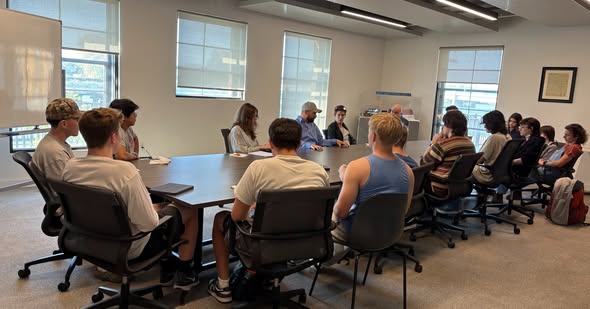
On Friday, Oct. 23, Mitchell Berman, the Democratic candidate for District 1’s House of Representatives seat, made a brief appearance in the Powerhouse’s Riverview Conference Room to sit down and have a heart-to-heart with the students of Beloit College.
Born to a working-class family in the tiny rural town of Peshtigo, Berman was a first-generation college student and ER nurse. With him still working for the Department of Veterans Affairs while on the campaign trail, Berman is a definite political outsider. However, perhaps in an effort to bring more earnest, down-to-earth politics to Washington, he has been selected by the Democratic Party to lead the charge in southern Wisconsin. His opponent is 7-year incumbent Republican Bryan Steil, and despite a staggering level of spending from both parties — just below $2 million for Berman, and over $6 million for Steil, per the Federal Election Commission — the two currently remain in total deadlock. The most recent congressional poll has Berman barely ahead, with a one-point lead. In the lead-up to election day, candidates across the country have been moving city-to-city at breakneck pace, attempting to rally their bases in these final moments and gather whatever support they can.
Democratic House member Mark Pocan, representative of Wisconsin’s 2nd district and one of Berman’s endorsements, entered first. Berman, arriving just after lunch, took an hour or so to answer a battery of questions from a group of just over a dozen concerned students. Before seating himself, he circled around the room, ensuring he shook hands with everyone in attendance, gave a short introduction and opened the forum for questions. Concerned students moved first, expressing some of their most pressing concerns. The questions below include those asked by various students present in the conference room.
“How do you feel about data centers and AI, and how they’re progressing?”
“We need to have guardrails. But then not only that, we can’t allow these private companies to try and manage themselves, because they won’t. But then we also need to have guardrails for data centers coming into our communities. For me, I’m not a fan of a [data center] moratorium, because I think a moratorium is kicking the can down the road, because what do we want at the end of that moratorium? Guardrails, and a way to hold them accountable. And so let’s just do that now. So we need to have a way to hold them accountable, make sure that they’re going to protect our land, our water, and our air, that they’re not going to pollute it … We can’t be subsidizing these billion-dollar corporations so that they can turn around and monetize what we’ve already paid for.”
“How will your election benefit the students of Beloit College and other colleges in Wisconsin’s first district? What’s your view on the cost of education, and what do you think about increasing Pell Grant rates?”
“I think we need to increase Pell Grant rates. When we talk about free, let’s remember, nothing is free. Somehow it gets paid for … I think we need to make it affordable. It used to be that if you worked a part-time job, when you were going to college, you could pay your tuition, right? And so I think that there’s ways that we could help bring down costs. Also, I think we need to look at raising wages to be able to also put more money in your pockets.”
The Round Table also asked a number of questions during the open Q&A, attempting to ascertain Berman’s political priorities, pin down specific issues, and talk about the campaign’s strategy in such a competitive district.
“If you had the opportunity to realize only one of your campaign promises during your tenure as a House Rep, what would it be?”
“Making healthcare affordable. I mean, that’s number one. Cause when we look at the overall umbrella of affordability, healthcare is such a huge piece of that, right? We are all one accident or one illness away from losing everything that you have. And I think for me, healthcare should be a human right. You should be able to afford to go to the doctor.”
“Would you vote to restrict private surveillance of Americans currently being conducted through companies like Flock Safety?”
“I don’t think we should have private companies just basically keeping an eye on you and putting it all in a database somewhere and selling it to the highest bidder. I think that’s a bad idea.”
After the Q&A had concluded, The Round Table managed to get an exclusive interview with Berman himself, where he answered a few questions.
“What are the ways you plan on engaging people who have not been engaged with the political system, people who feel disenfranchised by the lack of actual change?”
“I’m here. I think that’s what it is, showing up, it’s doing town halls, it’s having meet-and-greets. It’s coming back and talking to the constituents, talking to the people in your community about what you’re doing. Because it’s a representative job to not only go to Washington and represent you, but to also come home from Washington and tell you what they’re doing, and what’s happening there. And so when Bryan Steil disappears for a year and a half, and then only shows up around election time, he’s not doing his job.”
“I joked with somebody, I said: if you’re going to run into me at Menards– and you know, I don’t want to get an earful from somebody in the light bulb aisle, I better make sure I’m doing what I’m supposed to be doing.” Berman said he understands the frustration of young people who feel like the current systems don’t work for them — including the Democratic Party. “Let’s get off our hands, let’s take the white gloves off. Let’s get some stuff done for people, because that’s what we need right now. We don’t need to just go back to Washington and grease the wheels and go back to the status quo, because the status quo wasn’t working for us.”
“Recent widespread opposition advertisements have painted you as a danger to children, saying your presence at a school triggered a lockdown, and you had to be escorted out. How will your campaign meet these challenges to your character ahead of election day?”
“I mean, that entire campaign ad is false. And it’s being used by my opponent to basically distract and deflect from the fact that he doesn’t have a record that he can uphold and show what he’s done for folks here in the district. So he wants to talk about anything other than the fact that he’s voted to make healthcare more expensive, that he’s gutted food assistance for seniors and children in school, that he has voted to give the wealthiest people in this country the biggest tax break they’ve ever seen while adding four and a half trillion dollars to the national debt. So again, it’s just a completely false attack for him to deflect and distract from his poor record.”
“What do you think the average Wisconsinite in your district wants or needs most right now? How can you deliver on that over your opponent?”
“I think the top three things that folks are concerned about right now is affordability — cost of living right now, people are struggling with — access to affordable healthcare, and ending the corruption that’s going on in Washington. My opponent has only made those things worse, and participated in the corruption in D.C. I think that looks like repealing the blanket tariffs that are causing prices to be up for everyone at the stores. It looks like getting us out of this war in Iran, and bringing down costs at the pump. That looks like restoring the ACA subsidies, fully funding Medicaid, and offering a government option to bring down costs when people go to the doctor. And it looks like passing an actual congressional stock [trading] ban.”
Berman has been extremely critical of the current Republican government, citing rampant corruption, favoritism, and the effective selling-out of America’s younger generation through massive increases to the national debt. Talking directly to the students in attendance, he had particularly strong contempt for The Big Beautiful Bill, pushed forward by President Donald Trump and incumbent representative Bryan Steil.
“[The Big Beautiful Bill] added $4.5 trillion to the national debt, mortgaging your future, my kids’ future, and all to give tax breaks to billionaires. It really just made it permanent in the tax codes, and now, you can have somebody writing off their private jet, while you still have folks like you and teachers who can’t write off colored pencils, you know, that’re buying them for their kids in school. So to me, that’s backwards.”
Berman appears much in the same vein as other progressive, working-class democrats that have earned the nomination this year — like Donovan McKinney and Abdul Al-Sayed — that have run popular campaigns thus far. Their laser-focus on affordability, political accountability, and healthcare has granted Berman and others like him a particularly compelling narrative, speaking directly to the disenfranchised and apathetic, who have seen their lives upended by rising costs. The rise of AI, data centers, and private mass surveillance have also had significant impacts on farmers, rural communities and young progressives, all of whom have come together to form an unlikely but powerful coalition under Berman’s campaign. However, despite positive momentum in many of these campaigns, including Berman’s, the race is still neck-and-neck.
“Election day is November third,” said Democratic Rep. Mark Pocan. “Honestly, whatever you guys can do between now and then, it’s so important that we get your friends, your neighbors, and people you live with to all get out and vote. This race truly is one of the closest in the country.”
Featured image: Mitchell Berman for Congress

Leave a Reply