

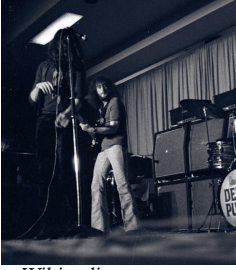
At the dawn of the 1970s, three bands emerged from England that would shape the history of rock music in that decade and beyond. Two such legendary bands, Birmingham’s Black Sabbath and London’s Led Zeppelin, have been lionized as perhaps the finest in the “classic rock” oeuvre, while the third has often been an afterthought in such a conversation.
Deep Purple’s Mark I lineup first gathered in the bucolic country village of Hertford, located 40 miles north of London, originally under the name Roundabout. Ironically this would become the title of the most-loved song of their classic rock peers Yes.
The initial lineup featured vocalist Rod Evans, stoic guitarist Ritchie Blackmore, bassist Nick Simper, classically trained virtuoso keyboardist Jon Lord, and innovative drummer Ian Paice. Despite their impressive musicianship, the group’s early work presents a mixed bag. Their two 1968 LPs, “Shades of Deep Purple” and “The Book of Taliesyn,” draw more inspiration from the psychedelia of the late sixties than from the powerful hard rock style they would later be known for.
A notable highlight from their cover-heavy early albums is a proto-heavy metal rendition of Joe South’s country hit “Hush.” In 1969, Deep Purple progressed with a self-titled album that more closely resembles their classic sound, featuring chunky organ riffs from Lord and an exploration of heavier instrumentals.
The band was trending in a hard rock direction, but Evans and Simper, being solid pop musicians, could not foresee the band’s legendary trajectory. They were dismissed from the band after the release of their self-titled album. Their replacements, bluesy vocalist Ian Gillan and rock-steady bassist Roger Glover would be the two missing pieces for Deep Purple’s ascension.
Of the three studio albums and one live album that Deep Purple released between 1970 and 1972, there is one that remains overlooked to this day within the band’s catalog. The awkward middle child of the Mark II lineup albums, 1971’s “Fireball” may be the quintet’s finest release. It should be understood that this is a bold claim. Many fans and even the casual classic rock radio listener would most certainly choose 1972’s “Machine Head” which is practically a greatest hits album, or “Made In Japan” released the same year, often considered one of the finest live recordings in rock history. However, no other album showcases the band’s versatility, musicianship, and songwriting better than “Fireball.”
Opening with sound effects that sound like they were plucked straight from the original “Star Trek” series, the title track and album opener quickly descends into speedy and propulsive runs by drummer Ian Paice. Lead singer Ian Gillan’s voice also fluctuates between a hoarse heavy metal shriek and a soulful croon throughout. This straight-ahead rocker ignites the record nicely.
“No No No” is another stuttering bluesy jam, where Blackmore gets to fully showcase some of his subtle guitar mastery. Despite admittedly dim-witted lyrics, “Strange Kind of Woman” is a staple of the band’s live act, containing some of Jon Lord’s most cacophonous and powerful work on the Hammond B3 Organ.
After three blistering rockers, the album slows down with “Anyone’s Daughter” a singular composition in the Deep Purple’s discography. A lilting and achingly beautiful countrified Blackmore riff guides the listener into a tale of a town rascal. Gillan narrates the comical story of the protagonist shacking up with the daughters of the farmer, the sheriff, and the judge in a small town, delivering the odd farce with enough sincerity to make the lyrics seem genuinely melancholic.
The band continues to showcase the malleability of their sound by dipping back into psychedelia with the frenzied head trip that is “The Mule.” This song serves as an acid-tinged homage to the band just a few years earlier, featuring Gillan’s slightly altered vocals, Paice’s Ginger Baker-esque drumming, and the stoned poetry of the lyrics. Blackmore also gets to unleash a transcendent, spiraling, trance-like solo around the three-minute mark.
Following the inoffensive yet unremarkable jam “Fools,” the album concludes with the melodic yet heavy “No One Came.” Infused with the band’s signature English irony, the song chugs along behind an all-time riff by Jon Lord as each member of the band takes turns demonstrating why they are among the best musicians in rock history.
“Fireball” finds Deep Purple amid an imperial run of albums, exemplifying their best traits. The quintet is loose, funky, cheeky, bluesy, and blisteringly rocking. With “Fireball” they manage to construct a record that has the depth to be a truly great rock album, yet doesn’t take itself too seriously. Although the lack of appreciation for the release in regards to the band’s others from this era makes sense, it is simply misguided to ignore the greatness of “Fireball” in 2026.

Leave a Reply