

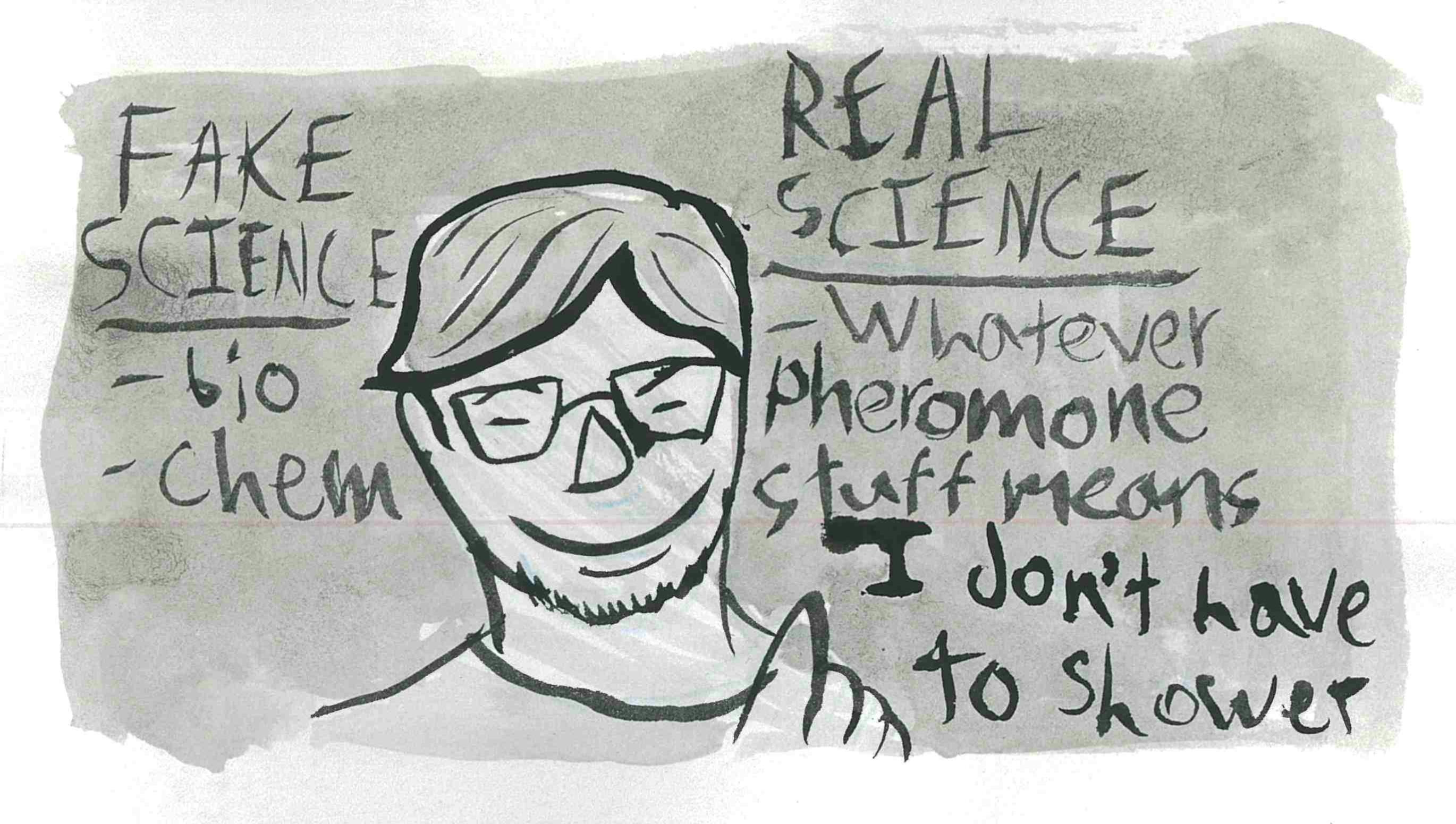
First, a preface: I am, among other things, a psychology student — as such, I can only speak from where I stand. Psychology has gone through several evolutions over the decades, including periods where it was neither standardized nor held to the standard of rigor we adhere to today. These impacts were often devastating for people whose mental illness was not properly understood.
Lately, I’ve been hearing a lot of chatter about “soft sciences.” From my professors, some of whom have begun starting research classes by talking about how the standards of study are different but just as stringent as they might be in other classes; from my friends, biology, geology, anthropology students, who are being told with increasing frequency that their fields of study “don’t count” when the topic of academia comes to the forefront; and from people speaking directly to me, whether they be business, math, chemistry, finance majors, whether they are classmates or coworkers or family: “that’s all soft sciences though, that’s not useful.”
So, what are “soft” and “hard” sciences? Nobody really seems to know.
I’ve searched in-person and online and gotten as many different answers as people: “hard sciences” include more math, they’re more scientific, they deal with completely controlled variables, they’re the ones in STEM (an answer I found particularly baffling).
“Soft sciences” are about politics, religion, education, they deal with people, they’re not rigorous, they’re the “easy ones.” Ask people whether or not they think anthropology is a science next time you’d like to hear some of the weirdest qualifiers for what, exactly, counts as “scientific process,” or who’s a “scientist” at all.
In short, this infuriates me. “Hard” sciences, by these metrics, should only include math, physics, and maybe — according to some nineteenth-century views on the topic — astronomy. But, as opposed to psychology, very few people will argue that geology doesn’t belong in Beloit’s Science Center because “it’s just guesswork,” although geology doesn’t deal with completely “controlled variables,” and there’s just as much chemistry involved in neurotransmitters as there is in the composition of rocks. Hard sciences don’t mean “tougher,” except maybe on the individual level (everyone has had one required class they absolutely suck ass at. If you haven’t had this class yet, you’re either a liar or you’ve got a big storm coming).
Instead, it seems like what people have started to mean by “soft science” is not a “social science,” but “less rigorous.” The creeping implication seems to be “a field where women outnumber men.” Gender discrimination in scientific fields is as old as any scientific field itself, sure, but social sciences might be one of the few scientific spheres where women are currently estimated to outnumber men by a pretty wide margin. From my own personal experience, I’m inclined to agree: psychology classes I’ve taken here are overwhelmingly female, as opposed to other classes in subjects like chemistry or biology, where the split seems (roughly) even.
Men do well in a field? It must be because they work hard. Women do well in a field? It must be because the field isn’t that difficult. I am sick to death of this narrative, outside and inside academia (look at what’s considered a “sport” or not, or how female divisions of those sports are treated, including by the president of the United States, and get back to me). At a time when over half of college students nationwide report having mental health struggles, according to a survey commissioned by UnitedHealthcare, and ancient DNA is being extracted from cave paintings, when social sciences touch literally every part of our lives, it seems unbelievably small-minded to declare that none of those fields matter, or that the people who dedicate their lives to them — yes, even women, gasp — are simply less worthy of academic acclaim.
You do not have the option of living in a world without the benefits of “the soft sciences,” and I am willing to bet none of you would want to.
Featured image: Betty Cavicchia’28

Leave a Reply