

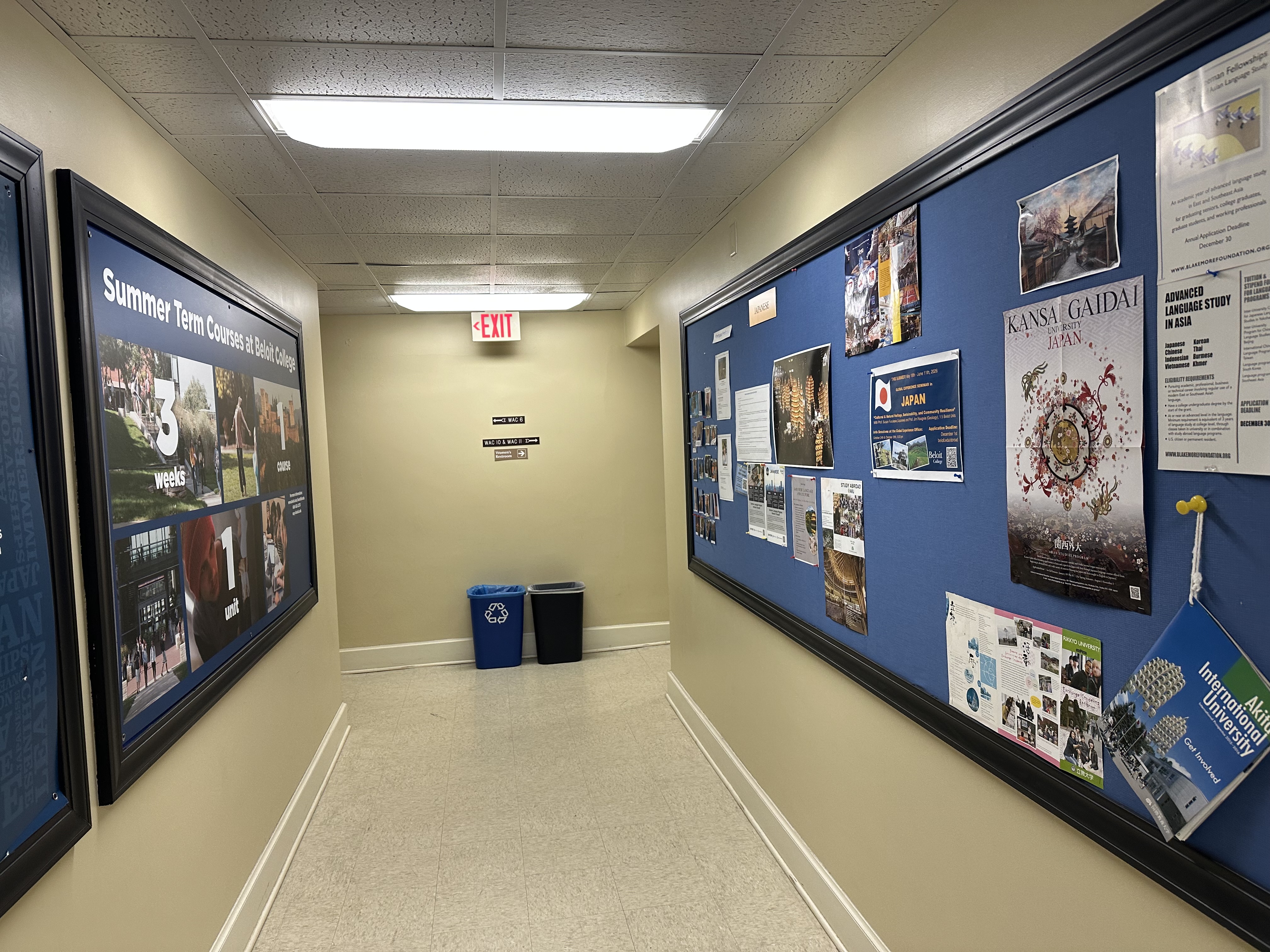
Beloit College’s Academic Senate officially adopted a proposal to eliminate the Japanese major and minor at a Nov. 4 meeting.
While the dissolution of the major was made official at the meeting, the proposal was finalized by faculty at the beginning of the 2026 spring semester. On the decision coinciding with her semester-long sabbatical, which she will return from in January, head of the Japanese Program and Professor of Japanese Susan Furukawa said, “The timing was unfortunate because since I’m not on campus, I didn’t have the chance to talk students through what was coming.” Furukawa said she wanted to be able to express to students in person that the end of “one of the stronger Japanese programs at a small liberal arts college” is “obviously not something that I want.” However, to benefit incoming students, the decision was made to move forward with the proposal this semester. “You want to make sure students know what’s happening, and in that sense, getting it done quicker is better than dragging it out,” Furukawa said.
“In general, students aren’t taking languages like they used to,” Furukawa said. She cited factors like a decreased emphasis on internationalism, fewer opportunities for students to take Japanese in high school, and the prevalence of large language models like ChatGPT leading to, as Furukawa put it, “people not really understanding the importance of the process of learning a language.”
Systemic problems of the decline of Japanese language education have manifested themselves at Beloit College, with lower class sizes for Japanese courses overall being a major contributing factor toward the decision to cut the major and minor. “Unfortunately, if you have a limited number of resources, those resources have to be allocated where student interest is pointing, and currently there are not as many students enrolling in language courses compared to say, business,” Furukawa said. The 12 current Japanese majors and eight minors will have the opportunity to complete their degrees.
Retention of students from introductory Japanese courses into intermediate and advanced language courses has also proved to be difficult. “Japanese has its work cut out for it,” Furukawa said, “because it’s really hard.” The U.S. State Department’s website classifies Japanese as a “category IV” language — one that is “exceptionally difficult for native English speakers. According to Furukawa, 40% of first-year Japanese students do not continue into a second year of language study. Students in the program also reported experiencing class sizes consistently below nine students beyond first and second-year Japanese language courses.
However, Furukawa expressed that students who clear this threshold tend to commit to the full four-year Japanese language program. “The goal has been to develop strong speakers and readers of Japanese by the time they graduate, which is very difficult to do in four years,” Furukawa said. According to Furukawa, students are given the basics of the language in the first two years and are helped in applying it when they are upperclassmen. Furukawa said her goal has been to enable students to leave Beloit College feeling able to use their Japanese language skills. This application can take many forms in the work of students, from museum exhibits to translations of literature and poetry. The program also afforded summer study opportunities for students to study in Japan. Students from the program have used their training to pursue post-graduate education or opportunities in the business sector to apply their language education.
Anna King’27, a Japanese major and member of Japan Club, shared that the major has allowed her and her fellow scholars to study abroad in Japan, which King described as a “life-changing experience” that was facilitated by courses taken in the Japanese program. “Learning a language uses your brain in a completely different way, and exploring a culture that is far different from your own changes the way you think and interact with people,” King said. Currently, a Beloit College student must complete two years of language study before they can study abroad in Japan.
Advanced courses in Japanese also prepared students for the cultural and social customs of Japan. “If you know Japanese, you have such a deeper understanding of the country than if you just show up and only speak English as a tourist,” said M Aman’27.
On the personal and communal impact of the loss of the program and the decrease in language study, Aman said, “I have a really deep love of languages, and seeing every language department get picked off year-by-year is so disappointing to me.”
King also spoke about the tightness of the small community of language scholars that she developed over the course of her studies at Beloit. “I feel like we were really bonded because we were so small, so it’s also sad for me to lose the program because I made some really good friends through it,” she said.
King said, “The soul of the program does still live on through Japan Club.” Aman and King said Japan Club’s activities will not be affected by the dissolution of the Japanese major. “We’re going to keep spreading Japanese culture across campus; we’re going to keep holding events like we usually do,” Aman said.
Though she is the head of the Japanese Program, Furukawa teaches courses in a variety of different disciplines at the college, from literature to history to media studies to environmental studies. This includes both language courses and literature and media studies courses in translation. “For me, teaching language is very different than teaching a translation course, so I get to use different parts of my brain and different parts of my skill set,” Furukawa said. The experience of teaching a language, she said, is much more logical and systematic, while still requiring her to bring humor, energy, and enthusiasm to keep students engaged.
In non-language courses, the discussions are analytical and based around close reading. With a research background in Japanese historical fiction, Furukawa said, “I have loved being able to do both.” With the elimination of the program, Furukawa said that “the overall richness of my teaching experience will change. I’ll adjust; it will be okay. I’ll still teach great classes because that’s what I want to do for students.” She said that to her, students remain the most important aspect of her work. “For me, the students are the most important, so I will continue to do whatever I can to reach as many students as I can.”
While looking forward to future opportunities to connect with students interested in Japanese culture, Furukawa admitted that “it’s hard to see [the Japanese program] go because I’ve put so much time and effort into building it.”
Featured image: Cian McKeown’27


Leave a Reply