

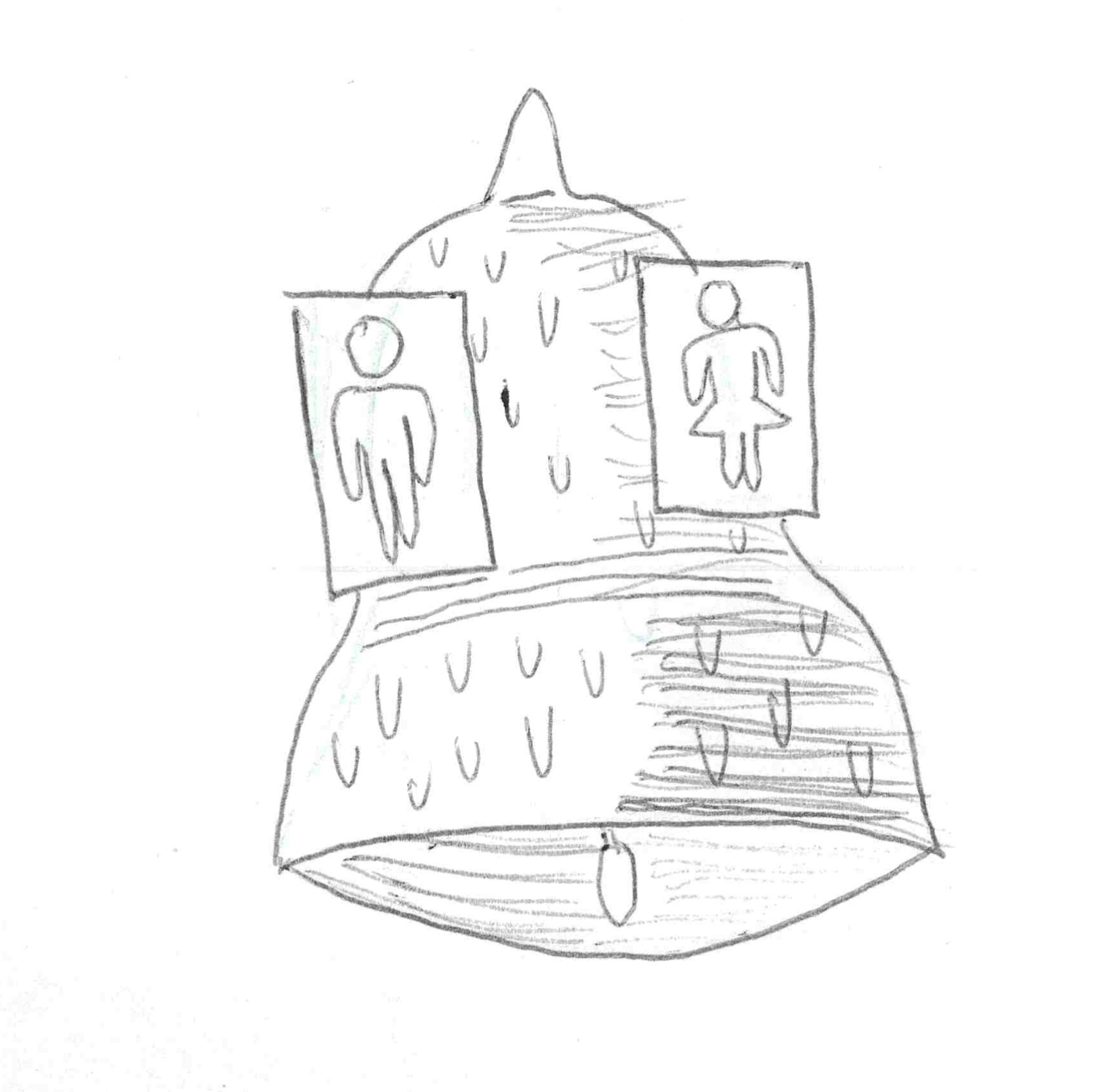
On a tiled patio behind Morse-Ingersoll Hall, a bell stands on a brick pedestal. Beneath it, a plaque reads: “That it may proclaim important campus events, we set this ancient church bell, which summoned early Beloiters to classes and to worship, in this modern senior wall.”
It’s unlikely the Class of 1950, who were responsible for moving the bell out of storage nearly eighty years ago, knew that it would become the focal point of a tradition that spanned generations of Beloit College students. It’s unlikely they knew that this tradition — the bell run — would become an enduring piece of campus mythology. And it’s unlikely they knew that, over half a century later, students would be running naked across campus to pee on the bell.
“It’s a piece of tradition at the college,” said Donaldo Robelo’27. “I would definitely say that. I would say — for what it is, you just get naked. You start at the Wall and you run down frat row. You pee on the bell and you come back.”
Robelo is the president of Omega Zeta Omicron, an on-campus social club which styles itself after a fraternity. Robelo estimated that he has done about 20 bell runs. “I think I might be at 20, maybe low 20s,” he said. “I’ve definitely slowed down just because I know my girlfriend doesn’t like when I do them. She says I’m allowed to do two more before I graduate, so I’m saving them for special occasions.”
The bell run goes as follows. Students, beginning from either the Wall or one of the Greek life houses at the college, run naked down “frat row” — meaning College Street, the long strip where the college’s fraternities and sororities are — to the bell at M-I, where they urinate on it and run back. While students often say “run” or “sprint” to refer to bell runs, typically, Robelo said, the pace is closer to a jog.
“I’d say people run it with some clothes on,” said Claire Winter’28. “But generally, if I want to be a purist about it, it’s completely naked, and you have to piss on it. I’ve seen variations where it’s like, you don’t have to go from the Wall; you go from X frat house. You go with your underpants still on. You go, but you don’t piss on it. You know, that kind of thing.”
Winter, a former member of sorority Theta Pi Gamma, said that Theta did one or two bell runs during her freshman year, but has since ended the practice. “I don’t think anyone ran naked. I think people ran in like undergarments or pajamas, and I don’t think they do that anymore, to the best of my knowledge.” She said she has not done a bell run.
Robelo described the bell run being used as a “punishment,” saying he and his friends often use it for bets. “We use it as a punishment for Madden, when we’re playing the game; ping pong,” he said. “It’s just something we like to bet with. Like if you lose, you gotta do a bell run. If you lose by this amount, the bell run.”
The majority of the people who do bell runs, Robelo said, are athletes. “Sometimes, I see some non-athletes doing it, but pretty rarely, or if they are doing it, they’re kind of hush-hush about it. I say athletes are doing it, because you hear them chanting it all the way down, like in the middle of the night, they’ll be going ‘bell run, bell run,’ and then you look out your window and you see a guy stripping down and running down the street.”
Students primarily associate it with fraternities. “I know I’ve seen Sig [Sigma Chi] do one,” said Winter. “I’ve heard of TKE [Tau Kappa Epsilon] doing several, and I think Phi Psi’s done at least one. As far as rumors go, I’ve heard that.”
Normally, according to Robelo, bell runs happen at night — though Winter said that, during her sophomore year, she saw a member of Sigma Chi doing a bell run during the day. “I saw one singular Sig member running down and doing one, and that one was completely like, middle of the afternoon, dick out,” she said. Members of the fraternity, she said, were cheering from the frat house’s front porch.
The focal point of the tradition is the bell at Morse-Ingersoll Hall, or M-I. The bell is more than a century old. According to “The Middle College Bell,” a 1951 piece by Professor Emeritus Robert K. Richardson, the bell was brought to campus in 1882 as a replacement for the bell in the cupola of Middle College — the second time the bell had been replaced in the span of two years. It remained at Middle College for 60 years until, according to The Round Table, it was removed “around 1940” while the building was being renovated.
Even early in its history, the bell was the subject of vandalism and practical jokes. “The Middle College Bell” broadly describes the bell as being the victim of “pranks” throughout its history. Two transcriptions of faculty meeting minutes held in the Beloit College archives — one from 1854 and one from 1914 — cite incidents involving the bell, described respectively as “illicit bell ringing” and “misuse of the College bell in celebrations.”
A 1962 issue of The Round Table describes how, only six years after its installation at M-I, the bell was stolen and dropped into the college’s newly-opened pool. After being retrieved by custodians, the bell remained under the bleachers for another six years before being returned to the pedestal by Round Table staff.
A 1979 issue of The Round Table also cites several incidents that occurred with the bell — including that in 1953 a group of people attempted to paint it red and that, later the same year, it was shot with a shotgun. The same article also says of the bell, “Its one function is to be rung by new Sigma Chi pledge classes.” It’s possible that this fraternity tradition might have been a precursor to the bell run.
“Bell run origins,” a piece by Buck McMorris’65 from the Beloit College archives, suggests a link between the bell run and earlier events involving nudity — including a 1949 “Strip Fight.” It argues that while the bell run may have started in fraternities, it could also be related to the presence of “naked public events” in campus culture.
Ollie Idzikowski’28 said his mom, who graduated Beloit College in 2002, recalled the bell run as coming from soccer players. “She ascribed it as being a soccer thing,” he said. “Honestly, I think it being kind of a universal campus thing, from what I’ve gathered, is only a relatively new thing. Because I don’t even know if soccer players even really do it anymore. I feel like a lot of the time it’s more fraternity guys and athletic guys.”
Peeing on the bell is likely a newer addition. “Bell run origins” quotes a 2002 alum, who makes no mention of it. (That alum also described how she “kissed” the bell, which would be a much bigger deal if students were regularly peeing on it.) A 2012 Round Table article, “Damn! That’s a Penis: A First-Year Perspective on the Bell Run,” mentions “the importance of not touching the bell,” implying that, by 2012, students had started to pee on the bell.
In a 2024 article for The Round Table, “Exploring the Existence of Rape Culture on Campus,” Jazmin Gomez’27 argues that the bell run “is an example of Beloit culture that normalizes the sexualization of women. For men, the Bell Run acts as a display of bravery and strength as society rewards the phallus or phallic imagery as symbols of power. For women, the Bell Run acts as in the intended manner, a joke.”
Idzikowski said that he believes people do bell runs for their shock value — but that people who do them otherwise view them as harmless. He said that he believes subconscious exhibitionism might play a role.
“Maybe, subconsciously, people are really getting off to it,” Idzikowski said. “That’s why I think it would be interesting to ask a sociologist, because it’s in a weird in-between in a lot of ways — because it’s not like, totally a sexual thing, but it also kind of is, maybe a little bit. I definitely think it’s chauvinistic. I think part of it’s like, ‘look at the links I got,’ because from my understanding, it is mostly boys. It’s a sausage party.”
Robelo said that campus culture has changed over time; now, the bell run is not as common. “Less people are doing bell runs,” he said. “At least freshman football, by this time, like half of our class already did bell runs. With the freshman class on the football team now, I think I’ve heard that two of them have done it, three of them have done it. I think it’s just also people aren’t just bringing them up anymore. Because they are dying.”
Robelo said that he views the bell run as an integral part of the Beloit College experience. “Just because it’s been embedded in our history so long, it’s a little upsetting when that’s just gonna go away, just because how long it’s lasted,” he said. “Talking to alumni about it, who are like — they have gray hair now, how old they are — they’re 50, 40-year-olds. And they’ve done bell runs. It’s just a long tradition that I’d be sad to see go away.”
Featured image: Betty Cavicchia’28


Leave a Reply