

By AUTUMN GREEN
TW: suicidal ideation, suicide, sexual assault, pedophilia, domestic abuse, self-mutilation, trauma, death, kidnapping, forced prostitution, amputation, depression, anxiety, body dysmorphia, child abuse, substance abuse.
*CONTAINS SPOILERS*
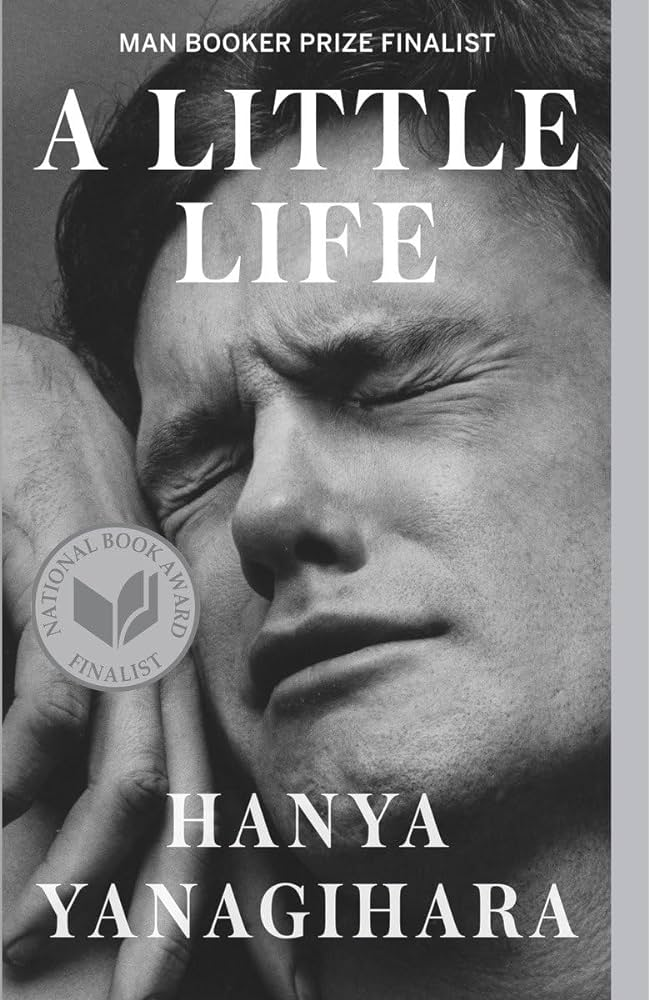
So long as you have not been living under a rock, it is likely that you have heard mutterings about Hanya Yanagihara’s ‘A Little Life.’ A behemoth of a novel, which comes in at a stiff 814 pages, ‘A Little Life’ tracks the lives of Jude St. Francis and his best friends Willem, Malcolm, and JB, from their college graduation to their 50s. Jude serves as the glue of this foursome, with each man sharing a unique dynamic with him; what dictates each dynamic is how much Jude chooses to share with each friend about his tortured past. ‘Tortured past’ could be taken as a cliched overstatement, but for Jude, this is, truly, the only way to describe the first 15 years of his life. But more on that later.
‘A Little Life’ is, unsurprisingly, a polarizing novel. Some loathe it, writing it off as trauma porn, while others – myself included – hold it in high esteem due to its stark and compassionate representation of mental illness. Initially, I picked this book up after reading on the internet that it contained every trigger possible in a novel; morbid curiosity took the reins, and I simply had to know how horrible one book’s content could possibly be. These claims were no lie; this book contains everything from child prostitution to heroin abuse to domestic abuse to kidnapping to amputation to self-mutilation. The novel even culminates in Jude’s suicide (told you there would be spoilers!), which, as you dive deeper into the novel, comes as no surprise.
While it is true that Jude’s ‘little life’ (roll credits!) has been quite nightmarish, I believe it is unfair to call his trauma unrealistic. To call ‘A Little Life’ trauma porn, too, is to completely neglect the novel’s purpose. These facts are what I will explore here, as both the traumas depicted in this novel and Jude’s realistic inability and downright refusal to cope opened my eyes to the power of human empathy. ‘A Little Life’ was an uncanny page-turner that I tore through in just under one month; I’ve never cried so much while reading! It has become my all-time favorite book, and since this statement will, undoubtedly, raise eyebrows, it is necessary that I reflect on the impact ‘A Little Life’ has had on me.
As someone who has battled depression, and, at one unfortunate point, suicidal ideation, ‘A Little Life’ provided me with a character through whom I could see myself at my worst. I am nowhere near as depressed as Jude St. Francis, but in his character, I was able to see a bit of myself and to empathize with his pain. I felt most connected to Jude in his moments of body dysmorphia, which I’ve fought with since middle school. ‘A Little Life’ is realistic in its portrayal of body dysmorphia in that even when everyone around you sees beauty in you, seeing beauty in yourself is a process that may either take a lifetime or never happen. So was the case for most of Jude’s issues in the novel; this was an ironic breath of fresh air, because it deviates from the mainstream narrative of loving yourself after finding yourself. Sometimes, we never find ourselves or love ourselves, and that is the sad truth.
Jude has a lifelong history of self-harm. He first learns to self-harm for release when he is being prostituted by Brother Luke, with whom he ran away from the monastery where he was raised as an orphan. When he takes up the compulsion, he is only 11, and he continues to engage in such behavior until his suicide at age 53. This aspect of Jude’s character opened my eyes. In both high school and college, I have seen my share of students with scars on their wrists, but I never gave the story behind the scars a second thought. In ‘A Little Life,’ Jude’s cutting is discovered by both his best friend Willem and by Harold, a former professor of Jude’s who adopts him as an adult. Willem and Harold cannot fathom Jude’s behavior; they do not know his past or the demons that haunt him at all times. Jude wears long sleeves at all times, concealing his arms, which are described as being so scarred that they feel less like skin and more like cartilage. This blew my mind; I’d never considered that self-harm is, for those like Jude, the only thing between a functional life and suicide. The issue of self-harm in our society is frequently written off as the behavior of angsting teens who will phase out of it; I, too, believed this. No such luck. There are a multitude of ways that people harm themselves to keep themselves afloat at all stages of life.
The novel’s presentation of Jude’s self-mutilation as a means of survival raises a heavy question: how do you provide help to someone who does not want it? Willem, Harold, and even Jude’s longtime doctor-turned-friend, Andy, all offer Jude options to cope with his trauma, and he refuses them all. I happen to be someone who does attend counseling sessions and who talks openly with my parents about my mental health; in short, if I need help, I recognize this, and I seek it out. But ‘A Little Life’ opened my eyes to an unfortunate reality for many people with mental illness – seeking help is not as common as I assumed. Call me naive, but this revelation punched me right in the gut. Still, I reflect on this book and the realism with which it depicts Jude’s struggle with mental illness and trauma, as well as his stubbornness in refusal, and I cannot answer my own question concretely. Willem, one of the only men Jude truly trusts and feels safe with, is able to provide a 40-year friendship (until his own tragic death), and even a 10-year romance. To open your heart to someone is the only way to provide some semblance of help; even if their harmful behavior does not cease, you have provided empathy, and empathy is the greatest human capability. From Jude’s struggle to accept and seek help, I learned how potent empathy can be in helping others through a life otherwise not worth living. I also learned that, unfortunately, even empathy can only help so much.
‘A Little Life’ gives us significant insight into Jude’s past, the things he does not share with anyone (except Willem, 30 years into their friendship). Most of his trauma is presented in relation to sex. Abandoned as a baby, he was adopted by a monastery, where he was physically, sexually, and verbally abused until age nine when he ran off with Brother Luke. His running off is not a choice, but he is groomed into it. Brother Luke promises they will live in a house in the woods as father and son, and he is kind to Jude. Jude is pimped out by the brother for three years until being saved. Next, he is sent to a group home where the counselors, too, abuse him. When he escapes, he is kidnapped, raped, held for three months, and eventually run over with a car, which leaves him with a permanent limp. As if this weren’t a most tragic set of fifteen years, he enters his first relationship in his late 30s, and the guy, Caleb, turns out to be an ableist abuser who rapes and beats Jude. That is not even all of his trauma – just the ones related to sex.
‘A Little Life’ haters will tell you that the amount of trauma that Jude goes through in his lifetime is unrealistic. But is it? Jude did not speak of his past, and this is likely true of so many others in our world. To call the traumas depicted in this book unrealistic, to say that there are too many, is a coping mechanism; we hate to acknowledge the things that make us uncomfortable. This seems to be specifically true regarding sexual trauma. Sex remains taboo, and to acknowledge a person’s experience of forced sex seems to be outlandish. ‘A Little Life’ presents Jude’s trauma not to shock readers or to exploit survivors, but to raise awareness and reiterate the roles of love and empathy in aiding survivorship. Jude never does come to terms with his sexual identity, and he never learns to enjoy sex, but the love Willem gives him reassures him of his worth. Willem does not force Jude into sex, but empathizes with Jude in his fear and hatred of the act.
This touched me so much because I realized the power of my own heart. The human heart, in tandem with the soul, is capable of glorious comfort and love – we simply need to be willing to channel it. ‘A Little Life’ taught me that what I can do is be open-minded and make myself available to those who need a safe person to confide in. It is uncomfortable, yes, because you, too, are made vulnerable in such a situation; yet it is this mutual vulnerability upon which empathy is based. We have to be willing to make ourselves vulnerable and uneasy in receiving confessions of trauma from the ones we love. Our societal discomfort and ignorance of trauma is what maintains that to be traumatized is something to be ashamed of. In ‘A Little Life,’ author Yanagihara never chastises Jude’s choices, attitude, or past – nor do the people he loves. Yes, they may be upset with his refusal of help and that he shares so little about himself, but their love for him surmounts these frustrations and embraces him in a system of support that keeps him going.
Prior to reading ‘A Little Life,’ I had never picked up a book that defies binary. Binaries are everywhere, whether we like to admit it or not. What this novel does to defy binary labeling is to push binary categories to the rear. Sexuality and love are huge components in Jude’s story, but he is never labeled. While his friends speculate on his sexuality, it is never confirmed. On top of this, after the first 15 years of his life, Jude conducts life asexually. Willem, too, refuses the labeling of his sexuality. While he becomes attracted to Jude and begins a relationship with him, he refuses to declare himself gay; this is because he isn’t gay. He loves to have sex with women, and has dated many in his life. However, the love that he and Jude share is otherworldly and unique to the two of them. They never consider themselves to be in a gay relationship, but in a relationship with each other. Willem and Jude defy social boundaries in a way that is thought-provoking and genuine.
Race, too, is largely set aside. ‘A Little Life’ has no specified time period; all we know is that we follow Jude and his friends for about 40 years in New York City. There is no mention of history or race relations. This is especially unique when you consider that three of the four main characters are BIPOC men; JB is black, Malcolm is biracial (black-white), and Jude is racially ambiguous. Jude’s racial ambiguity alone defies binary; the reader can hypothesize what he might be, but it truly makes no difference to the story. ‘A Little Life,’ sans a specified history or time period, is a character story. We learn that the characters are racially diverse, but their races have nothing to do with their choices as characters or the ways in which they interact with Jude and his trauma. This is a lovely, novel way to craft a universe. I found that the rare acknowledgment of identity and the vast focus on characters’ mental states and choices made me feel closer to the characters.
Speaking of feeling close to the characters in ‘A Little Life,’ I must say that I have never felt so united with any set of characters. Since Jude is the protagonist (and my favorite character), I naturally felt closest to him. Still, Yanagihara’s prose does an excellent job creating palpable bonds between every character and reader. I have a tendency to get engrossed in fictional worlds and to feel as though I know characters, but never, until reading this, have I ever truly felt a link between myself and every single character depicted. The characters in ‘A Little Life’ became my friends, and at times, they became a part of me. Part of this is story structure, but also the realism in their depictions. I felt that I was going through everything with Jude and that I could find a basis on which any character and myself could connect. I learned the importance of surrounding yourself with a multitude of carrying personalities and what they all bring to the life of a single person. With that being said, reading this novel was an experience that I am grateful for; ‘A Little Life’ became not a book, but a reality for me as I read.
The biggest way that ‘A Little Life’ changed my life is with its raw, genuine depiction of emotion. Because I felt so connected to these characters, I never hesitated to cry for them, to cry with them. I am typically not a crier, but this book taught me that you need to cry sometimes. You need to cry for people, and you need to cry with them, too. To do this is to wear your empathy as a badge – it is the most genuine way to connect. ‘A Little Life’ has convinced me that to cry is to be beautiful. Whenever this book made me cry, I felt good. It is an odd concept, I know, but it was a cathartic experience that opened my eyes to the glory of emotion.
I highly recommend ‘A Little Life’ to everyone. Even if you find that you are easily triggered, or that you have experienced many traumas, or are personally familiar with the traumas referenced in the novel, this book is a most important read. There is something to be taken away from it for everyone; what I’ve taken away will, undoubtedly, not be the same as what another reader takes away. ‘A Little Life’ seeks to reach everyone in unique ways through a single lesson of solemnity and empathy. You may even learn some things about yourself as you read – I know I did.

Leave a Reply