

By JOYA SAXENA
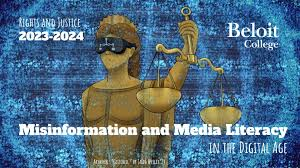
This year, the theme for the Weissberg Program in Human Rights and Social Justice is Misinformation & Media Literacy. We decided on this for this year’s theme because, with new technology, such as AI, social media, and search engines, we want to educate students to critically analyze what they see on social media and the internet. In this day and age, it is so easy to fall for misinformation that people with influence share on their public platforms, especially if the algorithms are manipulated to serve a certain ideological worldview in an audience.
During the height of the COVID-19 pandemic, misinformation on this serious public health issue was rampant due to politicization. This year, we want our peers to educate themselves on different topics to better understand and recognize when they see something online that is misleading to the public. In doing this, we want to keep the conversation going beyond keynote speakers during residencies.
That is why I wanted to do an article series on faculty, staff, and student leaders who can offer different perspectives on how misinformation affects the work they do in their respective fields and what we as a campus community can do to combat misinformation together in an interdisciplinary way. It is important to emphasize interdisciplinary collaboration in promoting a culture of truth and honesty in our media in the 21st century given the changes in technology and how information is given to impressionable audiences. What does interdisciplinary collaboration mean exactly? I invite you to hear from two amazing leaders on their unique perspectives!
Daksha Howard, Program Coordinator for Residential Life, talked mostly about language and the understanding of terminology. “When we talk about misinformation, I think about two terms that are interchangeable,” says Howard. “And that is misinformation and disinformation.”
“If we think about it,” Howard said, “those two words and terms can be used interchangeably but they’re often thrown around a lot. But there is a distinct difference in both of those for me. And so when I’m thinking about misinformation, I also look at disinformation. So in my opinion, for example, misinformation is simply inaccurate information. And it’s nothing more or nothing less. In other words, it’s about someone getting their facts wrong, which we all do. That doesn’t mean that misinformation doesn’t have any unfortunate consequences; obviously, all actions have consequences, right?”
For Howard, “there is a distinctive difference. So when I talk about disinformation, it’s important to know that disinformation is false or misleading information that’s deliberately curated. It’s to deceive someone in order to achieve their objective. Disinformation is something that is deliberately putting statements out there that are not correct in order to make ourselves look better but carry real consequences. Misinformation and disinformation are interconnected but are often used interchangeably. That’s why drawing the distinction between the two is something that we really need to pay attention to closely and ask ourselves, ‘Is this just an innocent mistake, or is this somebody that’s really trying to damage someone’s reputation?’ I highly encourage students to do their own research on this topic so that they understand on a deeper level.”
Abhey Singh Guram‘24, President of the Beloit Student Government, says, “Whenever there’s a structure, information is always top-down in most places, and when information is withheld at the top, the people at the bottom assume a lot of things. So in a structure like ours in the college, a lot of information is with the administration. And then when it’s not passed down to the students, the students assume certain things and that’s where miscommunication happens.”Guram added, “That’s when rumors or misleading information or the worst kind that is partial information, when partial truths can spread. I think students need to take more initiative. Students need to be more involved. When they have questions, they should not hesitate to say it out loud. If you see it, you should say it. Do not be a bystander. I also think faculty and staff play a very important role. Faculty and staff need to be approachable so that students are not afraid of saying things out loud.”

Leave a Reply