

By VANESSA SKILDUM
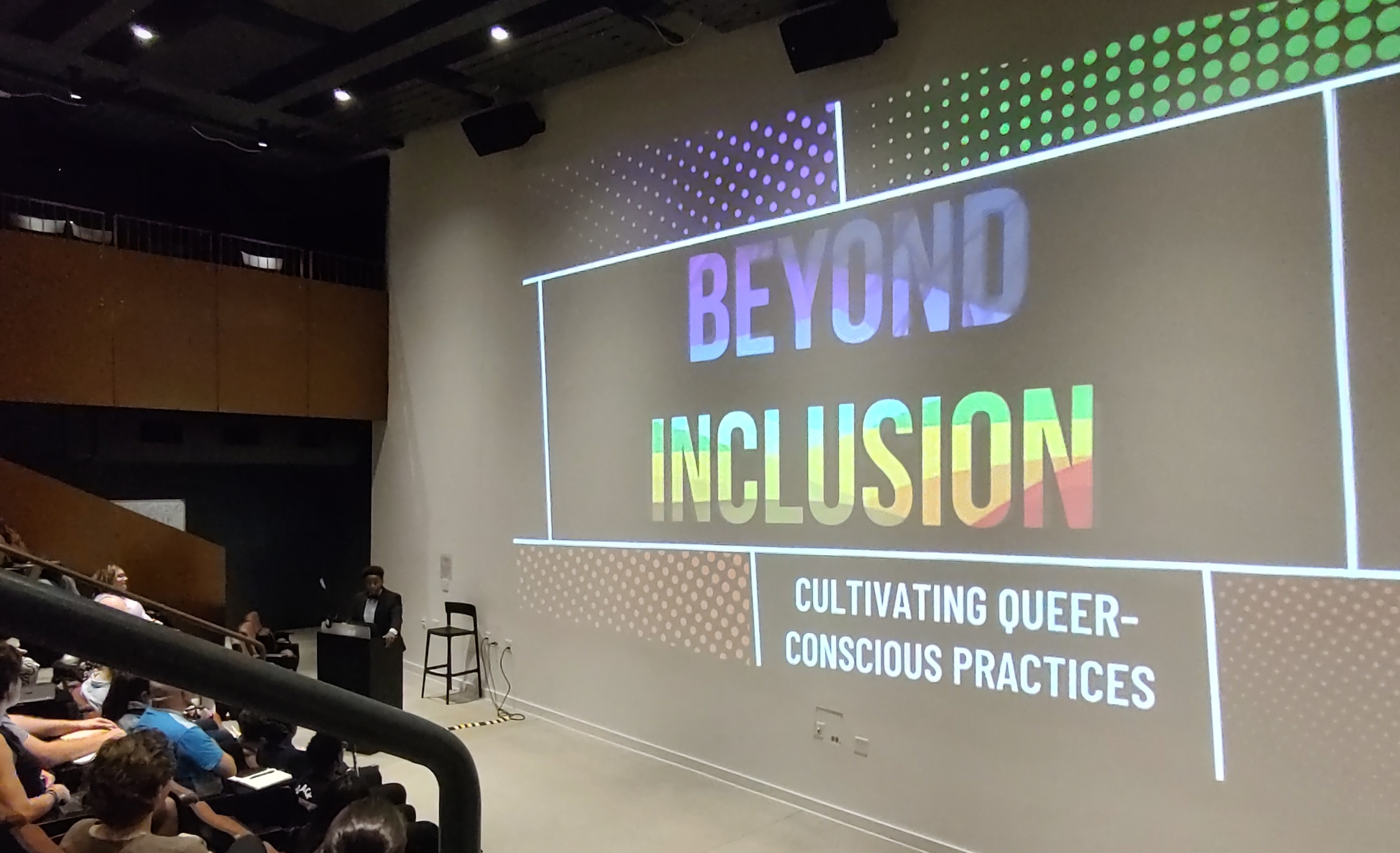
On Wednesday, September 25, Britney Daniels gave her keynote speech, Beyond Inclusion: Cultivating Queer-Conscious Practices, at 7 p.m. in the Weissberg Auditorium.
Daniels is an African American queer nurse with six nominations for the Daisy Award. “Daisy Award recipients are registered nurses who exemplify the nursing values of extraordinary Compassion, Courage, and Integrity in every situation,” according to the University of California Davis Health, and is a debut author of “Journal of a Black Queer Nurse.”
“Change does not occur through comfort” was an essential point in Daniels’ talk, focusing on intersectionality, bias, racism, and more. Her presentation aimed to give the audience a lens through which they could view her life from a perspective some might not have ever seen before due to different cultures, appearances, and identities.
Kimberlé Crenshaw coined the phrase intersectionality, which, according to Marium Webster’s dictionary, is “the complex, cumulative way in which the effects of multiple forms of discrimination (such as racism, sexism, and classism) combine, overlap, or intersect, especially in the experiences of marginalized individuals or groups.”
In Daniels’ book “Journal of a Black Queer Nurse,” she shares experiences she has had while working in a hospital, including those where intersectionality is quite clear. The book is written in vignettes or short passages focusing on a moment in time.
She shared one titled “I’m Not Fond of Your Kind,” in which a patient she had who was an older white man said, “You know I am not fond of your kind” to her as she was taking over his care. Immediately she thought he meant her as a black queer nurse. As the reader finds out, however, he is talking about the type of brief the hospital had, which was not the type he liked.
The end of the vignette reads, “As I walked to the storage room, I recognized that intertwined with my career would be the intangible hair-raising specter of oppression, racism, sexism and homophobia. It would linger over me, always threatening me like a shadow.”
Oppression was another critical point addressed by Daniels that ties into intersectionality. She shared a quote from Saeed Jones, which read, “Being black can get you killed. Being gay can get you killed. Being a black gay boy is a death wish. And one day, if you’re lucky, your life and death will become some artist’s new “project.”
Daniels’ ex-wife was Muslim and queer with the middle name of Mohommad. Daniels discussed how her ex-wife could not practice her religion at mainstream mass because it was not permitted and how, at the airport, she was always stopped due to her middle name. Daniels then shared how her ex-wife ended up legally removing her middle name to prevent that from happening.
Daniels also touched on bias, which Merriam-Webster’s Dictionary defines as “to give a settled and often prejudiced outlook on something.”
As a part of her presentation, Daniels reached out on Instagram with specific questions for others to join the conversation. One of those questions focused on when someone’s personal bias affected them. A response she got was shown from E, a Latinx and an openly gay man.
He recounted an experience he had while in the New York subway, during which he was wearing a more feminine outfit with his boyfriend. A guy did not like how he looked, so he attacked E. That experience has now caused E to dress less femininely and minimize that part of his self-expression.
“Intersectionality, Bias, and racism are not theoretical concepts. These are lived experiences. They are the threads that have woven stories of my life and your life,” Daniels remarked.
Daniels’ presentation also pointed out data from a study the University of California, Los Angeles (UCLA) Williams Institute conducted titled “Racial Differences Among LGBT Adults in the US.”
Their findings included that 37% of white lesbian, gay, bisexual, transgender (LGBT)–identifying adults, 31% People of color (POC) adults who identify as LGBT experience depression as well, and 47% of POC LGBT adults and 36% of white LGBT adults live in poverty.
“Queer people are not safe. Trans people are not safe. Gender non-conforming people are not safe. And we all have the ability to do something about it.” Daniels stated.
Daniels said this when describing herself, “I am a nurse. I am a warrior. I am a warrior that fights against racism, sexism, classism, xenophobia, and everything else I see in my everyday life and my professional life.”
She claims change comes through disruption and requires people to be uncomfortable. Collective liberation appears through raised voices and speaking through difficult, sometimes uncomfortable situations, which she aims to do to improve and encourage others to do the same.
She expressed, “I don’t want you to be my ally. I want you to be my accomplice.”
Featured Image Credit: Vanessa Skildum’27

Leave a Reply