

by INDRAYUDH SINHA
One of my first introductions to the American world of student jobs was when a fellow freshman and friend said on a Zoom call that they were working at KFC, even though they were vegan — a philosophical quandary, a humorous dilemma. To me, it became a signature of the work itself. Having a job meant doing it irrespective of one’s values. One only did so because having a job was important enough to transgress a moral or rational necessity.
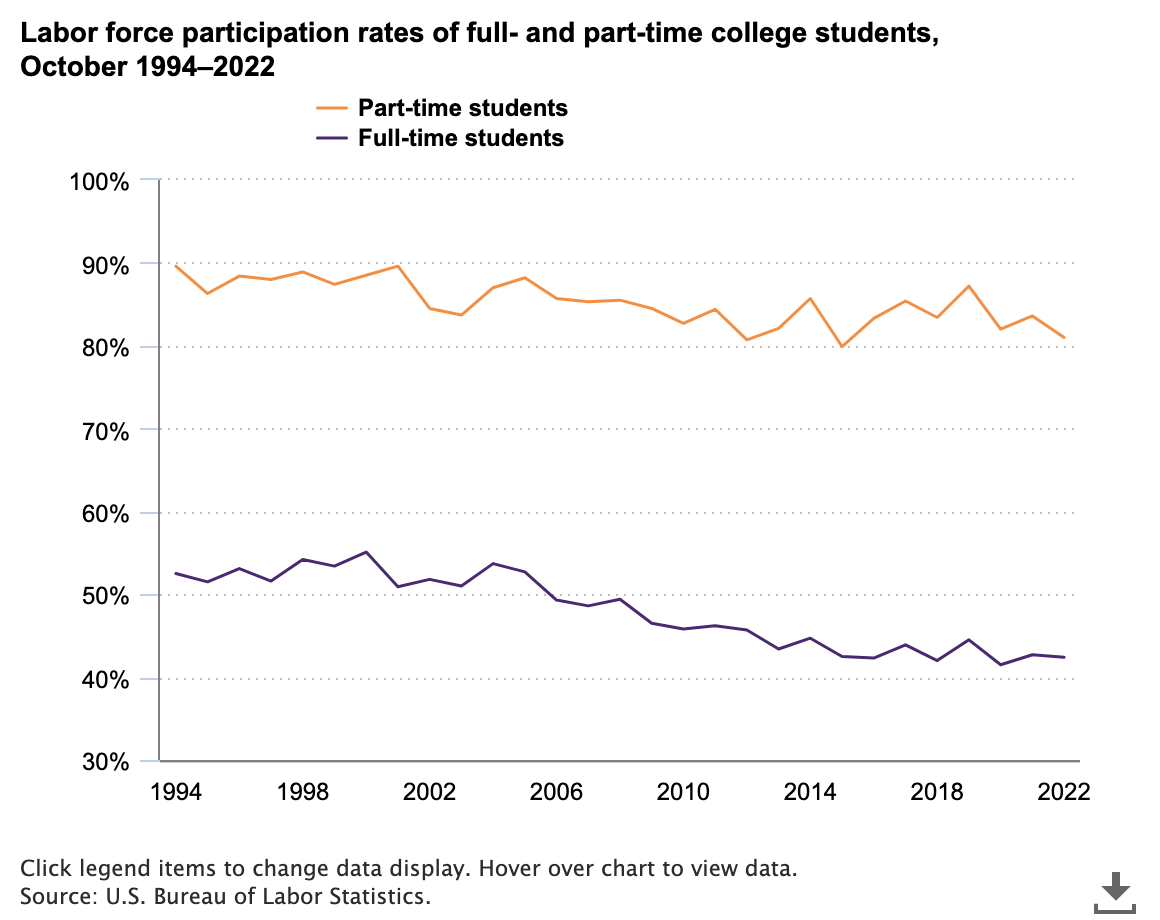
Full-time college students all around the U.S. can apply to be employed by their enrolled institutions. The Bureau of Labour Statistics estimates that there has been a sharp decline in the number of working full-time students, dropping from approximately 55 percent in 2000 to almost 42 percent in 2022.

Why there has been a decline, and where Beloit College students lie in this statistic, is worth investigating further. The most distinctly observable contribution to this decline is the decreasing minimum wage. In 2009, the federal minimum wage was $7.25 ($10.58 adjusted for inflation). Fifteen years later, in 2024, the federal minimum wage is still $7.25. The minimum wage has substantially lost its value, while education and other costs are soaring ever higher.

“I won’t get a job here, it’s like..a dollar above the minimum wage,” said Kelsey Gerstler‘28, a friend and fellow freshman from Saratoga, NY. “I’d rather get a job outside…Illinois, they have a higher minimum wage there, almost five dollars more. ”
I asked her why they were looking for a job, and what purpose it would serve for her. “I’m not looking for a job because I really need it,” she said, “but you know, it would help me look after my own extra costs…to be independent.”
The financial aid package for students at the college often includes an employment offer. However, the increasing number of colleges offering no-loan aid hasn’t helped international students, especially because of the rising cost of education in America. Some 73% of international students rely on sources outside the U.S.A. to finance their education. Even after substantial financial aid, due to the large exchange rates between their currencies and the American dollar, international students have to resort to taking education loans.
A student from Bangladesh told me that they work two jobs on campus, “the one at Commons helps me pay for school, and the other at The Powerhouse helps me manage my expenses.”
I asked them if they’d like a wage increase at their jobs. “Definitely,” they said, “one wouldn’t have to work multiple jobs then. Many of my friends, who are internationals, have worked or are working multiple jobs and shifts on campus. You wouldn’t pay a professional worker that less, would you?”
I then asked them the usual duration of their shifts, and they replied “It’s usually one or two hours at most. Most of these shifts are very short. But it’s nice that some departments on campus prefer hiring international students more since we don’t have any other employment options outside the campus.”
I asked if longer shifts would be nicer, and they responded, “Well,” they took a pause, “I don’t think so, since we have college work as well.”
This reminded me of something a sophomore from California had told me in conversation. “It’s also about the nature of the job,” they said, “how much it permits you to do other work you might have for the day, whether the job is boring or not and so on.”
A student who worked as a lifeguard on campus told me, “I really like my job, but on usual days I don’t do much, I’m just sitting there…I can’t always work on anything I have to, too.”
While I appreciate the amount and range of jobs that our college campus has created for us students, it’s also important to ask if these jobs are even on steady grounds, if they are purposeful, or whether these jobs are just generated for the sake of generating jobs.
Most department offices on campus usually hire students as office assistants. All of these jobs usually include doing small, logistical work for the office staff, like running their errands, printing documents, and answering the phone. However, some offices like Career Works hire students to utilize skills learned in college itself, like data analysis, marketing, communication, etc. These two job types are very different from each other.
As departments in the college are staffed by educated professionals, students are given an opportunity to shadow the professionals in the department and learn about its operations. But there is no direct involvement of students in logistical jobs. Jobs that allow students to use learned skills much better incorporate a student’s education.
One of the biggest criticisms that one has heard from most students is the near-uniform rate of compensation on campus for vastly different jobs. “Even though I work a job using statistical tools and do a job not everyone can do”, said a senior, “I’m not paid in the same manner according to the work I put in.”
International students also often look for internships to increase their experience on their CVs and to find a suitable alternative to campus employment. A college official I talked to echoed the sentiment of the students about their wages. “It should definitely be increased,” they told me, “some of us do talk about it here. Most departments spend almost half of their budgets on paying students. Say if I had a budget of 24,000 dollars for my department, I’d have to spend almost 11,000 dollars to pay student workers.” They said that, “the way to increase student wages is to increase overall department funding.”
The question ultimately remains, what jobs are good and incentivizing, and what jobs are not? Two contrary perspectives come up through research on student jobs: it can either make college life very difficult or it can give great mobility and first-hand experience at the kind of job one would like to have after graduation.
One of the possible solutions to the problem might be having job projects and performance as part of a student’s educational project, compelling both the student and the institution to invest more directly in industry-facing jobs, which the college is arguably pushing through Impact Beloit. The other solution might be entirely student-run departments with educational credits tied to it while compensating them equally to that of an employed professional.
Lastly, one should realize that there are multiple reasons behind this wage crisis: the town of Beloit itself (its economic decline and slow rejuvenation), the recession caused by the COVID pandemic and how it crippled small colleges like Beloit, and the desperate dependence of small colleges on influential and wealthy donors whose resignations and withdrawals from institutions have caused colleges to dwindle in their financial capacity.
Student wages deserve to be far higher than the minimum wage, and the federal minimum wage itself should also increase considering rising living costs. Colleges like ours should invest in directly hiring students in departmental positions and invest in producing more industry-facing jobs. The wage crisis, even though seemingly inconspicuous, is counterproductive to the affordability and academic performance of students in the long term and something that our college shouldn’t learn to live with.

Leave a Reply