

By RUBY BAUDHUIN
Beloit College, like many small liberal arts schools across the US, is currently facing an identity crisis.
“Centuries ago,” reads the back cover of the June 1922 volume of the Beloit College Bulletin, “Plato sat at the feet of Socrates. It was the beginning of The Intimate College. The Beloit Idea is the Intimate College Idea….”
Over a century since the catalog’s publication, Beloit still proudly boasts its intimate education. Yet present economic stresses and fears about the decline of humanities and arts departments nationwide have left students and staff confused about the next steps forward.
Amelie Lichte’26 is the vice president of Beloit Independent Theater Experience, or BITE, and is majoring in studio arts with a minor in museum studies. She expressed disappointment at the continuous budget cuts. “It really feels like they’re just kind of letting the arts departments crumble away a little bit. It feels as though they’re just kind of like, ‘well, they’ve operated this long, so with momentum, they can just keep going.’ And that’s not true.”
Beloit’s long-standing archivist emeritus, Fred Burwell’86, is also concerned. During his time as a student, Burwell majored in English Composition and worked for The Round Table and Beloit Fiction Journal in addition to his work-study job with the archives. The Round Table and Beloit Fiction Journal have both been subject to budget cuts this year.
“That editing and writing experience that I gained at the college just played into my life in many ways both in my job and outside of my job,” says Burwell. “And the college needs to consider some of those kinds of things as they’re focusing on experiential learning and pre-professional schools and all this stuff. I’m not saying it’s a bad thing. I think the college has to find ways to differentiate itself from other schools at this point and give people a reason to want to come to Beloit College. I don’t want to see them sacrifice some of the traditions, and in part, that’s a strong emphasis on the liberal arts.”
Donna Oliver was a Russian professor at Beloit for over 30 years before the program’s closure. But as of July 2023, she has a new role as the Provost and Dean of the College. She acknowledges the college’s push to advertise career-readiness opportunities to students, but says that this is mostly Beloit’s effort to better articulate what it already offered.
“We always knew that our students leave here and do interesting work in all sorts of fields,” says Oliver. “But this generation and their parents want to see that their investment in education is going to pay off in the form of gainful employment, right? And so the idea behind the schools is really to repackage the liberal arts to make those career pathways more visible.”
While Oliver is saddened by Beloit’s diminishing humanities, she sees this decline as reflective of the change in interests of prospective students.
BITE Vice President Lichte worries that the college’s focus on the schools is leaving some students behind. “I understand that the schools are meant to bolster the college as a whole and to make it seem like it’s not quite as tiny as it is and to give other people a chance to explore disciplines that aren’t necessarily in departments,” she says. “But it does feel like those other departments are just being left by the wayside, and that if you’re not a part of one of those schools that [you] no longer have priority.”
Fellow BITE executive Alister Murphy’26 echoes this sentiment. Murphy is a studio arts and performing and applied arts double major. They say that Beloit’s choice to combine music, dance, and theater into one program last year was disheartening, especially given that it coincided with the launch of its School of Business, which introduced new business-related majors and minors.
Murphy emphasizes that it’s “great to have so many different disciplines at a school, except it starts to be an issue when you start putting all your money in one section and not supporting your other disciplines—which is what is continuously happening.”
While archivist emeritus Burwell is troubled by budget cuts, he recognizes that this current wave of panic is not necessarily new. He says that during periods of financial hardship, the college must “try to reinvent itself… in order to survive.”
At the time Burwell became a student, Beloit was coming out of a difficult financial period. The Beloit Plan was introduced in 1964 and was an innovative reimagining of higher education. The Plan offered year-round education and required students to complete field terms along with common courses. “It attracted students from all over the country,” says Burwell, “and even the world. And we became, for the first time, a truly national college.” At the program’s peak, Burwell says that Beloit’s enrollment had increased to around 1,700 or 1,800 students.
The Beloit Plan lasted until 1978, when an increasingly competitive marketplace and The Plan’s financial oversights meant that the program was no longer viable. Students were devastated, but the college eventually began to recover. New administration focused on improving student life by renovating dorms and academic buildings on campus.
Certainly, says Burwell, “there are challenges now that did not exist” in the ’80s. Yet there are aspects of that era that feel all too familiar.
The ’80s saw an enrollment decrease as baby boomers graduated and the number of college-aged people declined. And though Beloit’s enrollment numbers are currently rising consistent with nationwide trends, they are likely to soon hit another hurdle. A new report predicts that the number of high school graduates will steadily decline starting in 2026.
Despite their critiques, members of Beloit’s BITE are truly passionate about the college. Casey Barasch’26, who is majoring in Spanish and education, is feeling more optimistic this year. He still hopes that the college will put more effort into supporting Beloit’s arts and humanities clubs and programs. “When we do get the money,” says Barasch, “I want it to go towards things like The Round Table that have impacted and contribute to the Beloit campus and to the student experience, and not arbitrarily following some particular trend.”
Susan Rowe, who is the program coordinator for Beloit’s Center for Entrepreneurship in Liberal Education (CELEB), believes that CELEB has helped Beloit stand out. CELEB offers a “start-up incubator, student-run art gallery, Beloit’s film and media production lab, student-led foundation, music recording studio, and a maker lab for hands-on creativity and collaboration,” according to the college’s website. Gallery ABBA, which stands for the “art of business and the business of art,” is a push to incorporate the arts with more vocational fields.
This effort represents Beloit’s attempt to distinguish itself by prioritizing the school’s financial longevity while still seeking to maintain its liberal arts identity.
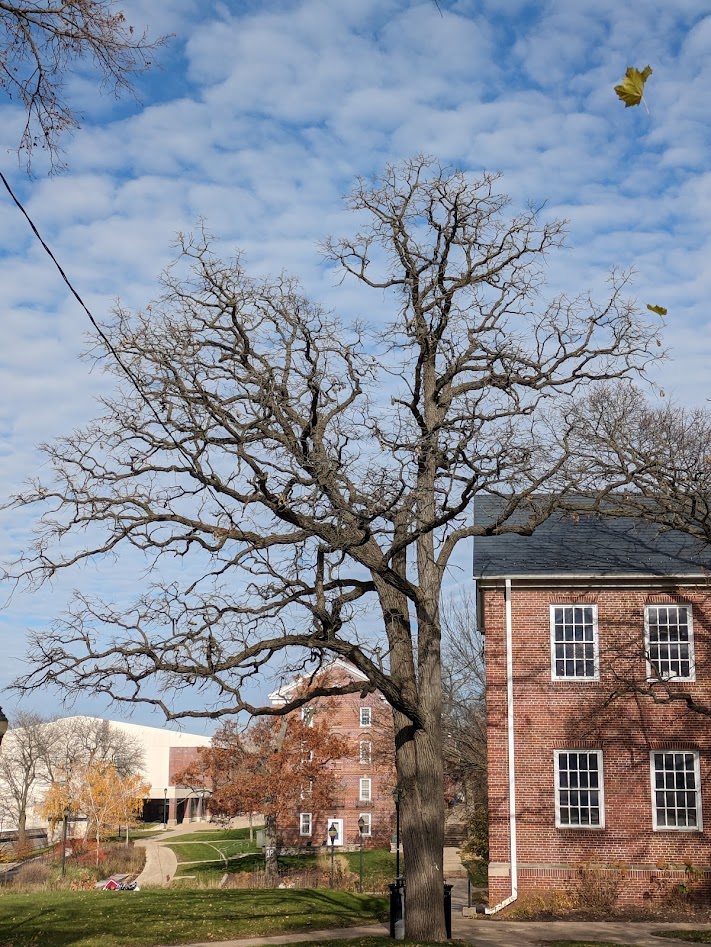
Featured image: Ruby Baudhuin ’28

Leave a Reply