

By ELLE TURNER
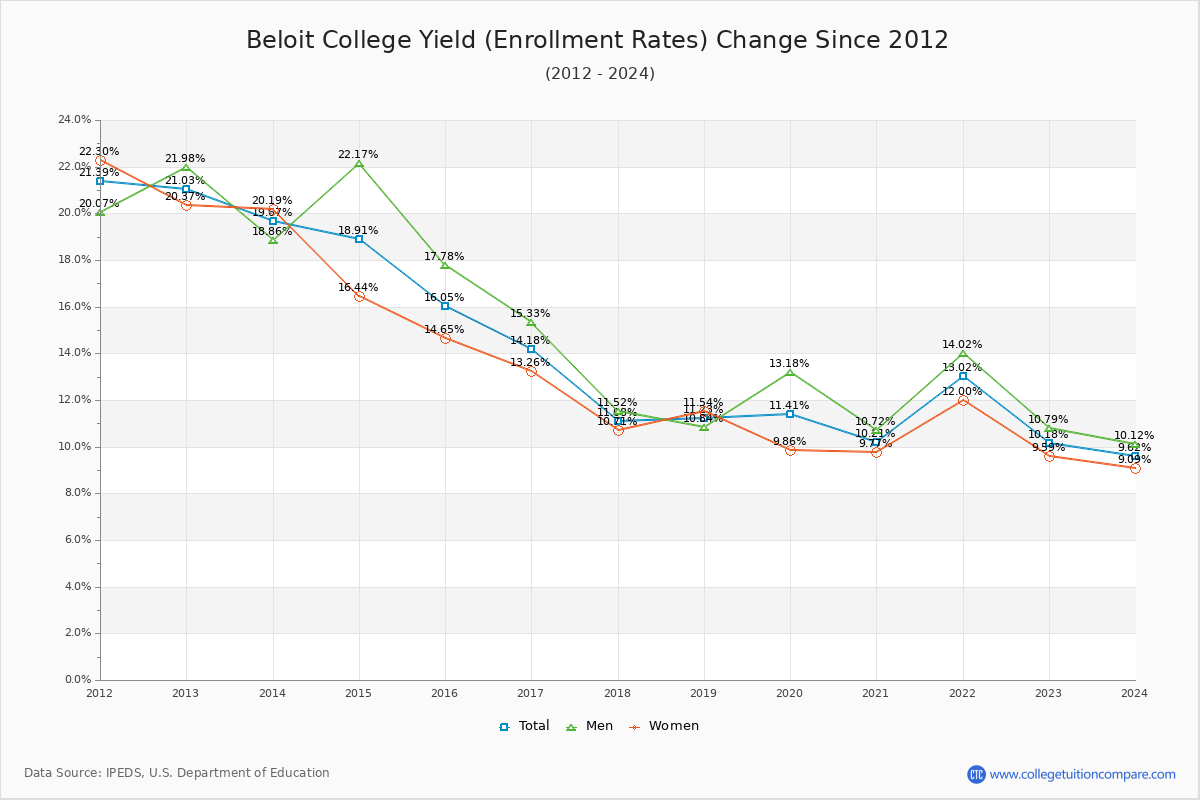
It’s no surprise that Beloit College is facing a bit of an enrollment crisis. In the last ten years, enrollment yield rates have just about cut in half, and the burden of this conundrum largely falls on the shoulders of Admissions. This raises the question—how has Admissions dealt with this problem? Has the college simply done a first-rate job at casting a wider net, to the point of playing fast and loose with its identity as a liberal arts school? Or has the bar been lowered for prospective students? Between interviews with Admissions staff and missing data from the Beloit College Common Data Set (CDS), it might just be a little bit of both.
Let’s take a look at the numbers. In 2024, Beloit College had a 9.62% enrollment rate—nearly half of what it was a decade ago. 2024 also saw the lowest student population since Whitney Houston’s passing, with fewer than 950 students at the college. While the number of applicants has been steadily increasing since 2021, the enrollment numbers don’t reflect that in the slightest.

Martha Stolze, the director of Admissions at Beloit College, still has high hopes for enrollment. “We have aggressive enrollment targets for the years ahead in order to help keep Beloit a vibrant community of learners,” says Stolze in an email interview, “with fewer students looking to enroll in college in the years ahead, we need to cast a wide net and make sure we are reaching as many potential students as possible.” There have also been shifts in focus and changes in the admissions process in Stolze’s time at Beloit; “In my time at Beloit we’ve been focusing on reducing barriers to students, and speeding the time in which we give students an admissions decision.”
“A lot of them seem,” begins Tessa Hunter’26, a Beloit College Admission ambassador, in an interview designed to ascertain just how wide of a net asmissions is casting, “like they aren’t quite sure what to do with their life. You ask them, what your passions are, what your career path looks like. And they’re like, I have no idea. I am just here… for the hell of it,” While Beloit’s “wide net” being cast might reign in a desirable quantity of students, it calls into question the quality of students. And nothing says concealing a lack of quality applicants like missing admitted student data.
The Beloit College Common Data Set (CDS) for the 2023-2024 admissions year is shifty, in that roughly twelve subsections of data surrounding incoming first year students are mysteriously missing. Section C of the CDS contains data about freshman profiles, including, but not limited, to SAT/ACT score averages, class rank, and average GPA. For Beloit’s 2023-2024 admissions season, however, much of this data (which has been available in previous years) has been removed. Twelve subsections of freshman data—including, but not limited to, class rank, GPA distribution, average GPA, and application fees/policies—are unavailable for the most recently published admissions season.

“It’s clear. I mean, in what I’m seeing, I believe it’s intentional,” says Hunter, whose job as an ambassador also involves database work, in regards to the 2023-2024 CDS’s missing data; “I mean, I hope it’s not because they want to… make people think that our students are coming in with a higher GPA than Beloit is telling people about.”
To be clear, the CDS is not a legal requirement of any US college, it is simply common practice; colleges are free to leave any spaces blank, so Beloit College is not in any legal obligation to disclose this information. Nonetheless, it’s strange that the past seven CDSs have these available, and only the most recent had elected to omit it. In tandem with this, the 2023-2024 CDS omits headers and footers containing page numbers, years, the institution’s name, and other organizational tidbits that would ordinarily help one discern whether this missing data was a formatting error or an intentional omission. If this is an accident, it’s an incredibly shady-looking one that coincidentally occurs in the least organized (and, thus, most easily manipulable) edition of the CDS. And if it’s intentional, it raises the question—why doesn’t the college want people to see this data all of a sudden?
Between subpar admits and mysteriously missing academic data, a wide net cast may very well be one in the same as a low bar set. With less transparency surrounding students’ academic achievements in the most recent data, we just don’t know—can’t know—how low they’re setting the bar.

Leave a Reply