

BY CLAIRE WINTER
In December of 2024, the Donmar Warehouse in London opened their run of “Macbeth,” starring David Tennant and Cush Jumbo. This was pretty much to be expected for a theater in London, especially one that had hosted the Royal Shakespeare Company in decades past.
Directed by Max Webster, it was reported to be expensive, captivating, and pretty much unreachable for most audiences anywhere but the UK- until it was released in theaters worldwide this February.
If you haven’t read or cared about Shakespeare since you had to read “Romeo and Juliet in high school, this probably means less to you than the lies on the Commoltons daily menu. However, if you’re a massive nerd like I am, you understand the enthusiasm.
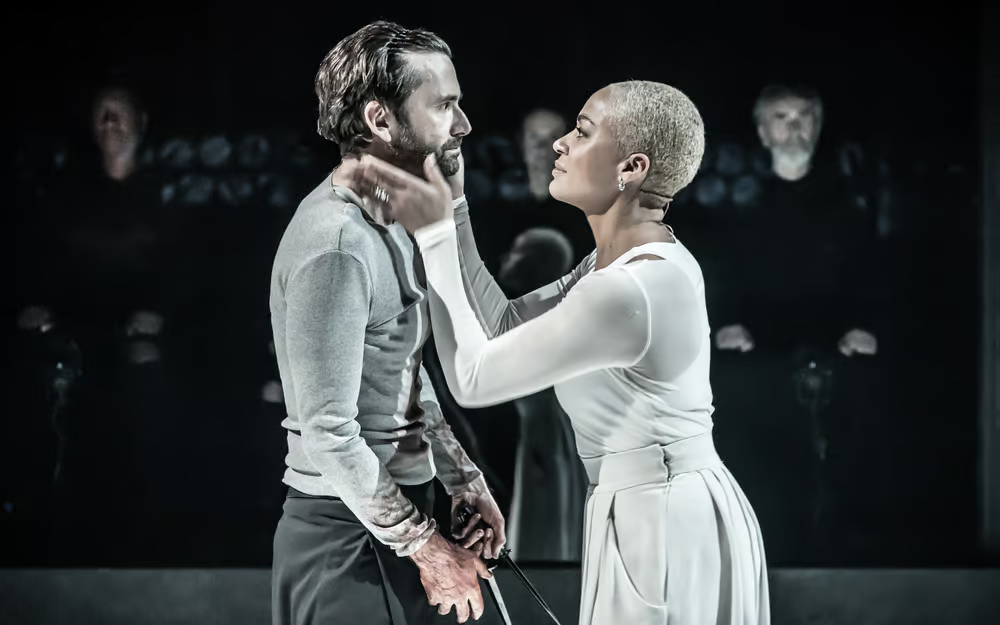
Performed as a traditional theater production and then filmed for streaming- think of Hamilton’s Disney+ release- this production of “Macbeth” is a definite deconstruction of the traditional take on the Scottish play. For one, the stage is starkly minimalistic, with no props, no backdrop of a castle or an ominous Scottish countryside. Instead, actors emerge from behind a glass screen to the modest main stage, dressed in utilitarian greys. And while generally, “Macbeth” isn’t an actual production of it unless you’re two hours in and silently waiting for everyone to start dying already (most productions will run somewhere between 130 and 165 minutes long), Webster’s movie-length production is only 114 minutes. Between these two factors, you might think the atmosphere would suffer or that the play would feel almost rushed- but it doesn’t. Instead, the starkness of the surroundings and the brevity of the exchanges lend the production a kind of desolation not found in more richly-colored adaptations.
One of the things that makes this run of “Macbeth” stand out is the chosen sound design. From the first minute of the performance, the witches’ voices swirl around the theater in a surround-sound effect, facilitated in the actual performance by headphones worn by the audience. I can’t speak to how this kind of audioscape feels in live theater, but in a recording-cum-movie, it works with the unsettling scenery to make certain scenes downright nightmarish. The Macbeths are no longer projecting discussions of their crimes to an audience (one of those necessary quirks I’ve never been able to get over); they whisper frantically instead.
As always, David Tennant (Macbeth) is excellent, and he and Cush Jumbo (Lady Macbeth) complement each other captivatingly onscreen. Similarly to his performance in BBC’s 2009 production of Hamlet, Tennant’s dialogues are marked by staring down the camera during some of Macbeth’s long monologues. Jumbo’s Lady Macbeth is constrained, constantly on edge rather than raving, but this serves to make her slow descent into madness more compelling than anything else.
There are some downsides, as there are with any kind of adaptation from live theater to movie or vice versa. It’s not an intuitive introduction to “Macbeth” for someone unfamiliar with the story. The cast is small enough that actors play multiple roles without distinguishing costume changes, and one actor plays every child role in the story, which makes it hard to keep track of names and characters without prior knowledge. Some critics have complained that the sound design distracted from the theater production, marring an excellent performance with unnecessary technical effects. And at points like the Porter’s speech, the movie version feels unignorably like you’re watching a very well-filmed bootleg of a theater performance.
But these detriments are small complaints compared to the enthralling effect of the overall performance and the accessibility it grants via its transplant to movie form rather than staying sequestered in a 251-seat London theater. If you have any interest in Shakespeare (or you’d like to see what all the fuss is about), I can’t recommend it enough.
Featured image: A clip from Macbeth; Marc Brenner

Leave a Reply