

By CIAN McKEOWN
When walking into Morse-Ingersoll Hall, it’s challenging to spot Gregory Koutnik’s office as you pass the gutted Coke machines and water fountain to climb the stairs. His office is exactly where he is, on the ground level. Even if you’ve never had a one-on-one conversation with the man, once you’ve taken a few of his classes, you feel like you know him well. Morse-Ingersoll was lazily empty when I walked in on Friday afternoon.
Warm sunlight filtered through the grimy windows. I knocked twice, timidly, and he beckoned me in without looking up or breaking stride in furiously typing out his sentence.
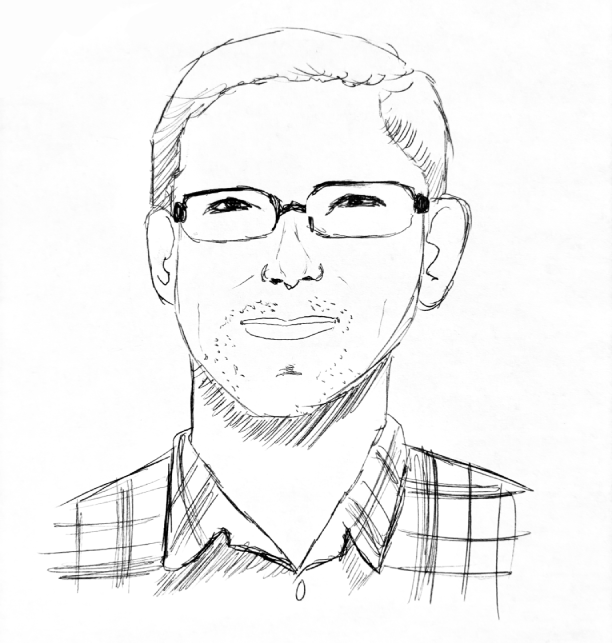
His space is modest and sparsely decorated. There is nothing on the walls save for a poster advertising an art exhibition, and a towering bookshelf that stands filled up in the corner. I can see the enthusiasm gleam in his signature rectangular spectacles when he turns to me. Professor Koutnik is clad in attire that follows his usual style template. Khakis, chunky dark brown dress shoes, and a checked button-down shirt. His hair is like him, restrained yet playful. It forms a curly quiff above his forehead with splotches of grey from long nights.
Gregory Koutnik’s life has been one of fault lines. While he grew up in the Twin Cities in a town called Eagan outside of Minneapolis, his family frequently vacationed to the bucolic wilderness of Northern Minnesota. This instilled a love of wilderness in the young academic from an early age. Getting back to the wild beauty of the northern wilderness has always been the goal for Koutnik, he says he can imagine himself “Retiring north, not south like most people do.”
“My work and my sense of identity have always been pulled in multiple directions,” he says, “I think that’s been a source of tension, but also a source of creativity for me.” Firmly a child of Minnesota, his family hailed from Wisconsin and the New York/New Jersey area, instilling the duality of thought and place that has defined his career. Koutnik is a fan of the Green Bay Packers, owing to his Wisconsin heritage, which drew the ire of his schoolmates growing up in the heart of Vikings country. Having this multifaceted identity has given him a curiosity like few have, as he eloquently puts it, “Seeing value in different parts of the tapestry of the landscape.”
Yet there are still other fault lines that exist. He talks of driving through the rolling hills and expansive farmland of south–central Wisconsin, and being whisked away to the towering skyline of New York City. “I’m someone who grew up equally attached to New York City, the great metropolis of our country, and the Boundary Waters canoe area. That gave me a sense of range. How do you reconcile the very different values of those two places and see them as a part of a coherent whole that we should preserve, steward, and protect?” He talks of going on trips to Yankee Stadium and Broadway shows as a beacon of culture in his young life. To this day, he is a Yankees fan, a controversial choice in the Midwest.
These competing attachments eventually manifested themselves in Koutnik’s college search. He chose to stay local at the University of Wisconsin in Madison over Columbia University in the heart of New York City. He commented on the contrast that these two options represent: “They felt like two very different versions of myself. One was the kind of living in the big city, doing the things I had fantasized about doing every day.”
The decision was mainly for financial reasons, but it proved to be the right one. Family connections beckoned him to a place where he kickstarted his current path, double majoring in economics and political science, and meeting his now wife.
One of the reasons why Professor Koutnik bears his title is his innate curiosity. Even sitting in the back of one of his classes, it feels as though he is speaking directly to you. This is because he genuinely loves the art of learning, teaching, and thoughtful discussion. He talks of an undergraduate mentor who taught him a different way to be curious that has more to do with, as he says, “Looking very closely at where you are.” And that “Sometimes the greatest journeys come not when you step out your door, but when you read the right kind of book or look at the place you’re at in a different way. And appreciate it in a more rooted and concrete sense.” This is the throughline that runs through much of Professor Koutnik’s teaching and helped me foster a greater appreciation for the natural landscape of the Midwest.
After undergrad, he decided to indulge that other, more cosmopolitan, East Coast version of himself by going Ivy for graduate school at the University of Pennsylvania. He rediscovered his East Coast roots in Philadelphia, describing the experience as almost “Undergrad 2.0.” For him, the best way to appreciate the Midwest was to escape from it for a while. He still claims to miss city life, and laments how car-dependent smaller cities in the Midwest are compared to the web of public transportation that large metropolises offer. Koutnik crystallizes the perpetually oscillating nature of his life thusly: “It’s a ceaseless dynamic. We’re always going away and coming back. And I feel this most vividly because this is how my childhood played out. I was always feeling that I was both at home and away from home at the same time.”
Academia was a tool for Koutnik to fully realize what made these different parts of his identity and senses of place so meaningful. “I’m interested in a kind of environmentalism that takes these attachments that people already have to their environment and brings that to the forefront.” He does so in the classroom, assigning an autobiographical essay to students based on the subject of the course at the beginning of each semester.
Koutnik’s research mainly focuses on environmental political theory, a concentration that barely existed when he began his academic career. This niche interest came from a marriage of his two intellectual loves.
A debate kid in high school, he became fascinated with social sciences and public policy, while still retaining his connection to wilderness. He found himself in the middle of a vendiagram between the environment, politics, and economics when taking courses as an undergraduate. He found the most interesting courses to be the ones that dealt less with empirical answers and more with theoretical questions. He says, “I found myself stepping back to ask things like what values are at stake in the question?” Going on to say that “My level of excitement went from being a good student who wanted to do good work to I would do this forever.” Environmental political theory for Koutnink became his preferred route because it “So effectively integrated so many of the things I’m interested in before I even knew that was possible.” He had found his one true academic love.
Koutnik describes his intersectional style of teaching and scholarship as “Always assuming, and wanting to show the reader or student that the fault lines are inescapable.” Elaborating, he clarifies that “There isn’t some way to just harmonize conservatism and liberalism, or the fault lines within those ideologies. There’s no way to just seamlessly say, ‘we’ve reconciled the wilderness and the urban, we’re done.’”
Although he seems to have found a happy medium in Beloit, arriving at the college in 2022, where he has since remained a visiting assistant professor of political science. This is certainly not his first teaching experience, though. He spent time at Hamilton College, another midwestern liberal arts institution, and first discovered his love of teaching as a graduate assistant at the University of Pennsylvania. He speaks highly of the liberal arts experience: “There is something different about the small liberal arts model. I can see it in students and see it in my colleagues around me who are so much more passionate about teaching. I come here with the understanding that we’re in practice together.”
But in the classroom, it’s not simply practice, but game time for Professor Koutnik. On the ancient blackboards and within the cramped classrooms of Morse-Ingersoll, he is in his element. He scribbles and scrawls the class agenda and parts of his lecture or class discussion on the board with alarming speed and varying legibility. Often, he may even call on someone who did not have their hand raised, as he is constantly shooting back and forth between the board and the class. In hectic moments like these, the powdery white chalk dust will sprinkle itself on the lapels of the charcoal blazer he is particularly fond of wearing in the colder months.
Speaking about his teaching style, Koutnik emphasizes the need for dialogue and discussion as opposed to empirical solutions. He conveys the mantra that “None of these texts [I assign] are going to give you a final answer on anything. If you came here for a formula, you came to the wrong class.”
Beloit College finds itself in a fraught position as a style of education on the decline. Koutnik broached the question like this: “We want to make sure that we’re here as a relevant and highly regarded institution decades in the future so that your degree really does mean something.” He continues, “What I think I have a lot of optimism about is the continuing importance of liberal arts. Employers recognize its value, and students, when they leave and become adults, recognize its value. As much as sometimes the liberal arts feel like they have to justify themselves in our age of AI, I don’t think many people truly don’t believe in the value of a liberal arts education.”
In an age of pessimism, Koutnik provides an earnest and well-thought-out optimism that is difficult to find for young intellectuals. And yet, despite his love of higher education, Koutnik stays down to earth and is wary of getting lost in the “ivory tower” of academia, as he calls it.
His life is one of many sections. A thoughtfully furrowed brow and a personable smile. A jazz nerd who loves to play Vince Guaraldi on the piano and a geek who likes to watch the Venture Brothers TV series. An eloquent wordsmith and a witty jokester. It all comes back to the city kid who loved the country, and a curious mind that loves the wild. We hope that Koutnik’s curiosity will keep him at Beloit for many years to come.
Featured Image: Svea Jones’25

Leave a Reply