

By CLAIRE WINTER
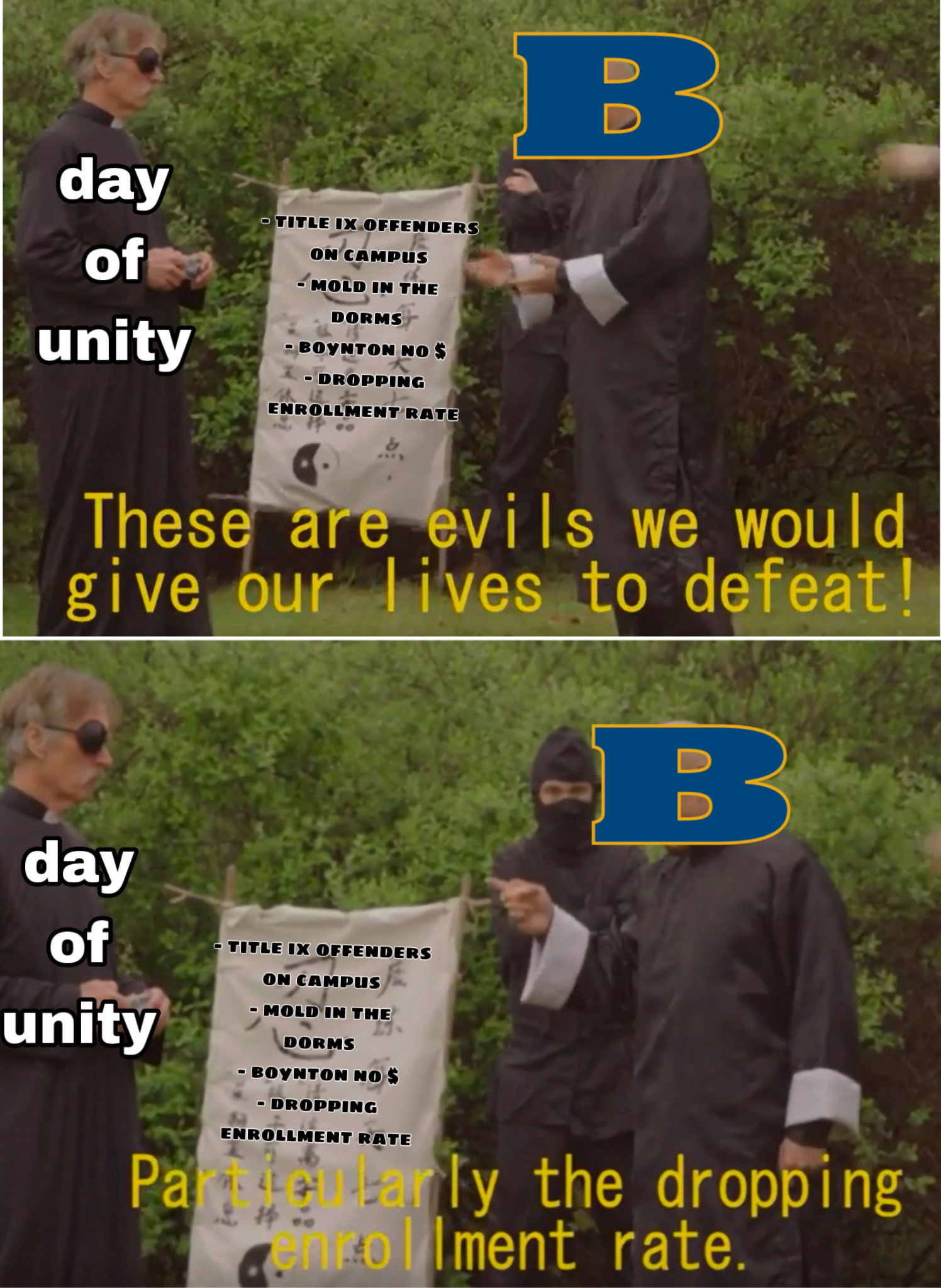
Last week, I did a fairly simple report on Beloit College’s “Day of Unity”- date, time, general goals, how many people turned up, et cetera. However, there was much about Beloit’s approach to the Day of Unity that’s worth addressing a second time, particularly as the school year ends.
This event hosted Dr. David Anderson Hooker (Ph.D., J.D., M.Div.), along with the help of many Beloit College faculty and staff. The entire event was presumably to work with the Beloit College community and to create a “narrative of a shared future” among students and faculty. And while this approach has clearly worked in communities that Dr. Hooker has worked in before, many aspects during the Day of Unity felt less like a dialogue between students and the college, or with conflict between disparate groups on campus, and much closer to platitudes about students’ issues.
Understanding the various reasons why the college can’t offer every class a pre-med major might require (for example, the fact that there’s a relative give and take between how many classes the college can offer and how much it has to pay its professors for their work) is not a bad thing for students to examine and discuss. Communicating frankly about the limitations of what the college can provide, and why those limitations exist, is a very, very good thing to do.
The focus on external factors, however, seemed to easily merge into shifting blame. Beloit College certainly has plenty that it can’t help: the socioeconomic state of the world, our current federal administration, and its budget constraints. Recognizing these outside influences can be useful, especially in the context of smaller issues. But much of the discussion I was privy to seemed to ignore the fact that the college is an institution, with active control over smaller issues that affect student life in large ways: class requirements, student jobs, housing, and building management, to name a few. I wasn’t in a group that focused on, for example, student work on campus, but it’s worth wondering if anyone brought up, “Hey, the college was attempting to union-bust our student workers. What’s going on with that?”
A “gathering and dialogue of student groups, clubs, faculty and staff, aimed at co-creating the campus we want”, to “bring us together in new and creative ways” (as the college website describes the Day of Unity event) isn’t necessarily doomed to failure and corporate dodging tactics. In fact, in a perfect world, it wouldn’t be a possibility. But an overwhelming focus on dissecting a single problem into external factors- things that Beloit College just can’t fix without huge societal upheaval- doesn’t leave room for accountability. Talking about creating a narrative alone does not bring a narrative into existence.
Another thing that the Day of Unity emphasized was that their (and by extension, our) work was not done. The promise of change happening in Beloit as soon as the 2025 fall semester sounds enticing- until you hear that “the committees will take all this information and figure out how to continue processing it” over the summer, at which point it will reconvene for another round of feedback from students.
If your solution is ostensibly for the students, and from the students, then it follows that it should involve the students beyond the medium of a suggestion box. Ordinary, everyday students- not just those in student government, not just those required by their sports teams to show up- should be able to collaborate on solutions in tandem with the college. Students must, as Dr. Hooker says, “practice being a problem.”
This does require students to take on responsibility to actually show up (not buzzed, not high, not hitting your vape every three seconds, thanks) as well as to take time to have conversation with the college administration. But it also requires the administration to widen opportunities for students to participate.
There is a possibility that this will be the case in the overall conversation between administration and students set to continue next semester. Dean Gloria Bradley recently sent out a follow-up email to attendees and referenced a “Day of Unity recap and next steps”. (As of the time of writing, no followup email has been sent.)
But there’s also the possibility that the college will collect student complaints without treating students as members of the community equally as competent in fostering solutions as they are in identifying problems. Co-creation does not mean that one party is completely excluded from the decision-making process. Again, there must be spaces in which students are allowed and encouraged to be included in college decisions before they’re declared.
If Beloit College takes the route of demanding to know “what they could improve on” through mass emails and Google forms, as their MO generally is, without being transparent about how they plan to improve, and what give and take they’ll enact to reach those goals, students and faculty may end up with a cure worse than the disease. We will be left with a narrative that we are still not a part of.
As the semester wraps up, the results of this Day of Unity are still in progress. If Beloit College can successfully create a narrative that suits its administration, faculty, staff, students and goals remains to be seen.
Featured image: The VelociPastor, 2017

Leave a Reply