

By QUINN ANNIS and THEO BJORNSTAD
Beloit College is not an institution that many would call transparent. Aside from a scant few statements made by the administration each year, most changes are pushed through with little warning or student input. A fountain springs up outside of the library, the old wildflower garden gets bulldozed, the writing center gets sold off; all of these changes, which happened over only this past summer, came as a complete surprise to most of Beloit’s students. It’s enough to get anyone asking: what exactly are they planning next?
And so, determined to find out, a few writers at the Round Table sat in on the All-Faculty Meeting on Sept. 10, with the hopes of bringing an answer to that question to light.
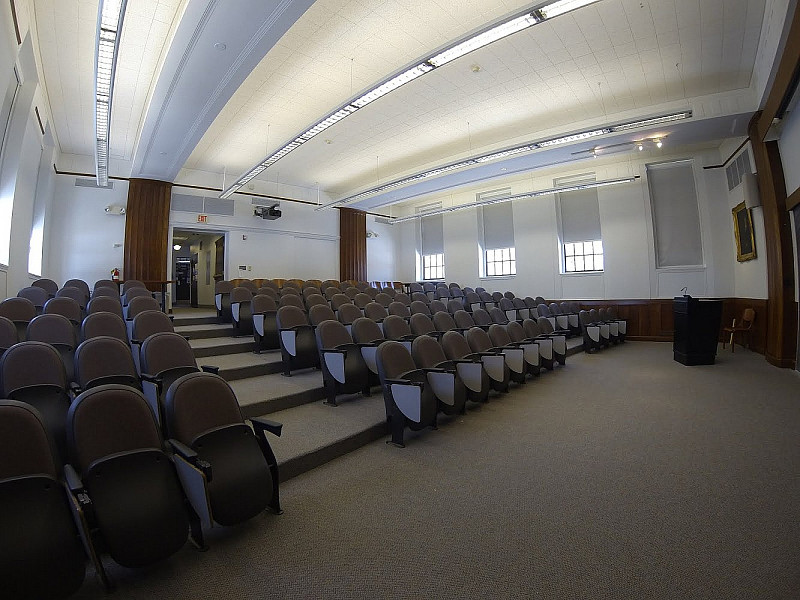
The meeting was held in Richardson Auditorium; the Campus Events Calendar describes it as “serv[ing] to assess and advance issues relating to interdisciplinary and/or all college curriculum, policies and procedures.” All-Faculty Meetings are held approximately once a month. The content of the meeting was varied, with several faculty members taking the microphone to address different subjects, namely changes, announcements and faculty concerns.
The first item on the agenda was a presentation from the Education and Youth Studies department, given by Jingling Lou, department chair, alongside Amy Van Deuren and George Dalbo. EDYS’s licensures allow students to teach different grade levels, depending on the program. It, like many other programs at Beloit, has suffered some fairly substantial losses, with the recent cuts racking the college across almost every department. Chief among these losses is a substantial reduction in the certifications and programs offered.
Teaching programs for secondary social studies, ELA, secondary science, K-12 theater and arts, Japanese, Chinese, French, Russian, German, and Dance have all been scrapped for multiple reasons, largely low enrollment and a few lapses in licensure. In terms of the department’s remaining offerings, the more versatile K-9 licensure, which is used for more general training but only covers elementary to middle school education, will continue to be offered as one of the department’s flagship programs. The EDYS department is actively working to renew the secondary ELA and secondary social studies licensures, which would allow graduates of the program to teach those subjects up to a high school level.
Lou expressed some of the department’s future hopes for the licenses. “We’re hoping to transition [Spanish] to a world language license, where Spanish would still be the primary language, but it would open a door to allow us to license students who are interested in teaching other languages as well,” she said.
Other ambitions from the department include the possibility of bringing back the slashed science and math licensure programs, although no strict time frame for their return was noted.
While the Education and Youth Studies department continues to hold out for the future of the program, with most in attendance applauding their resilience, the future of its more niche offerings remains, for now, decidedly uncertain.
The next topic raised at the meeting was that, recently, student athletes have been missing classes due to scheduling issues. Since the closing of Northland College and Beloit’s subsequent absorption of their men’s and women’s hockey teams, absences have seen an increase.
Charles Westerberg’94, speaking on behalf of ASP, the Academic Strategic Planning Committee, said that they are working towards a solution.
“Discussion between the Provost, the Dean of Students, and our faculty athletic rep have already begun, and will continue with this issue as a priority,” he said. “So we want you to know that we’re taking this very seriously and we will pursue a long term policy that addresses athletic participation, course attendance, expectations, and the scheduling of games, practices, and courses, because we don’t want to continue applying band-aids to this situation.”
He encouraged faculty to reach out and share their perspectives and concerns, and highlighted their goal of supporting junior faculty with regard to how to handle these issues.
The hockey teams have, thus far, been a significant boon to Beloit College’s athletic programs, and are otherwise poised for an excellent season. However, as the campus is rocked by its semi-annual plague, many among the faculty are starting to worry that academics may be falling by the wayside.
The meeting’s final speaker was Beloit College Registrar Yaffa Grossman. She had a different kind of message to share, more warning than announcement. Grossman explained how, under FERPA, the law that dictates the privacy and accessibility of students’ academic records, students are able to request information that pertains to their educational record. This includes, she emphasized, any material related to the student. “…[A]nything other than your own private notes, are part of a student’s education record,” she said. “If I send a message about another student, to a person, that’s part of the student’s academic record.”
Correction: In the print edition of the article, Susan Rowe of CELEB was credited as the final speaker at the staff meeting, but it was actually Yaffa Grossmann. We have corrected this web version, and we apologize for any confusion caused by the error in the print version of the article.
She also emphasized the lack of opacity in this system; messages that are apparently private can, potentially, be accessed by a student if requested. For example, texts sent by faculty about a student could be considered communications related to their academic record. She cautioned faculty to think carefully about what they might include in an email. “In other words, if you got something to say about a student, do it in person.”
As the meeting moved into final questions, quite a few faculty members raised concerns regarding the college’s operation. The first of these, raised by Chris Fink of the English Department, was regarding the budgetary restrictions that have since caused some significant frustration. He reminisces that, only a few years ago, it was nowhere near as restrictive, with purchases even as low as $10 needing to be put by the budget agency beforehand, significantly increasing friction. And as the meeting entered its final minutes, Corbin Livingston of the Chemistry Department then capped off the meeting with a statement seeming to echo the feelings of many in attendance: “…Transparency in administration, going forward, is needed to reduce resentment.”
The meeting, of course, is only a glimpse into Beloit’s overall goals as an institution. But it’s certainly interesting to gain some insight into what the faculty’s most immediate challenges and priorities are. And, beyond that, it’s fascinating to have a chance to see the inner workings of a system that, while it often affects students directly, often remains unseen. It’s easy to feel disconnected from a body that you’re not in direct communication with, to talk to individuals without seeing the whole. The Beloit College Administration is frequently opaque, distant, and difficult to get answers from as a student. Changes are made around campus all the time- from what DK’s new menu will look like- all the way up to what programs are on offer for any given year. It can be frustrating, being so consistently left out of the loop, but from what was said at the All-Faculty Meeting, it seems that sentiment isn’t unique to just the student body.


Leave a Reply