

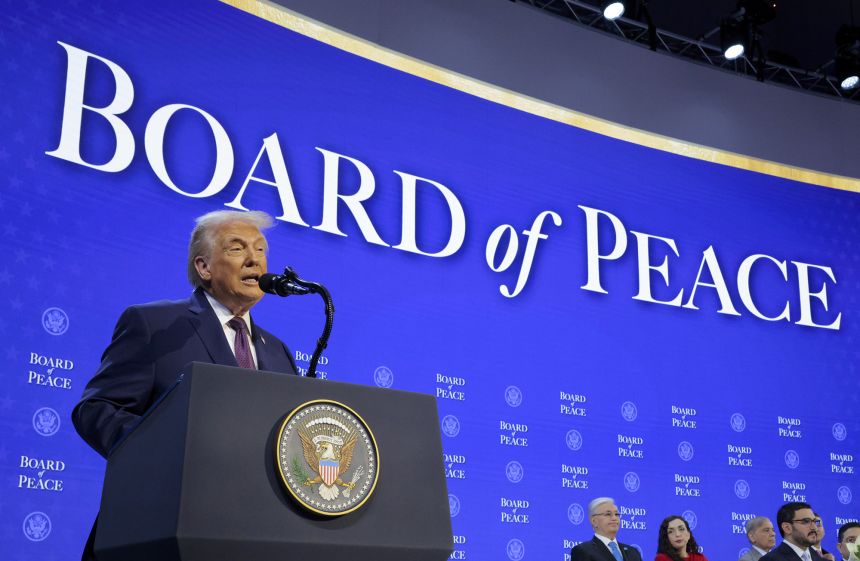
President Donald Trump convened the first meeting of his newly launched Board of Peace on Feb. 19, 2026, at the U.S. Institute of Peace in Washington, D.C. Representatives from nearly 50 countries gathered to outline detailed plans for Gaza’s reconstruction efforts amid a fragile ceasefire between Israel and Hamas. Trump described the summit as a historic turning point for global stability, positioning the board as a new force to drive peace initiatives worldwide.
Participating nations secured pledges totaling more than $7 billion for immediate relief and long-term rebuilding in Gaza, with major contributions from Bahrain, Qatar, and Saudi Arabia. The United States committed $10 billion to the cause, although congressional approval and exact funding mechanisms remain under discussion.
Leaders endorsed a comprehensive plan for Gaza’s demilitarization, the deployment of an international stabilization force comprising thousands of troops from countries such as Morocco, Albania, and Indonesia, and mechanisms to oversee aid distribution while preventing weapons smuggling. Trump emphasized that the board would work alongside, but also overlook, the United Nations to ensure accountability in conflict zones.
Trump opened the proceedings with a symbolic golden gavel. He issued direct warnings to Iran against interference, stating that any destabilizing actions would face swift consequences. The president praised the assembled nations for their commitments, calling it proof that bold leadership could rally the world against chaos.
The Executive Board, tasked with day-to-day operations, consists of nine prominent officials and experts. Nikolay Mladenov serves as High Representative for Gaza, appointed by the United States. Marco Rubio holds the position of United States Secretary of State. Steve Witkoff acts as United States Special Envoy to the Middle East. Jared Kushner functions as Senior Advisor to the President. Tony Blair contributes as former Prime Minister of the United Kingdom. Marc Rowan participates as Chief Executive Officer of Apollo Global Management. Ajay Banga represents his role as President of the World Bank. Robert Gabriel Jr. provides counsel as a United States political strategist. Hakan Fidan attends as Minister of Foreign Affairs of Turkey. Ali al-Thawadi speaks as Minister of State for Strategic Affairs of Qatar. Hassan Rashad leads as Director of Egypt’s General Intelligence Service.
Twenty-seven countries signed on as founding members, dispatching high-level delegations to the inaugural session. This coalition includes Albania, Argentina, Armenia, Azerbaijan, Bahrain, Belarus, Bulgaria, Cambodia, Egypt, El Salvador, Hungary, Indonesia, Israel, Jordan, Kazakhstan, Kuwait, Kosovo, Morocco, Mongolia, Pakistan, Paraguay, Qatar, Saudi Arabia, Turkey, United Arab Emirates, Uzbekistan, and Vietnam.
Challenges and skepticism shadowed the optimism. Major U.S. allies including India, Italy, Greece, and the European Union limited their involvement to observer status, citing concerns over the board’s legal authority and overlap with existing UN frameworks.
Experts highlighted logistical hurdles, such as the National Committee for Gaza’s limited access to the territory and enforcement mechanisms against non-compliant factions. Despite these obstacles, Trump administration officials expressed confidence that the board’s momentum will overcome resistance and deliver tangible results in the coming months.
Featured image: CNN

Leave a Reply