

House MD is a legacy medical drama that ran from November 2004 to May 2012. It is a Sherlock parody, with actor Hugh Laurie playing that fucked up guy Gregory House, a disabled doctor with a vicodin addiction. From this description alone, there is no reason a show like this should succeed. And yet.
The show has also withstood the test of time enough to resurge in popularity somewhat recently, and references to the show are recognizable even among people who haven’t even seen it. Admittedly, much of this is to be attributed to the House MD GIF and subsequent dubs on YouTube, the most highly viewed of which stand at 1.4 million views. If you’ve ever heard the sleeper agent phrases “did you try the medicine drug?”, “only stupid people try the medicine drug, you are stupid,” and/or “the patient needs mouse bites to live… more mouse bites!” then your neurons have been primed to be susceptible to House MD content. It makes sense that this would get popular within House MD circles– it’s bass boosted, after all. But its popularity far surpasses the popularity of other medical dramas. Comparably, Gray’s Anatomy comes to mind, but very few people can quote that show or make references off the top of their heads, and even fewer non-viewers would be able to identify it as a reference. As far as quotability goes, The Good Doctor could arguably rival, but the only quote people recognize from that show is Shaun’s “I am a surgeon” breakdown, but the reason for that scene’s widespread popularity is half because regular viewers clocked the autistic character portrayal as mediocre at its best, and half because non-viewers who saw the clip without context decided it was funny in a “point and laugh at the guy breaking down” sort of way— the scene itself and the reception of it have been varying degrees of insensitive, if not entirely ableist.
That’s not to say House MD is sensitive and avoids uncomfortable topics– the exact opposite. One of the reasons for House’s success is the titular character, Gregory House. He’s got a blunt nature about him and questionable methods. He’s abrasive and tunnel-visioned, and often purposefully offensive. He’s a doctor for entirely selfish reasons– further than vicodin access, he treats patients as brain teasers more than people. Even in cases where he resonates with them, he’s more focused on their ailment than their personhood– an exact treatment he hates to receive from other people.
Perhaps the most memorable and most powerful part of the show is the dynamic between and among House, Wilson, and Cuddy. House and Wilson are certainly more well-known for their dynamic, often received by audiences as “best friends who are definitely so gay for each other.” This is a fair and accurate read of the characters. Outside of this dynamic, though, Cuddy plays an important role. Among the three of them, their three-way dynamic mirrors a love triangle, but without all the parts that everybody hates. There’s rampant workplace sexual tension without resolution. There’s constant power plays between House and Cuddy in an upscaling of a McMurphy/Nurse Ratchet dynamic, and Wilson finds himself balancing between his alliance to his friend and assisting in Cuddy’s power plays in the interest of care for House.
The balance of genuine concern and assertion of will for and over another person is a critical part of this dynamic. House resists both of these caustically, because from his perspective it’s so easy to conflate the two. House’s character is so compelling, and the viewers seeing the story through his eyes make it seem as though his vicodin usage isn’t necessarily a problem– it’s just another one of his questionable methods that get the job done. Part of the show is horrific in that way– the ease of slipping into an addict’s mentality and subscribing to rationalization is much closer than we might ordinarily think. Some seasons choose to gradually pull the viewer from that, and some seasons violently rip the limited comfort away (think “Both Sides Now” from Season 5, episode 24).
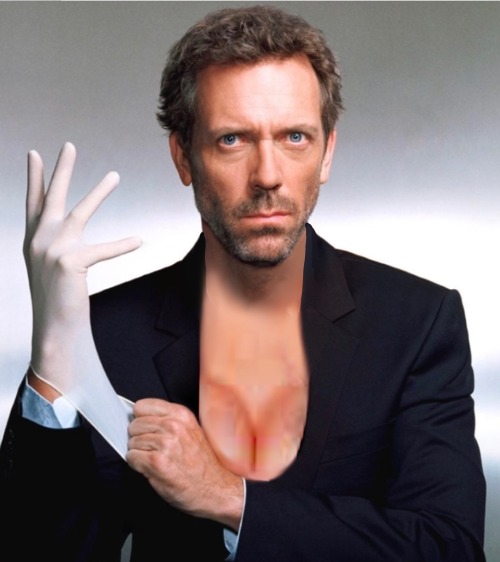
So why did House MD have a lasting impact enough to resurge? The easy answer is a long runtime, a bass-boosted dub of a GIF, workplace yaoi, and an edit of Gregory House with boobs. The harder answer is that the characters are too memorable, the dynamic among them shapes the themes enough to rock the world of viewers. Even when the ratings were down, House’s persuasion as a character is enough to goad viewers enough to root for him, even when he sucks. Which is a lot, in magnitude and in frequency. This is difficult to do when the protagonist is unrelatable, by and large. Its legacy is inimitable by others of its ilk, and its memes are proportionally spectacular.
Image credit: Tumblr

Leave a Reply