

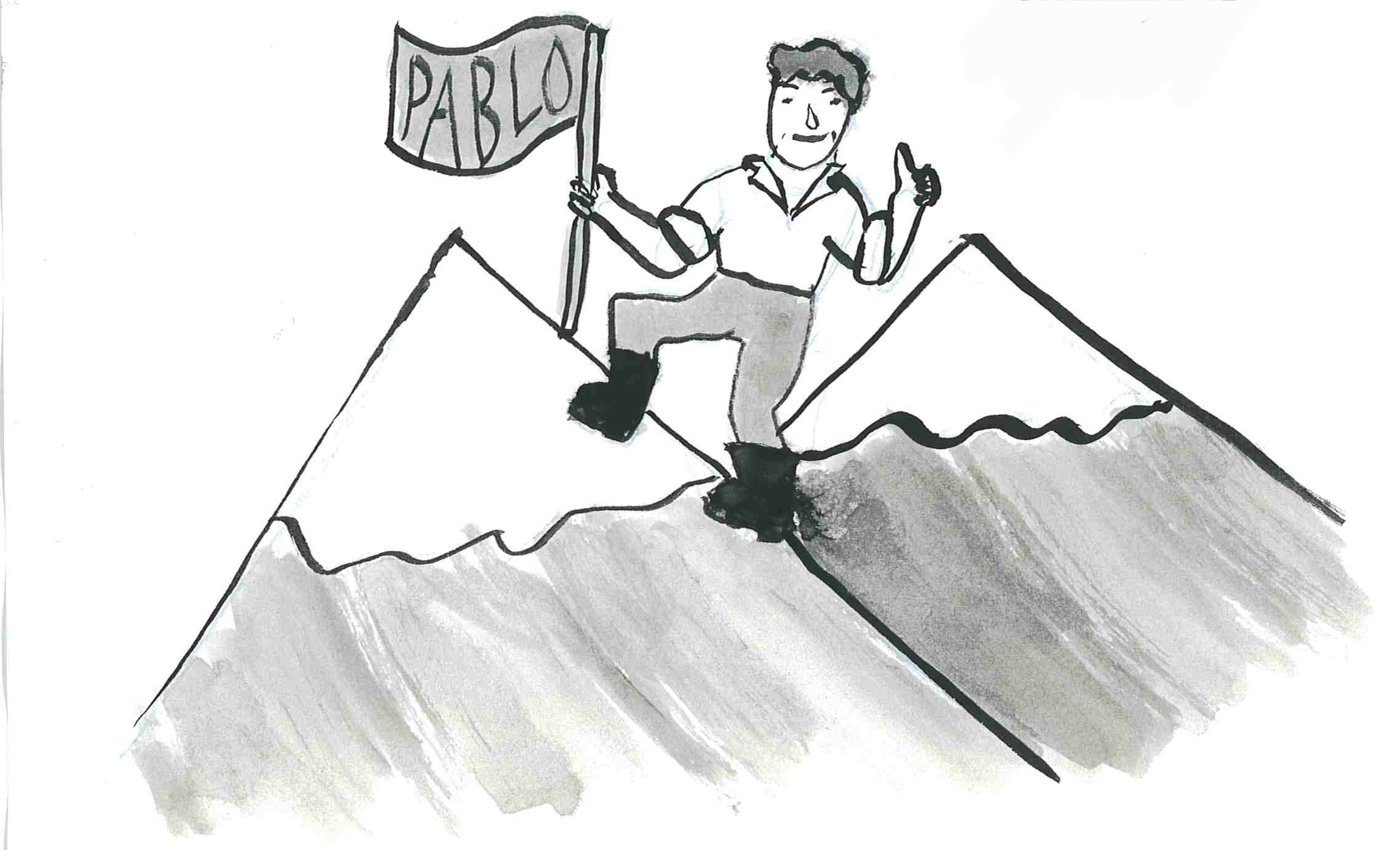
Since joining the Beloit College faculty in 2003, Pablo Toral has become one of the most recognizable and unique professors on a campus studded with offbeat charm. Toral was brought to the college to teach interdisciplinary studies, helming majors that did not yet have a department. Today, Toral’s official title is Professor of Environmental Studies and International Relations, and he is also the chair of the Environmental Studies department.
Colleague and Assistant Professor of Political Science Gregory Koutnik describes him as a “character,” adding that, “I’ve met few academics who are as thoughtful and rigorous, and yet who are also so humorous, it’s such a refreshing thing.”
Toral brings a similar enthusiasm and humor to whatever he chooses to pursue, and regardless of the setting, categorizes himself as “very social.” The storied life he’s led is apparent when first walking into his office in Morse-Ingersoll Hall. The walls are strewn with mementoes, artifacts, and photos from his various field excursions across the world, and the back walls nearest the windows are peppered with dozens of thank-you notes from former students.
He looks at me with a slender face and a smattering of grey hair. His over 6-foot-tall frame still feels imposing even when sitting down across from one another. He wears an eclectic mix of knit and patterned sweaters, always with a button-up shirt peaking out from the collar. The colors clash and stripe and vary, but never feel out of place or out of step with Toral’s life or personality.
With typical humor, Toral rebuffs the idea that his life has been particularly colorful, saying, “Whether my life is colorful or not, I can’t tell because I’m colorblind. So I don’t know what colors [others] see in it.”
Regardless, Toral is well-traveled. He was raised in Northwestern Spain, in what he describes as “one of the rainiest places in Europe” and one of the last remaining pockets of the Atlantic Rainforest. The climate of his home region would cause one to think of the grey and rainy skies of the Pacific Northwest rather than sunny Spain. “I could not take this,” Toral says, “I had to leave.” The opportunity to see himself outside of Spain came in college, where studying in a more tropical location provided a springboard for further adventures.
In college, he pursued field work in a multitude of countries and regions, crisscrossing the Americas. As Toral says, “I always try to go to places where I like the place, I can meet new people, I can learn new things, I can have fun, and where I feel I also experience professional development: this is something I can bring home and be better at what I do.”
Toral expresses that he is comfortable in both large cities and sparsely populated areas, granting him a unique ability to find something to enjoy about wherever he finds himself. As a social scientist in the field, Toral was always brought back out into the world by a fascination with the environment, ecology, and the human relationship to it.
“I’m very fortunate that I actually get paid to do a job that allows me to do what I would do regardless,” Toral says. He explains that the wealth of English-language scholarship in the disciplines he was interested in is what brought him to the U.K. and, in turn, the U.S., as well as the academic scholarships and career opportunities that were offered to him there. “I started to follow the money, but only to jump on the trains that were going to my destination,” he says.
To Toral, the main appeal of traveling so often is the ability to, as he says, “lose myself somewhere. I like the sense of not knowing where I am.” While to others the idea of being lost might induce panic, Toral explains that it grounds him. “It helps me be confident that if you have a good intellectual compass, you will eventually realize that you can find yourself.” This then gives way to a sense of freedom and a singular thrill that is difficult to quantify. To hear Toral tell it, there is a certain serenity that comes with this feeling. He says that, “Sometimes I think: ‘wow, nobody knows I’m here, nobody can give me an assignment, nobody can tell me ‘you’re late to a meeting.’”
Toral used the example of taking his students into the Boundary Waters near the Canadian border, and not being able to pinpoint exactly where he was on a map. Summarizing the phenomenon, Toral says, “Being lost is not necessarily a bad thing; it forces you to be creative. It forces you to realize that you actually know more than you think. You can always dig deeper.”
A time when he was literally lost came in graduate school, when Toral was conducting field research in the highlands of Peru. He decided to take a week off from research after some free time presented itself, hiking around and exploring different isolated communities perched high in the mountains. When Toral climbed to over 15,000 feet of elevation, he began to experience a lack of oxygen for the first time in his life. “My body was reacting in ways that I wasn’t used to, and that’s what got me lost, which led to everything else.”
He was able to go on only after he realized that he simply needed to pause for a moment, catch his breath, and trudge along. Although he had figured out a way to momentarily fix his breathlessness, Toral still found himself lost in an area of the highlands where the Quechua and Aymara communities both resided, and where Toral spoke neither of the native languages.
Despite the fact that he was an outsider, townspeople in a nearby village invited Toral into their homes out of concern, telling him temperatures would turn frigid and inhospitable once the sun went down. Toral visited homes that were, as he says, “very poor” yet still showed tremendous generosity toward a stranger. He could only communicate with them in broken Spanish, but he soon found out that some children in the village were schooled in Spanish, and he was able to speak with the elders by allowing the children to translate. “I found myself communicating with people my age or older via seven-year-olds, which added a completely different experience to the whole thing.”
This made Toral see the cultural dilemma that the community was facing, confronted with the erasure of their indigenous cultural identity, judging by the fact that younger generations were more comfortable speaking Spanish. Toral estimates that if he were to return to the village now, the younger generations would most likely communicate in Spanish.
Toral’s entire week off was spent in this village and those nearby, soaking up the local culture and observing the intricate handmade crafts woven by the locals from Alpaca wool. While native to the region, Alpaca wool is very expensive in the United States, and Toral was offered specialty goods for whatever he could afford. Locals then asked him if he needed any jewelry to take back with him.
“Everything was made of silver,” Toral remembers, “and they were offering me a lot of silver, for so little. And that really created an ethical dilemma. I said to myself: If I take this and I sell it in the U.S., I can make thousands of dollars, but that would be very wrong. And yet, they’re telling me that they will give it to me for whatever I can afford.” Toral tells me that he bought a lot of gifts that he would have otherwise gotten for friends and family, but felt so deeply conflicted that he decided against buying the silver, even though he could have used the money to pay for his education and make a big difference in the lives of the locals.
Recalling the exchange decades later, Toral reflects, “I’ve been thinking a lot about what I should have done, and now I know what I should have done, but I didn’t do it.” For Toral at the time, the moral quandary was simply too much to bear, despite its possible benefits. Toral’s week in the mountains left him with a lifetime of knowledge, as the locals essentially trained him to survive in the adverse conditions by teaching him strategies to combat altitude sickness, maintain his appetite, and climb mountains without overexerting his body.
Toral invited me to sit in on his Sustainable Cities course, held on the second floor of Morse Ingersoll Hall. Twenty-seven students manage to pack themselves into the modestly sized classroom, each wall and corner lined with chairs affixed with small writing surfaces. Two students were absent that day, and there was only one vacant seat, other than the one I occupied, in the west end of the room.
In the brief moment of conversation I shared with Toral before the start of class, he informed me what I had already suspected: I would be an active participant, and not merely an observer. “We have a plan for you, it is a secret plan, however,” Toral said with a smile.
Before beginning official business, Toral always kicks off class by emphasizing the importance of wellness and self-care, encouraging students to share the self-care practices they have been utilizing. Embodying this ethos in his own life, Toral can regularly be seen attending strength and wellness classes offered by the college, such as Yoga and Jiu-Jitsu, even dressed in his Gi as he makes his way from his office in Morse-Ingersoll Hall to the Power House.
Toral spoke to me about the importance of staying active, saying, “I like to feel alive by having my body do things. I have a very sedentary lifestyle, but I like to stretch, I like to exercise, I like to do different things.” Toral told me that he’s always enjoyed playing sports, but is rarely competitive. “I like team sports in particular,” he clarified, “because they allow me to be physically active while talking, which drives everybody crazy. Because most people are more competitive than I am, and I’m there talking about the latest movie I’ve seen or a book that I’ve read while people are trying to win a game.” He retains a love of soccer and cycling from his youth, still riding his bicycle to work each day, resting it against a bookshelf in his office. Toral also lauds the healing power of picking up new wellness habits in his mid-fifties, saying that it allows him to be more agile and feel better daily than he would have otherwise.
Jiu-Jitsu has also provided Toral with a similar ethos to the one he applies in the classroom and out in the field. “One of the things that I learned in Jiu-Jitsu,” he explained, “is that flying requires landing. But it doesn’t necessarily have to hurt you.” Although he maintains that he doesn’t overemphasize this in an academic setting, as he is still a student of these practices, saying, “I don’t want to teach what I don’t think I know enough about.”
As soon as class officially got rolling, Toral referred to me principally as “the press,” and students quickly jumped in with suggestions as to what my role should be after I had introduced myself. It was promptly decided that I should devise and present my own version of the cognitive mapping exercise that Toral asked students to complete earlier in the course. I was instructed to sketch a map of my hometown, with the scale determined by each location’s importance to me personally. Toral explained this by saying, “The best bit of data is your gut.”
I quickly began to tear a page out of my composition notebook, before I was abruptly stopped by a cautioning student sitting near me, “No, you have to get a piece of paper out of the recycling.” Soon realizing that she was in fact not joking, I sprang up out of my chair to rifle through the small blue recycling bin perched near the staircase. I retrieved a mostly blank page from the back of an old math exam and got to work sketching.
The scope of the course revolves around the importance of cities and their relationship to the environment around them, with students aiming to develop some of the technical skills needed in the field of urban planning. The course also challenges students to sharpen their interdisciplinary and collaborative skills. Toral explained that homework assignments and readings are given to prepare students for field work, and Toral’s classes are always in conversation with current events and new environmental legislation that will alter the scope of their studies. Toral illustrates that, “We don’t just say ‘memorize laws,’ we don’t just sit down and read, we actually apply, we bring things into the classroom.”
Toral creates an environment in the classroom that is highly democratized yet maintains a sense of organization and discipline. As a student in the course, Ethan Cooper’27, puts it: “He runs that [expletive deleted] like the navy.”
While I was busy drawing Mt. Hood and Forest Park, the class voted on changes to the syllabus, which required a unanimous vote by all students registered for the course to be passed. That day, the class was voting to change the due date on an upcoming assignment, and after a brief period of deliberation, they hurriedly wrote down their names in a Google Doc that also functioned as the class notes. The class mantra is: if it’s not in the notes, it didn’t happen. Toral emphasizes the collective nature of the classroom community with his rhetoric, addressing the class as “citizens.” He tells the class, “We’re all building this village together.”
Intentional with his movements and words, Toral directs the class with a booming and authoritative tone that can be heard from the next classroom over, according to a student in a neighboring class on the same floor. His guise is focused and inquisitive, and he stands as if a piece of plywood is shoved up the back of his knit sweater. Toral told me this was an intentional wellness choice, correcting years of poor posture.
While Toral was delighted to allow me to throw off the class’s typical rhythm, he placed an analog timer on a small desk at the front of the room to time small group work and discussion. When the chatter would cease, and the students would ask for another minute, Toral calmly wound the timer again, and the room once more buzzed with cacophonic conversation.
Before I was scheduled to leave, it was time for me to present my cognitive map to the class. With the help of another student, I was able to set up the overhead projector and present my drawings. I was allowed one minute (wound on the timer) to explain myself, and then I was to take questions from the class. Toral handed me three pieces of chalk and instructed me to go around the room and present them to three students who were giving me the least eye contact, as they would pose the best questions. I selected two students in the farthest corners of the room and another on the far side of the classroom.
To my surprise, each “citizen” posed incisive questions about my hometown of Portland, Oregon, asking me about the city’s transit system and demographic makeup. My response to the third and final citizen was cut off by Toral, who insisted that the question not be answerable by a mere yes or no.
Toral’s students were certainly up to the challenge, but it was clear he endeavoured to push them to achieve things even greater than what they had previously thought possible. Speaking about this phenomenon, Toral states, “One of the things I like to do in my classes is to give my students something to learn, but to really pivot in the directions they want to go. I want to be surprised by the students, by the questions they ask. I love it when they ask questions that don’t really lend themselves to an easy answer.”
In speaking with Toral the day after attending class, he remarked that he was pleasantly surprised by how much the students had learned in just a month and how well they were able to put their knowledge into practice in the presence of an outside party. “Things happen for a reason,” he told me.
His field work and environmental research even extends to the local level in Beloit. In 2023, he helped organize a community volunteer air monitoring project to detect pollution in Beloit’s air and help pinpoint the chief CO2 emissions culprits in the area to mitigate climate impact. The project was a continuation of a network of more than 30,000 air monitoring stations in the world. Beloit emerged in the study as the 14th-worst city in North America in terms of air pollution. The only problem: few other cities in the region were monitoring. Toral surmised that other cities in Wisconsin and post-industrial towns in the region certainly had worse air quality and emissions, but they just weren’t reporting. Always putting Beloit on the cusp of environmental studies and understanding, Toral is still fighting for himself and others to breathe, even in the low marshlands and plains of Southern Wisconsin.
Toral maintains an active relationship with his students, even after graduation, telling me that he often receives glowing emails from alumni about how they have used assignments or exercises from his classes in their professional careers to resolve dilemmas and work through solutions. Toral explains, “I get that a lot, and it’s very rewarding to see how adaptable our students are that they take a methodology from any of my classes and they can apply it in whatever they do.”
May Zaw’27, a student of Toral’s, told me a story about how Toral closely cultivates relationships with students. “Somehow we found out that me, [another international student], and Pablo’s birthdays were on consecutive days; he baked us a cake because he said he understands what it feels like to be away from home and celebrate [your birthday] alone.” She adds, “I thought it was really sweet of him to open up to us like that. So I feel really supported as a student in this department, that someone understands how I feel.”
Pablo Toral has never been an easy person to categorize. He surmises, “That’s why I’m single, I’m not easy, period.” Existing in the same multi-disciplinary space in which he teaches, Toral will always be a man of many facets. Wherever Toral’s curiosity takes him next, whether it be to the thin air of the Andes or the soupy humidity of Southern Wisconsin, he will bring enthusiasm, good humor, and discipline.

Leave a Reply