

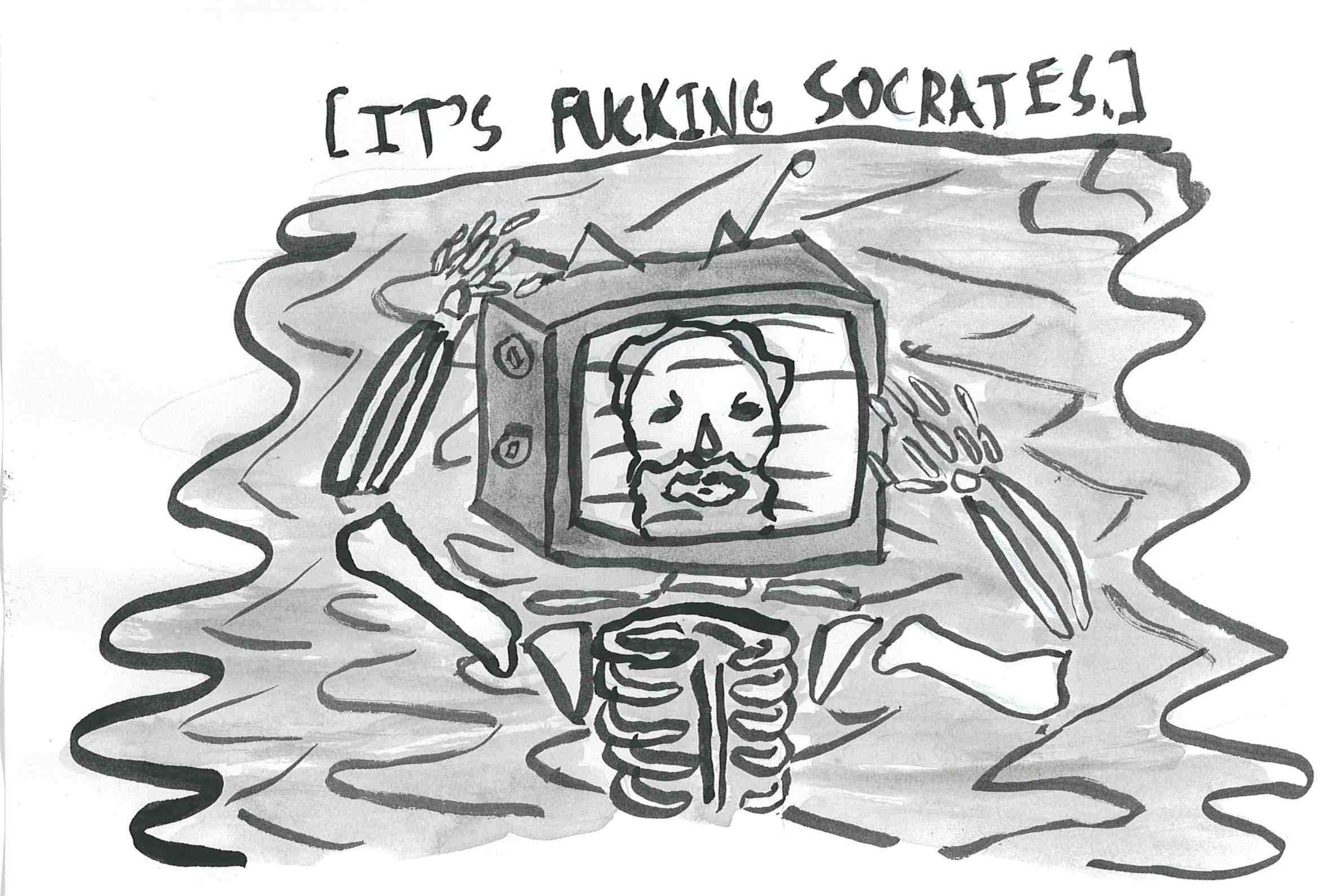
Every field of study is subject to public perception, both in terms of presence and absence when it comes to public consciousness. Philosophy is no different, and while there is some debate to be had concerning how much the tradition of philosophy should concern itself with the temperaments of the public, a philosophical figure suddenly gaining presence in modern pop culture is something that is worthy of analysis. Internet meme culture is a topic that has already been documented and explored in academics and the ability for memes to express certain viewpoints, especially political ones, is obvious to anyone who has so much as heard the word 4chan. Rapid public accessibility to AI only has added to the complicated phenomenon that is meme culture. A recent trend in meme culture are AI-generated videos that feature Socrates interacting with a time-traveling skeleton.
I will make an immediate judgement of the value of these videos. The existence of these videos does not justify the water it takes to generate videos of this length. Even if some of the criticism I will make later on is rectified I do not see why this concept needs to be executed through the usage of AI. A rough animation or a short film with a cast of one actor playing all the roles would be preferable as the content of the video would not have to prove itself against such a steep tax on resources.
The basic plot of a majority of the memes in this trend are as follows: The viewer, depicted with a skeleton with eyeballs fully intact, time travels to an ancient civilization, often Athens but other ancient civilizations are sometimes used as settings. All of these videos are narrated in the second person. The skeleton brings along with them some modern inventions and presents the item to the Greek public. These modern items tend to either be tech items such as smartphones or, ironically, Chat GPT, or a trendy or popular edible item such as matcha or pizza. The public, oftentimes the military and athletes in particular, will be wowed by this item and will begin to buy the item in large quantities, which leads to wealth for the skeleton.
This is where Socrates will enter the scene and inquire about the nature of the item. Socrates might sample food or interact with the technology. The philosopher will present questions to the skeleton, with the common question being if results achieved by using the item are attributable to the person using the item or the item itself. The question is often met with annoyance from the skeleton and even outright hostility. This firing off of questions is commonly labeled ragebait and may or may not provoke a reaction from the public of Athens. These videos often end suddenly and somewhat inconclusively, often with the skeleton ascending to some high rank in Greek society or having a lasting-effect on the public.
As with all memes, this trend has and will continue to mutate. Initially I found a variant of this meme that focused on historical scientists traveling back to meet Socrates. Videos including Issac Newton, Nikola Tesla, and Albert Einstein were the early examples of this specific branch of this trend. Now it seems as though other philosophers have been introduced. One video featured Nietzsche traveling back in time to meet Socrates and was riddled with many inaccuracies, to the point where I am concerned that dissecting the misportrayal of Nietzsche would derail this article, so I will hold off for now. Some videos have the reversal occur, with Socrates traveling to the modern world and commentating on daily life in the 21st century.
The appearance of Socrates is a point of interest. He is depicted as an older man mostly inoffensive in appearance. This is in contrast to his appearance as described in actual ancient Greek texts, which is ghastly. Socrates was said to possess basically all of the physical qualities that were seen as ugly by the Greek, with his appearance being sometimes pointed to as a secondary reason he was so willingly put to death. This is an inaccuracy that is far from exclusive to AI and can be seen in varying degrees through-out art history. All of these videos depict ancient Greece as made up of white individuals as opposed to the racial diversity that was present in the Mediterranean region.
I am not writing this article necessarily to defend Socrates and the thinkers in his wake. I think that there is valid criticism of Socrates and I do not take issue with philosophers being depicted in humorous or satirical manners. My main concern is how philosophy as a whole is being implicitly portrayed in this trend. My theory for why Socrates was picked out of all other philosophers is a combination of recognizability and his ability to be used as an archetypical figure. Socrates did not write anything, so his work is preserved only in the interpretations of his successors. Using a thinker like Confucius in these situations instead would require AI to consistently understand the complex philosophy illustrated in the Analects, the main record of Conficius’ thought. With Socrates, one can arguably be more varied in their interpretation and not be contested.
Socrates in these videos verges on becoming a general caricature of the philosopher. His verbose questioning being antithetical to the very medium of short form content. If Socrates is the stand in for all philosophers, then these videos promote the view that philosophy is ultimately inefficient in changing the dispositions and actions of individuals. Socrates never convinces the skeleton to truly think about the effects of their actions, and the skeleton tends to go unpunished and is rewarded economically.
One could argue that this trend will inspire more people to look into and discuss Socrates. Obviously this article would not exist without this trend, and I therefore would not have reviewed my knowledge of Socrates. However, I do not feel that will be the case. This content by the nature of the medium of generative AI is effortless, so I question if a casual audience will be willing to put in effort in response, and if this content does not truly promote education then I do not believe the resource usage can be justified.
At the very least, those of us that prefer Heraclitus to Socrates can find some solace in the fact that the AI content machine has yet to caricaturize him and make Heraclitus a character in these bizarre digital scenarios that haunt your For You page.
Featured image: Betty Cavicchia’28


Leave a Reply to Morganna WilliamsCancel reply