

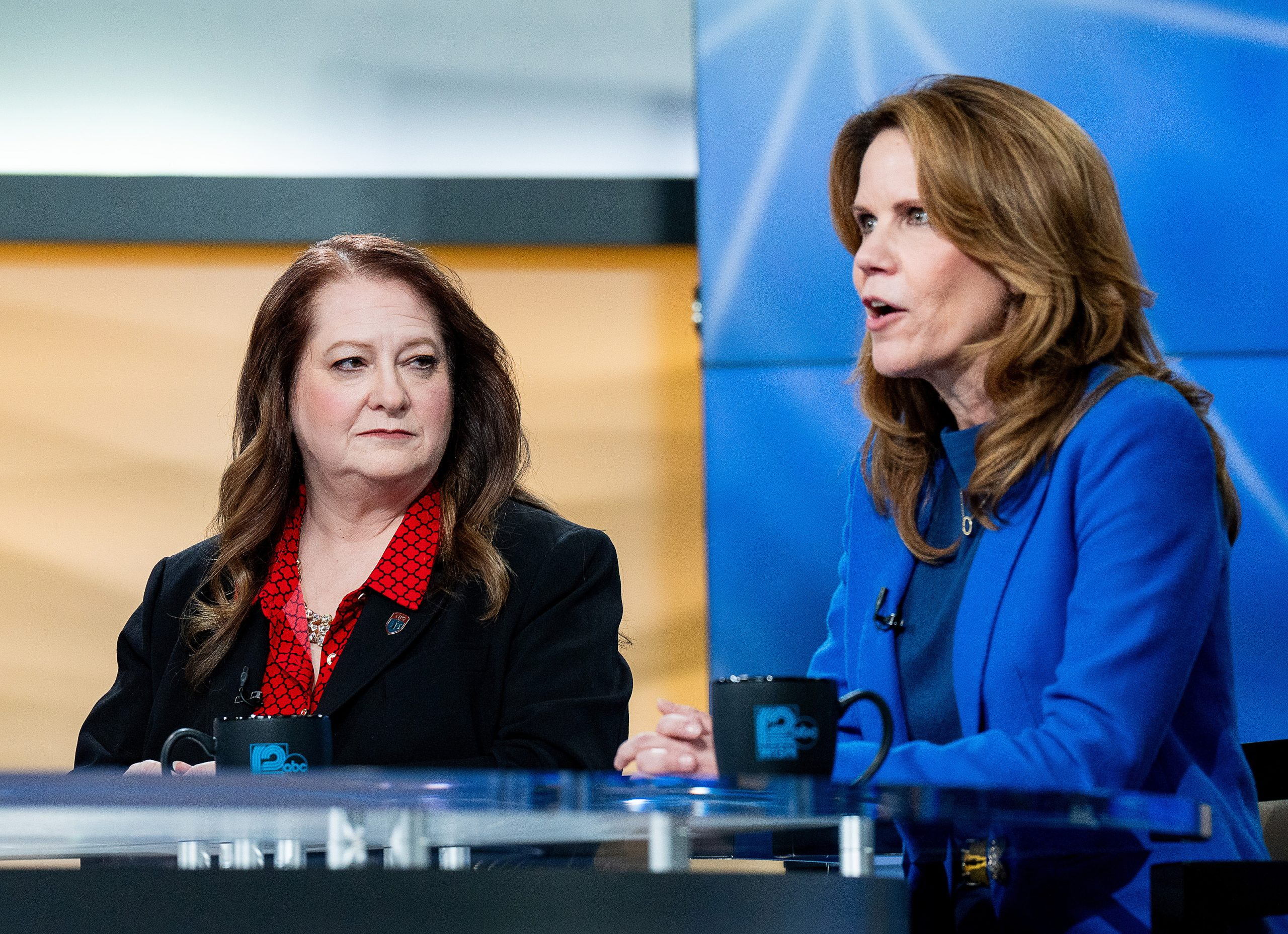
On April 2, campus organization Beloit Votes held a watch party for the hitherto postponed Wisconsin Supreme Court debate between candidates Maria Lazar and Chris Taylor.
The event, furnished with pizza and drink, was held in Richardson Auditorium from 7-8 p.m. Although the debate was pushed back last week after Taylor was hospitalized, Beloit Votes adjusted accordingly, moving the event back a week. Unfortunately, extreme weather reports would intervene to delay the debate once more, this time by an hour.
Despite continuous setbacks, Beloit Votes remains intent on continuing their work, especially as elections lurk just around the corner. Keira Linton’28, co-founder and treasurer of the organization, describes the club as “a nonpartisan initiative [whose] main focus is educating students on voting, elections, and getting them to go out and vote.” She maintains that the club is “hoping to get more people educated on the candidates for the Supreme Court election that is coming up in five days (April 7) and just letting people know who they want to vote for before they go into the polls.”
The first and only debate between the candidates took place at WISN Studio located in downtown Milwaukee, moderated by studio political director Matt Smith and anchor Gerron Jordan. Beginning an hour past schedule, the moderators laid down the structure of the debate, which aimed to cover broad, divisive topics in a conversational manner. The first speaker was decided by a coin flip, giving Taylor the opening words.
Chris Taylor was appointed as a judge in the Dane County Circuit Court by incumbent Tony Evers in 2020 and was elected to the Wisconsin Court of Appeals in 2023. She was democratic lawmaker in the state assembly previous to her appointment.
Maria Lazar was formerly a Waukesha County Circuit judge from 2015 to 2022 and an assistant attorney general for the Wisconsin Department of Justice from 2010 to 2015, serving under Republican Governor Scott Walker. She currently serves on the Wisconsin Court of Appeals since being elected in 2022.
Despite almost 251,000 ballots being sent in early, many around the state are still unclear about who to vote for in this race. Although the office of the Wisconsin Supreme Court is technically non-partisan, Lazar and Taylor have taken on conservative and liberal personae respectively. They are competing for the vacancy being left by conservative justice Rebecca Bradley, who has chosen not to run again after completing her decade-long tenure. As of now, the court is split 4-3 liberals to conservatives. If Lazar beats Taylor, the ideological makeup of the court will remain the same. However, if Taylor wins, the liberal majority will expand to 5-2.
The first question addressed to the candidates regarded the stakes of the race. Both candidates were asked why their leadership would be better suited to the office. Taylor emphasized protecting rights and democracy, consistent with her liberal positioning and ties to the democratic party. She even invoked past ties to Planned Parenthood, hinting at support for reproductive rights.
Lazar, on the other hand, underscored legal independence, in the process framing Taylor as a judicial activist and liberal ideologue, employing language such as “extreme” and “radical agenda” when describing Taylor’s policy.
When asked about their respective judicial philosophies, Taylor responded that hers was “centered around people and equal justice,” while Lazar described hers as “originalism with a touch of textualism.”
Textualism and originalism are formalist legal doctrines which seek to interpret the text of the constitution as it was written, while giving limited consideration to context or intent. This doctrine was notably advocated for by conservative justice Antonin Scalia, and has since been employed by Trump appointees Neil Gorsuch, Brett Kavanaugh, and Amy Comey Barret.
Lazar attacked Taylor’s philosophy, saying what Wisconsin needs is “not a judge who loves their causes or their beliefs or their agendas. I am going to be a judge on this court who’s looking to put only the law and interpret the law as it’s written.”
Taylor responded in kind, saying “Judge Lazar is the only person in this race who has brought an extreme right wing political agenda to the bench. . . she ruled to release personal private voting information to a right wing group that tried to overturn our election.” Importantly, Taylor noted that the latter decision was overturned by the supreme court. “In Wisconsin Voter Alliance versus Secord . . . she was admonished by our state supreme court because she ignored precedent,” said Taylor.
Lazar countered that reversals are normal and a sign of an independent, functioning judiciary. “You’re actually not a true judge until you’ve been reversed,” she argued.
Throughout the debate, Taylor emphasized broad and trenchant political support from the state’s courts and legislature, while Lazar highlighted her superior experience as a judge, having held office 10 years longer than Taylor.
Bradley, whose seat the candidates are fighting for, also cautions against judicial activism, saying, “For years, I have warned that under the control of judicial activists, the court will make itself more powerful than the legislature, more powerful than the governor. That warning went unheeded.” Gerron Jordan asked the judges whether or not her assessment was correct.
Taylor alleged the courts are in the pockets of right-wing extremists and promised to be independent, citing her “spine of steel” and Lazar’s lack of endorsements. Lazar fired back with her endorsements from the Milwaukee police and the Fraternal Order of Police.
Moving on to redistricting, Smith and Jordan inquired about recent lawsuits directed towards the new congressional maps and subsequently rejected by a three-judge panel. These congressional maps, drawn by democratic governor Evers, were alleged by 11 citizens to be illegally partisan and gerrymandered. However, the circuit courts rejected the case, citing a lack of authority over the Supreme Court. The moderators asked the candidates if they agreed with the court’s ruling, and whether similar suits should be rejected for the same reason. Both judges refused to comment, as the cases are still pending, but both also took the opportunity to besmirch the other. Taylor alleged that Lazar participated in gerrymandering efforts under the leadership of Scott Walker, while Lazar deflected towards Illinois, conceding that the Wisconsin map is fair, but that if liberals were to have control as they do in Illinois, the situation could get worse.
Up next on the docket were controversial voter ID laws, made constitutional in Wisconsin after a vote last year. While Taylor again declined to comment on whether she personally voted on the amendments, she vowed to uphold the law of the land, and expressed concern over Lazar’s position on the outcome of Trump v. Biden, the suit brought by President Trump to challenge the results of the 2020 election.
After fielding questions over judge recusal and the Save Act, the debate moved to abortion, a hot button issue in contemporary politics, especially after the contentious overturn of Roe v. Wade. Smith asks the candidates about last summer’s 4-3 decision, led by the court’s liberal majority, to invalidate the state’s 1849 abortion ban.
Lazar promised to honor existing abortion legislation, leaving aside what she thought about the decision while simultaneously decrying Taylor as too liberal on abortion. “My opponent . . . said that she thought that it shouldn’t be 20 weeks or any type of restriction whatsoever,” said Lazar, “but that abortion should be allowed at any time during the pregnancy up to the end.”
Conversely, Taylor affirmed the court’s decision last summer, recalling her empirical support for women’s reproductive rights and a history with Planned Parenthood. When asked if she would recuse herself in a case involving Planned Parenthood, however, she distanced herself from the organization, saying “I have not worked for Planned Parenthood in 15 years.” Moreover, Taylor cited a report where Lazar allegedly expressed support for a heartbeat law, a statute that would severely limit access to reproductive healthcare. Lazar denied outright support for heartbeat legislation in the debate, although she hinted at wanting to know more about “where people in Wisconsin stood.” She added that “Some people wanted it from the beginning.”
Under consideration next was Act 10, also known as the “Wisconsin Budget Repair Bill” or the “Wisconsin Budget Adjustment Act.” The bill, signed by Scott Walker in 2011, imposed significant limits on collective bargaining powers and compensation for public employees with the exemption of the police and firefighters, in order to combat the state’s $3 billion deficit. After a recent ruling by a Dane county judge, an appointee of governor Evers, that Act 10 was unconstitutional under the equal protection clause, Republican Speaker Robin Vos has appealed the decision. As the case will eventually find its way to the supreme court, the candidates were prompted as to how they might decide.
Lazar defended Act 10 as Assistant Attorney General, while Taylor has long been an outspoken opponent of the legislation. Both candidates denied the necessity of recusing themselves if it ever came to the high courts. Although there was no direct answer about rulings over Act 10, Taylor expressed support for unions and workers’ rights, saying “I very much value the rights of working people to be fairly compensated.”
The meat of the debate concluded with discussion of the arrest of Milwaukee County Judge Hannah Duggan on felony charges for obstructing federal immigration officials attempting to make an immigration arrest inside the courthouse. Again, both refused direct comment on the pending legal case, while Taylor decried federal overreach and expressed concern over judicial independence. Lazar concurred with the general sentiment.
Overall, the debate was symptomatic of the turbulent, highly partisan political climate in which it took place. Although the majority makeup of the court will not see any major changes regardless of the outcome, remaining reliably liberal for the foreseeable future, the results may still carry high stakes for the state of Wisconsin.
Klara Fredriksson, assistant professor of Political Science at Beloit College, said “A lot of voting rights cases, which are extremely controversial, will end up in the Wisconsin Supreme Court, because states run their own elections. Any kind of voting changes in Wisconsin are typically going to be down to the SCOTUS specifically. So, for those kinds of things, it really matters who’s in the courts, because Wisconsin is so balanced. It might have national implications for that reason.”
Elections will take place April 7, determining who Wisconsin wants to represent them in the judiciary.
Featured image: Wisconsin Watch

Leave a Reply