

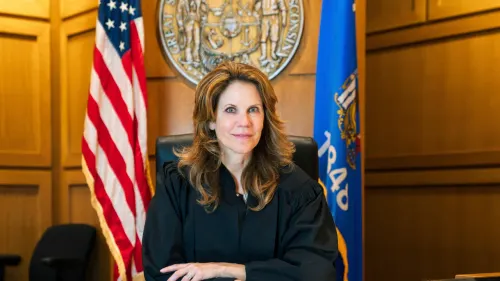
Wisconsin Supreme Court candidate Chris Taylor beat opponent Maria Lazar in a statewide election held April 7, 2026. Taking the seat left by conservative justice Rebecca Bradley’s absence, the liberal court majority will increase from 4-3 to 5-2 as several divisive issues find their way to the upper courts later this year, including congressional redistricting and reproductive rights.
The spring elections came after incumbent Rebecca Bradley chose not to seek another decade-long term.
Over 1.5 million people cast their ballots, with Taylor winning just over 900,000,000 votes or about 60%, and Lazar garnering around 600,000,000 or 39.8%, losing by a margin of 20 points.
324,000 people sent in early ballots, meaning about 77% of those who received an absentee ballot, compared to 694,000 early votes last year.
The elections were technically non-partisan, despite the candidates aligning themselves along partisan lines. Taylor, for example, was previously a Democratic lawmaker in the state assembly, stressing her previous connections to Planned Parenthood and labor union endorsements, while Lazar garnered support from former Republican Governor Scott Walker as well as the Fraternal Order of Police, decrying Taylor’s liberal agenda.
Wisconsin Democrats have been emboldened by the last two Supreme Court elections, both resulting in double digit victory margins.
Lazar, as assistant attorney general under Scott Walker, defended the controversial Act 10, a law which eviscerated collective bargaining in the state of Wisconsin. A Dane County Circuit court judge has recently ruled the act unconstitutional, a decision likely to end up in high courts. While the effects of Taylor’s election to the supreme court have yet to be seen, the act is certain to end up in a liberal court, a fact which is certain to bear on their decision.
According to AP, approximately 32% of voting age Wisconsinites exercised their civic prerogative to vote, down by 20% from last year’s historic supreme court election. This can likely be attributed to changing stakes, as the ideological makeup of the court will remain reliably liberal for the foreseeable future, in contrast to last year where a flipped seat would have meant a conservative majority.
Being the most expensive judicial election in history, billionaires George Soros and J.B. Pritzker donated a combined $3.5 million to winning candidate Susan Crawford, while Elon Musk spent at least $3 million himself, with groups he funds spending upwards of $19 million. Total campaign expenditures reached previously unseen heights, soaring past a combined $100 million, more than dozens of past elections combined and drawing over 50% of eligible voters. Sitting at less than $10 million combined, this year’s spending and turnout seem meager in comparison.
“Once again,” Taylor began in her acceptance speech, “the people of Wisconsin showed the entire nation that we believe that the people should be at the center of government, and the priority of our judiciary, not the billionaires, not the most powerful and privileged, but the people.”
As liberals deepen their hold in the Wisconsin judiciary, Democrats are seeking to keep the office of governor later this year as well as flipping the state legislature while elections continue to loom large. Democrats see this as a critical moment to start shifting public opinion in a deeply purple swing state, working as well to undo the state’s conservative legacy which lingers from the 2010s.
The emphasis which certain political actors place on the Wisconsin state government highlights just how crucial of a role it plays in national politics. For example, when President Donald Trump sought legal action to overturn the election results in 2020, the conservative majority court was only one vote away from siding with the executive, sparking deep concerns over judicial independence and democratic backsliding.
Since gaining a majority in 2023, the courts have already worked to defend Democratic Governor Tony Ever’s congressional redistricting plan, and overturned a prohibition on absentee ballot drop boxes.
Notably, yet another conservative justice, Annette Ziegler, will not be seeking another term, giving liberals another chance to expand the majority even further. Ziegler was a member of the conservative court who voted against the majority opinion in Trump v. Biden to overturn election results.
Other elections that took place on April 7 included the appointment of several county supervisors, village trustees, alderpeople, mayoral candidates, and more. State primaries will be held on August 11, and the general election on November 3.
Featured image: Fox 11

Leave a Reply