

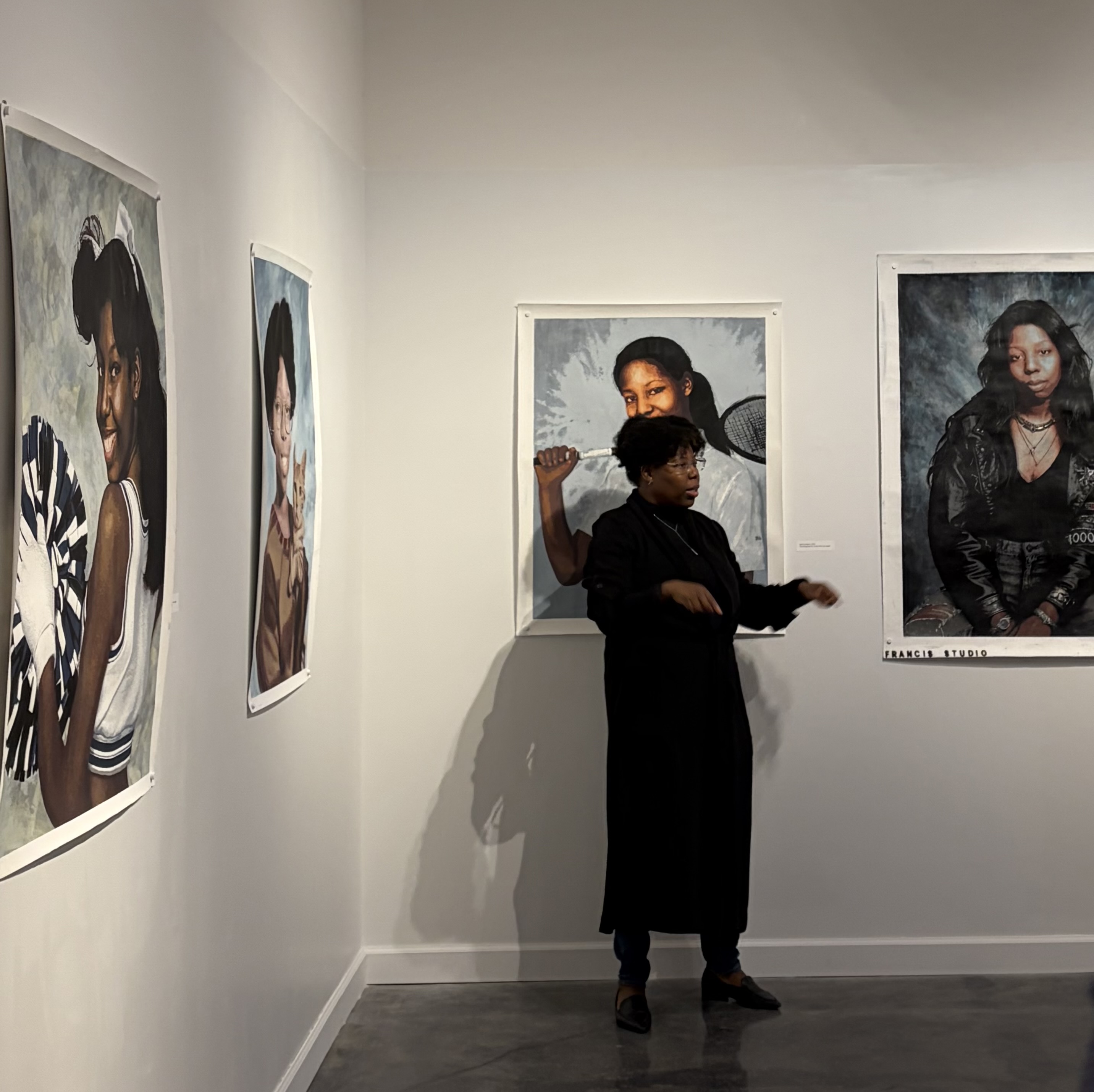
Ferrall artist-in-residence Tyanna J. Buie completed her residency at Beloit College last week, visiting classes, discussing her work, and delivering a keynote lecture. A collection of Buie’s work, titled “Source Material.” is on display in the Wright Museum South Gallery until Oct. 31, exploring themes of personal identity, intergenerational exchange, racial politics, and pop culture.
Buie, a Chicago native, received her bachelor’s from Western Illinois University and an Master of Fine Arts from UW-Madison. Her art has been featured in several galleries and museums across the country, including Freeport Art Museum, South Bend Museum of Art, RISD’s Chace Center Gallery, the University of Iowa Stanley Museum of Art, and more. Her work centers mainly around printmaking, a complicated process involving the transfer of ink from a matrix to a medium such as paper, wood, or metal.
At 12:30 p.m. on Oct.21, Buie gave a gallery talk, during which she explained the processes, techniques, and motivations behind the works in “Source Material.” The talk was attended by various faculty members and some students, crowded into the rectangular gallery space.
After an introduction given by Academic Curator Christa Story, Buie opened up about the origins of her current process. “I was helping institutions write anti-racist statements — which, who knows where those statements are now,” she said. “But I was on a lot of that kind of work, and it was just very taxing, and I felt like I just needed a relief from the seriousness of what was going on. That’s where I found myself just hunkering down on Instagram, and then this Reface app.]” Reface was an app that allowed users to create deepfakes, which, compared to the state of the technology today, were relatively crude. She noted that this nascent artificial intelligence app has since gone defunct, facing legal problems in the early 2020s.
What began as a form of playful technological curiosity quickly evolved into a more sophisticated mode of artistic expression. Featured in “Source Material” are several large prints featuring well-known pop-culture icons — for example, Cleopatra Jones — while other images were generated from scratch using artificial intelligence. In both cases, Buie’s face was transposed onto each one. The images subsequently underwent the printing process, intermingling the digital with the analog. The result is a hybrid between forms.
The work intersects with political and ethical questions surrounding the use of artificial intelligence and the racial puzzles which inevitably arise. “When I was planning the work, and I was just playing with the app, my friend started playing with the app, too,” Buie said. “She [a white woman] was living in Paris at the time, and she put her face over Beyoncé, and her students did not like it … So, I thought it was interesting in this conversation I was having about this technology and digital blackface.”
Also featured in “Source Material,” and discussed in the gallery talk, is a collection of VHS tapes available to insert into an old TV-VCR. The tapes are decorated to appear as old movies, complete with a cover, fake reviews, and a description. Each has an ironic title, such as “Reel Therapy,” referring to the use of Instagram Reels for mindfulness practices. The tapes themselves are edited compilations of short-form content taken from Instagram Reels, TikTok, TV shows, and movies.
Buie, over the course of the talk, also opened up about her troubled childhood, from an abusive household to the uncertainty of the foster care system. As a result, nostalgia plays a significant role in the construction of her art. “Having such a shaky childhood I have to lean on my siblings to fill in gaps,” she said. “I think I remember something a certain way, but it didn’t happen that way. I got used to not trusting my own memory of my past. But I do trust my feelings and emotions around it … [Self portraiture] makes me feel like I’m healing something, and I don’t even know what I’m healing exactly.”
The next day, Buie delivered a keynote address in Weissberg Theater, where she would explain more about her childhood and early work. Displaying prints from her undergraduate education, graduate years, and into her professional era, Buie presented a narrative of personal and technical evolution. She also considered the impact of her personal life on the symbolism and motifs found in her art.
The timeline concluded with her most recent commission, “Be the Change!” a piece for the Barack Obama presidential center in Chicago.

Leave a Reply