

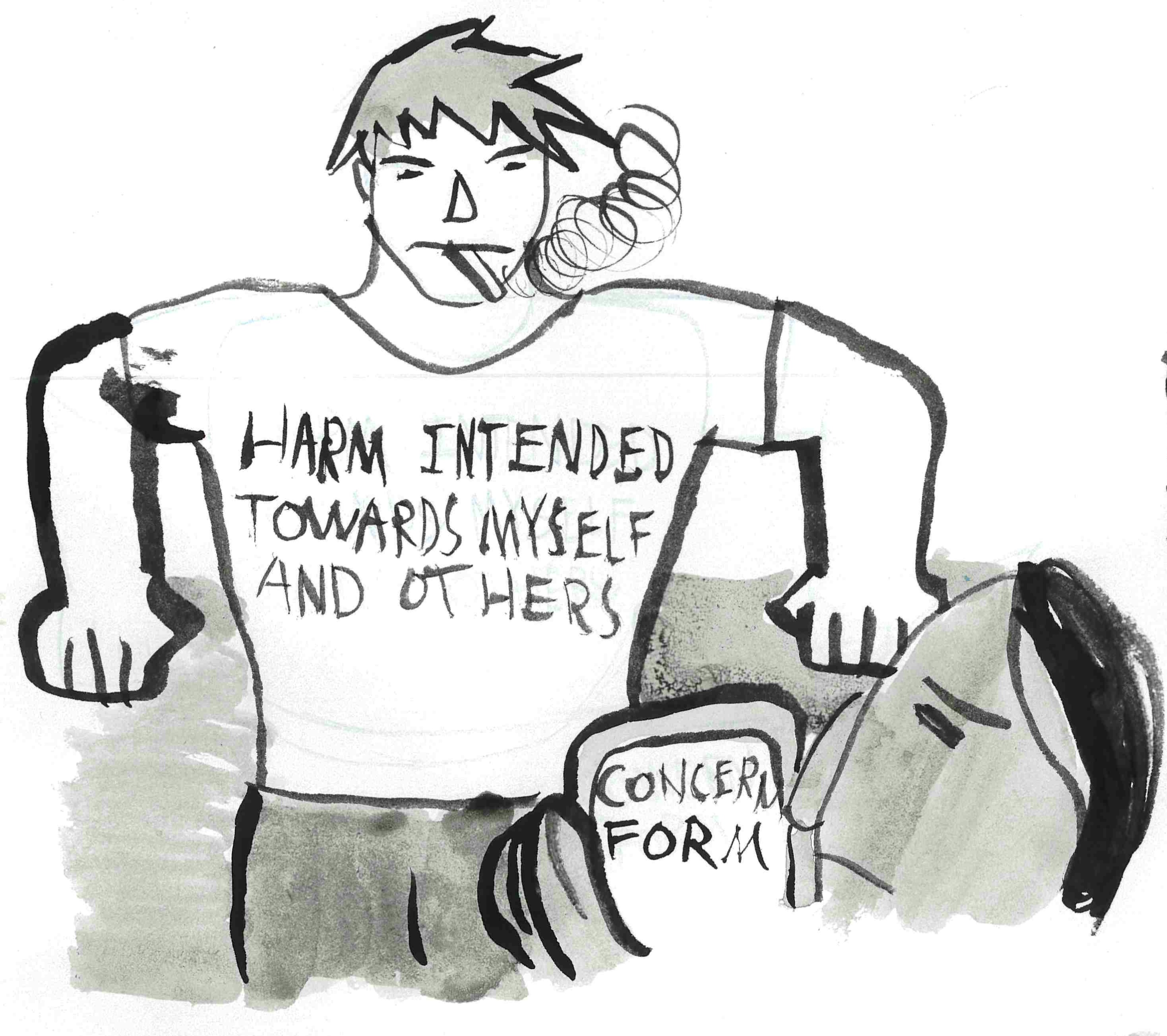
The Dean of Students sent out an email announcing the Student of Concern form, designed to enable students to share information about a person who may need additional support.
The Nov. 4 email highlighted that the form was not to be used for emergencies, would only be reviewed during standard business hours, was to be exclusively used for Beloit College community members, and that information reported would not be confidential. The form itself asks questions about the location of a given incident, the nature of the report, the details of the concern, whether or not the individual making the report has discussed concerns with the person being reported, and others.
“It’s kind of funny, but for a small college, there’s still lots of things that we may not know about. And so our goal is to really make sure that students are getting the resources that they need,” said Associate Dean of Students Jessica Fox-Wilson. “And so our goal is to really make sure that students are getting the resources that they need.”
The Round Table inquired as to the origins and creation of the Student of Concern form. “We onboarded this new program called Maxient over the summer … and initially, we were looking at it as a way for us to track students that we were concerned about, not for punitive reasons, or disciplinary reasons, but … we want to make sure that someone is keeping track of them, and making sure that they’re okay,” said Fox-Wilson. “The eventual goal with Maxient was to do this community form so that students, faculty, and staff could share their concerns. Again, not a punitive thing, but again, a way for students to say, ‘hey, I think my friend is struggling, and I don’t know what to do — could someone check in on them?’”
Maxient is a conduct software that advertises creation of reporting platforms, communication tools, analytics, access restrictions for levels of information, and user activity audit trails. “Whether it’s student discipline, academic integrity, care and concern, or Title IX matters, Maxient provides a place to easily manage records for your student body’s conduct and well-being,” says the Maxient website.
Fox-Wilson highlighted the importance of the Student of Concern form even in light of existing campus resources, namely the academic alert system. “So for the academic alert, the purpose is primarily academic in nature — you’re missing class, you’re missing assignments, you did poorly on the exam, whatever that might be.” Fox-Wilson said that the individuals the academic alert is sent to includes the student themselves and various faculty — such as the student’s advisors, the instructor who initially sent the alert, the Dean of Students’ office, coaches (in the case of student athletes), and international student advisors for international students. “It’s sort of a public, ‘we’re going to help you with this academic issue.’ The Maxient form, on the other hand, focuses primarily on well-being, and it can be filled out by staff, faculty, and students. So, someone who’s a staff or student might not have access to sending an academic alert for someone that they’re concerned with. So, this gives us that opportunity to do that.”
“The purpose is well-being,” Fox-Wilson emphasized. “We’re concerned about your mental health. You might have food insecurity. You might be missing a lot from the activities you normally participate in … and I think our goal always in student life is to make sure that we match the students with the resources that they need.”
The Round Table also asked about the lack of confidentiality for reporters using the form. “That’s a standard, actually, across colleges … As a student, your educational record is for you. This is part of your educational record … so you do have access to it,” Fox-Wilson explained. “Students can ask if they’ve had a form submitted and someone talks to them about it. They can ask to see the form who sent it, what did it say, that sort of thing. So, we try to be as transparent as possible with the student while also recognizing that we want privacy for the student within the professional staff.”
Fox-Wilson also explained the review process for a submitted form. “It gets routed to someone in the dean of students’ office and we review the information. If it is something really minor … we’ll do what’s called a soft check with an RA or an RLC… We don’t tell the RA what it’s about. We just say, ‘hey, can you just check them?’ That’s something that we’ve done for years and years.” Fox-Wilson said. “If it’s something more serious, then we might send an RLC or the director of Residence Life to do a more explicit check where we say, ‘hey, someone is concerned about you, can we talk? Are you okay?’”
There also exists a specialized committee for students of concern. “We have a committee in student life called the Students of Concern Committee, where our whole job is to say, we have the shared pool of information about students that we’re concerned about,” Fox-Wilson said. “In this form, if we figure out that… [something] is serious enough, we talk about the student— not in a bad way — but we talk about the student [about] how we can get them to the resources they need… It’s never shared outside of student life.”
Local health professionals also serve on the Students of Concern Committee. “One of our campus counselors from the Health and Wellness Center — the ones that we contract through Beloit Health Systems — serves on that committee.” Fox-Wilson said that HIPAA regulations mean these professionals do not share information about students without releases, but that these professionals can use information from the college in best practices.
The Student of Concern form can be accessed through the Dean of Students page on the Beloit College website, as well as through announcements on the For Beloiters page.
Featured image: Betty Cavicchia’28

Leave a Reply