

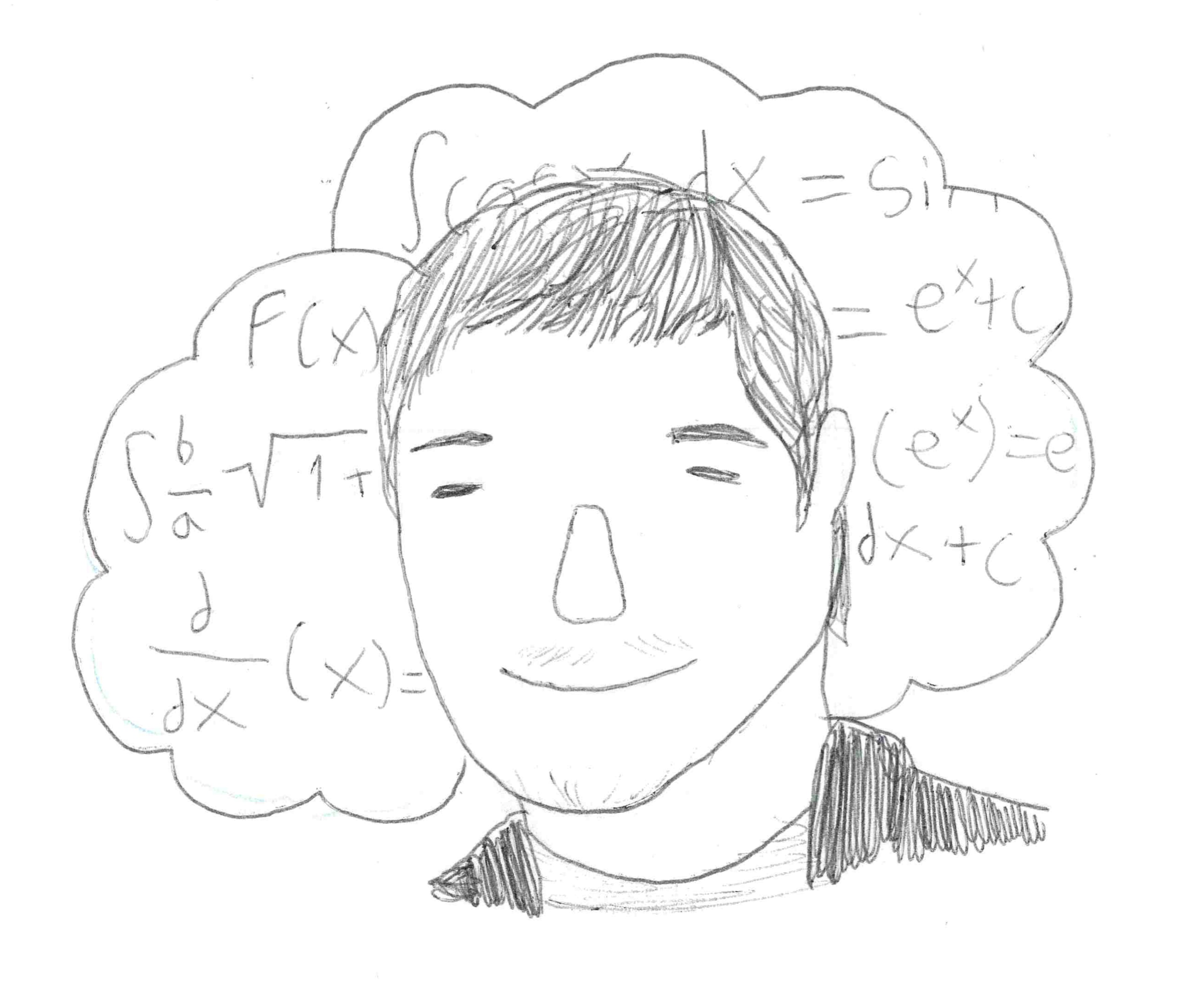
Faculty members convened at the Weeks Lounge in Pearsons Hall Wednesday, Nov. 11 for the opportunity to socialize, enjoy lunch, and hear a presentation given by Professor Tom Stojsavljevic concerning how mathematical models are used, where they break, and how they can be used to study pathogens.
Stojsaljevic opened the discussion by addressing the impact of AI on the work of mathematicians. OpenAI and other large language model companies have become increasingly disruptive to the math world as they evolve. The Navier-Stokes equation, for example, has been a longstanding unsolved problem with a million dollar bounty — a Millenium Prize Problem crucial to 3D physics and fluid motion used frequently for designing aircraft. Recently, OpenAI published a 166-page response generated by their LLM, accompanied by a vortex-shaped model. However, this model hypothesized that fluids could reach infinite speeds with finite energy, which is fundamentally impossible. Stojsaljevic used this example to outline the philosophy that mathematical models can’t perfectly capture reality, and are only approximations with a breaking point to be tested.
Further controversies have arisen around the intersection between math and AI and the implications for the community. Alongside accusations of stolen work and questionable methodology, OpenAI released 722 generated manuscripts on GitHub with complicated results. Only 372 of their 4,000 prompts (9.3%) had answers, and many of those 372 were incorrect due to major and minor mistakes. Stojsaljevic said some mathematicians have dubbed this the “mathpocalypse,” and prospective students question if the subject is as “safe” and concrete as it once seemed. Stojsaljevic raised the question of what math values, and the value it holds intrinsically on the social and economic levels. According to Stojsaljevic, the answer is clear: the value of math lies in its ability to impact the real world.
Stojsaljevic delved into his own recent projects, which utilized modeling to study Neglected Tropical Diseases, or NTDs, a diverse range of devastating conditions that often plague tropical communities. These diseases are severely underresearched, due to being largely asymptomatic at the beginning, alongside the weight of stigma, and the World Health Organization’s restrictive classification has been criticized as a social injustice. Public health efforts focus on more well-known conditions such as HIV/AIDs, meningitis, etc. while ignoring NTDs. NTD outbreaks appear worldwide, yet see little to no media coverage.
Stojsaljevic worked alongside former student Dylan Costello to create a coinfection model of meningitis and an NTD known as Dengue fever by using a compartmental model to track populations of interest — those who can transmit the diseases. They calculated what is known as the base reproductive number (R₀) to determine the number of cases that can result from one infected individual. If the resulting R₀ is less than 1, then the diseases can be non-endemic, and the opposite is true if that value is greater than 1, causing the disease to always be in circulation. This process was repeated for a project with former student Ellie Repinski to model the spread of African Trypanosomiasis.
Mathematical models still have their uses, Stojsaljevic said, despite their inability to mirror how the world works in practice.
Featured image: Betty Cavicchia’28

Leave a Reply